Silk · 30 Oct 2026 · 16 min read
What 22 Momme Means: Why Silk Weight Matters in a Pillowcase
What does 22 momme mean in silk? Learn the g/m² maths, how 19 and 22 momme compare, what momme can't tell you, and how to verify a silk pillowcase listing.
By Jade Castle, founder. Wellness product, not a medical device.
Part ofThe silk guide
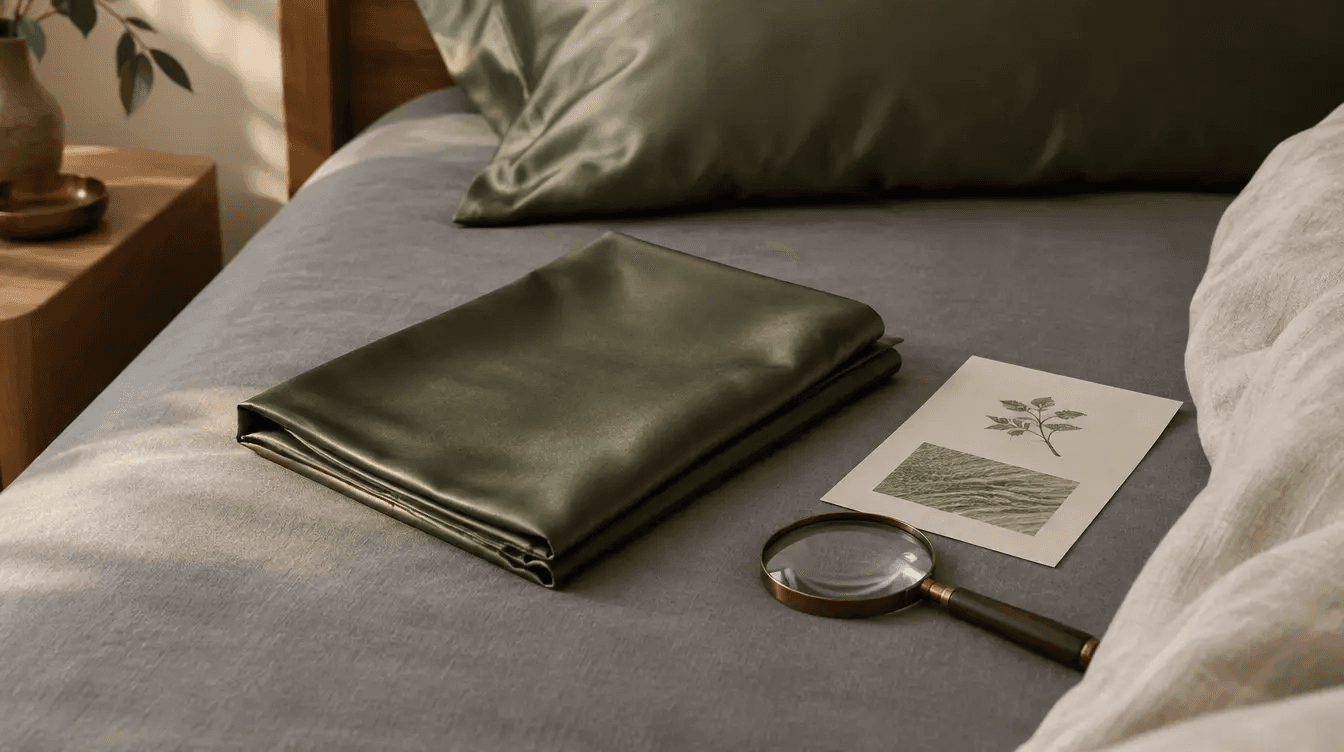
A 22 momme silk pillowcase uses silk that weighs about 95 grams per square metre. Momme is a Japanese unit of silk weight, and 1 momme is roughly 4.34 g/m². Higher momme means denser, more opaque and generally more durable silk. 22 is a common choice because it balances substance with a soft, fluid drape.
I started Organic Earthing before I had heard of grounding. I was already choosing natural fabrics for my own skin, because I had become conscious of what touches your skin every night. Silk was part of that, and so was the first thing I learned to distrust: a listing that says luxury and gives you no numbers.
Momme is one of the few real numbers a silk listing can offer. It is easy to print and harder to check. This guide explains what 22 momme measures, how it compares with 16, 19 and 25, what it leaves out and how to verify a listing, including ours. We are an Australian-owned, family-run brand selling globally, and I would rather you question us than trust a badge.
Key Takeaways
- Momme is silk weight per area. 1 momme is roughly 4.34 g/m², so 22 momme is about 95 g/m².
- Thread count does not apply to silk. Weight is how the silk trade describes density.
- 22 momme is a common middle path: dense enough to last, light enough to keep its drape.
- Momme says nothing about fibre, weave, dye, finish or testing. A heavy fabric is not automatically a good one.
- Sleepers report less friction, less frizz and a cool feel. Those are reported experiences, not health or skin outcomes.
- Verify any listing by asking for the momme, the fibre and the certificate numbers, then checking what each certificate covers.
Summary: Silk Weight Tiers at a Glance
The four tiers below correspond to 16, 19, 22 and 25 momme, in that order. These are general characteristics, not test results for any one fabric.
| Weight tier | Feel and drape | Opacity | Wear under repeated washing | Usually suits |
|---|---|---|---|---|
| Lightest | Very fluid, thin hand | More likely to show light through | Shows wear sooner | Occasional use, tighter budgets |
| Mid-weight | Soft and fluid | Moderate | Reasonable with careful washing | A sound entry point into silk |
| Heavier (our pick) | Substantial but still fluid | Dense, little show-through | Holds up well with correct care | Everyday use |
| Heaviest | Fuller, less drape | Very opaque | Generally the most durable | People who prefer a heavier hand |
What Does Momme Mean in Silk?
Momme is a unit of silk weight that comes from Japan. Today it works as a density measure: roughly 4.34 grams per square metre for every 1 momme. A 22 momme fabric therefore weighs about 95 g/m². That is its mass per area, not a quality rating.
The conversion is simple. Multiply the momme figure by 4.34. For 22 momme, that gives about 95 g/m². By the same maths, 16 momme is about 69 g/m², 19 momme is about 82 g/m² and 25 momme is just over 108 g/m². These are conversions of the unit, not lab results for any particular pillowcase.
You will also see it written as mommie, or as 22mm in product titles and URLs. In a silk listing, 22mm does not mean millimetres of thickness. It is shorthand for momme.
Why thread count does not apply to silk
Thread count is the number of yarns crossing a square inch of fabric. It was built for cotton, where yarns are spun from short fibres and can be plied or counted in ways that inflate the number. It says nothing about how heavy each yarn is.
Silk is different. It is a continuous filament, reeled from cocoons and combined into threads of varying fineness. Two silk fabrics can have a similar thread count and very different amounts of silk in them. So the silk trade weighs the cloth instead.
Why a weight is a useful spec
A weight per area is a physical measurement. In principle, a lab balance can check it. That makes it more honest than a word like luxurious. But it measures mass, and mass is only one property of a fabric. Section three covers what it leaves out.
16, 19, 22 and 25 Momme Compared
Higher momme means more silk per square metre. That brings greater opacity, a more substantial feel and, generally, better durability through washing, at the cost of some drape and a higher price. 22 momme is a common middle path: dense enough to last, light enough to stay fluid against the skin.
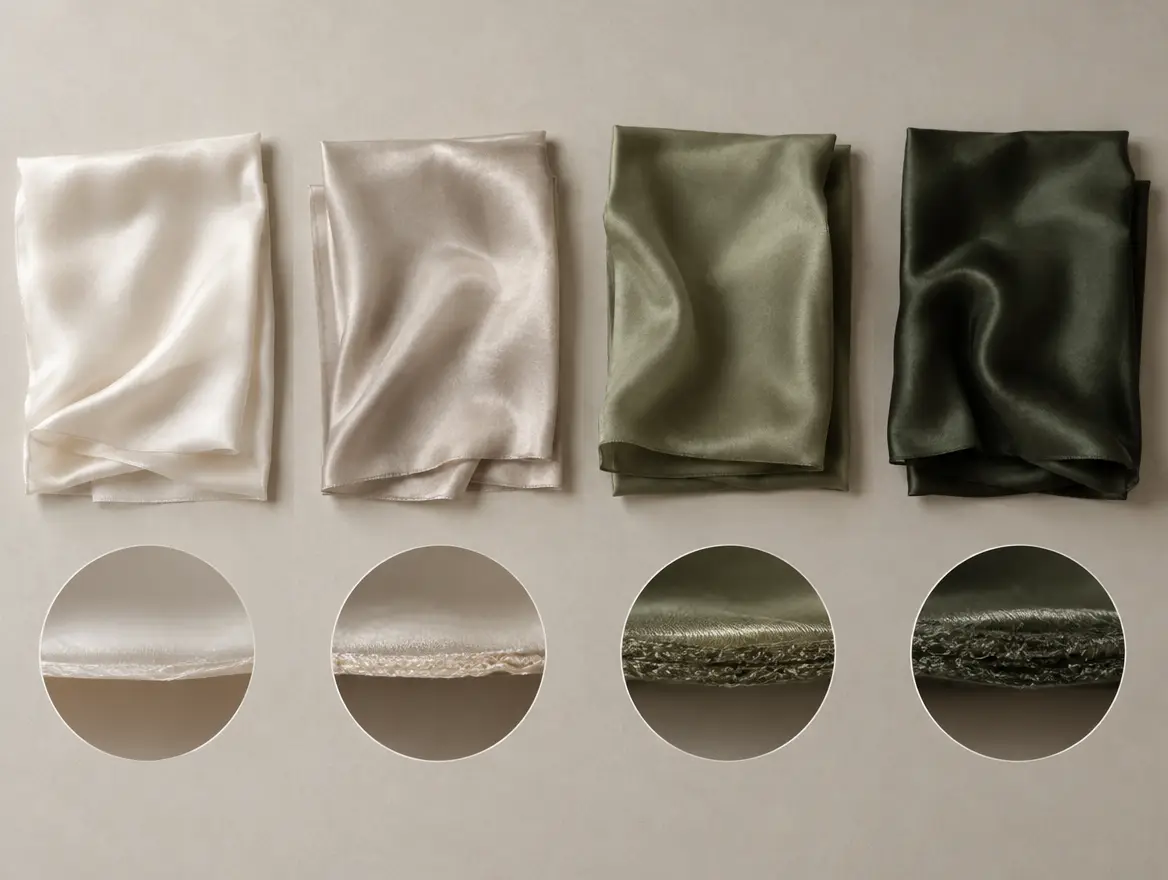
16 momme
At about 69 g/m², this is the lightweight end for pillowcases. It feels very fluid and thin. It is more likely to show light through, and it tends to show wear sooner when washed often. It can suit occasional use, but I would not choose it for a case that goes through the wash every week or two.
19 momme vs 22 momme silk
The 19 vs 22 momme question comes up most often. 19 momme is about 82 g/m². 22 momme is about 95 g/m², roughly 13 g/m² heavier. In hand, 19 feels soft and light. 22 feels more substantial while keeping the same fluid fall.
The gap matters most in two places. One is opacity, especially in lighter colours. The other is how the fabric ages with washing. A well-made 19 momme can still beat a poorly made 22. That is why the next section matters.
25 momme
At just over 108 g/m², 25 momme feels fuller and more structured, with less drape. It is generally the most durable of the four and usually the most expensive. Some people love the heavier hand. Others find it less fluid.
Why 22 is a common sweet spot
Here is my view, and it is a view rather than a measured result. A pillowcase is not a garment. It is not cut, fitted or stressed at seams the way a shirt is. Its main enemies are friction, body oils and repeated washing. At 22 momme you get enough density to resist those, without giving up the drape that makes silk feel like silk. Above that, I think returns diminish for a pillowcase, though plenty of people will disagree.
What Momme Does Not Tell You
Momme measures weight and nothing else. It does not tell you the fibre, the weave, the dye, the finish or what the fabric has been tested for. A heavy fabric can still be made from lower-quality fibre or finished poorly, so regard momme as one spec among several, never the whole story.
Fibre: mulberry silk
Mulberry silk comes from Bombyx mori silkworms fed on mulberry leaves. It produces long, continuous filaments, which is why it is the standard choice for fine silk textiles. Other silks, such as wild silks, have different textures and different filaments. A listing that gives momme but not the fibre has left out half the answer.
Weave: charmeuse
Charmeuse is a satin weave with a lustrous face and a matte back. Momme in a different weave, such as a plain-weave habotai, feels flatter and less glossy at the same weight. The weave is a large part of why a pillowcase feels the way it does against hair and skin.
Dye and finishing
Dyes and finishing processes are where restricted substances can enter a textile. A momme figure cannot reveal them. Historically, silk has also been weighted with substances that add mass to the fabric. I am not suggesting a particular seller does this. I am saying weight alone should never be accepted without fibre and testing information.
Silk grade labels
You may see grade labels such as 6A on listings. If you do, ask what the grade was assessed against and who assessed it. We do not claim a silk grade for our pillowcases, because we have not verified one.
What Sleepers Report: Friction, Frizz, Creases and a Cool Feel
Sleepers commonly report less friction against hair and skin, fewer sleep creases, less frizz on waking and a cool feel at first touch. These are reported experiences, not clinical outcomes. Silk's smooth surface is the plausible reason, but results vary and I would not promise any of them.
Less friction and less frizz
The smooth face of a charmeuse weave lets hair glide rather than catch. People with long, curly or textured hair are the group most likely to mention a silk pillowcase for hair frizz. They describe waking with hair that looks less roughed up. I have no study to cite on this, so I will not dress it up as one.
Fewer sleep creases
Some sleepers report fewer pillow marks on the face in the morning. The reasoning is the same: less drag as you move overnight. Again, this is a reported experience. I make no claims about skin outcomes, and nothing in this article is a health claim. Organic Earthing sells wellness products, not medical devices.
A cool feel against the skin
Silk often feels cool on first touch, and that is the main reason hot sleepers, many of them over 50, ask about it. Be careful with one assumption. Momme measures density, not temperature. I do not have test data showing 19 momme sleeps cooler than 22 momme, and I would be wary of any seller who says so without evidence. If you run hot, regard the cool feel as a first-touch sensation and judge it on your own bed.
How to Verify a Silk Pillowcase Listing
Ask for three things: the momme, the fibre and the certificate numbers. Then check each one with the issuing body. A trustworthy seller states them plainly and tells you what each certificate covers. If a listing offers adjectives instead of numbers, that tells you what you need to know.
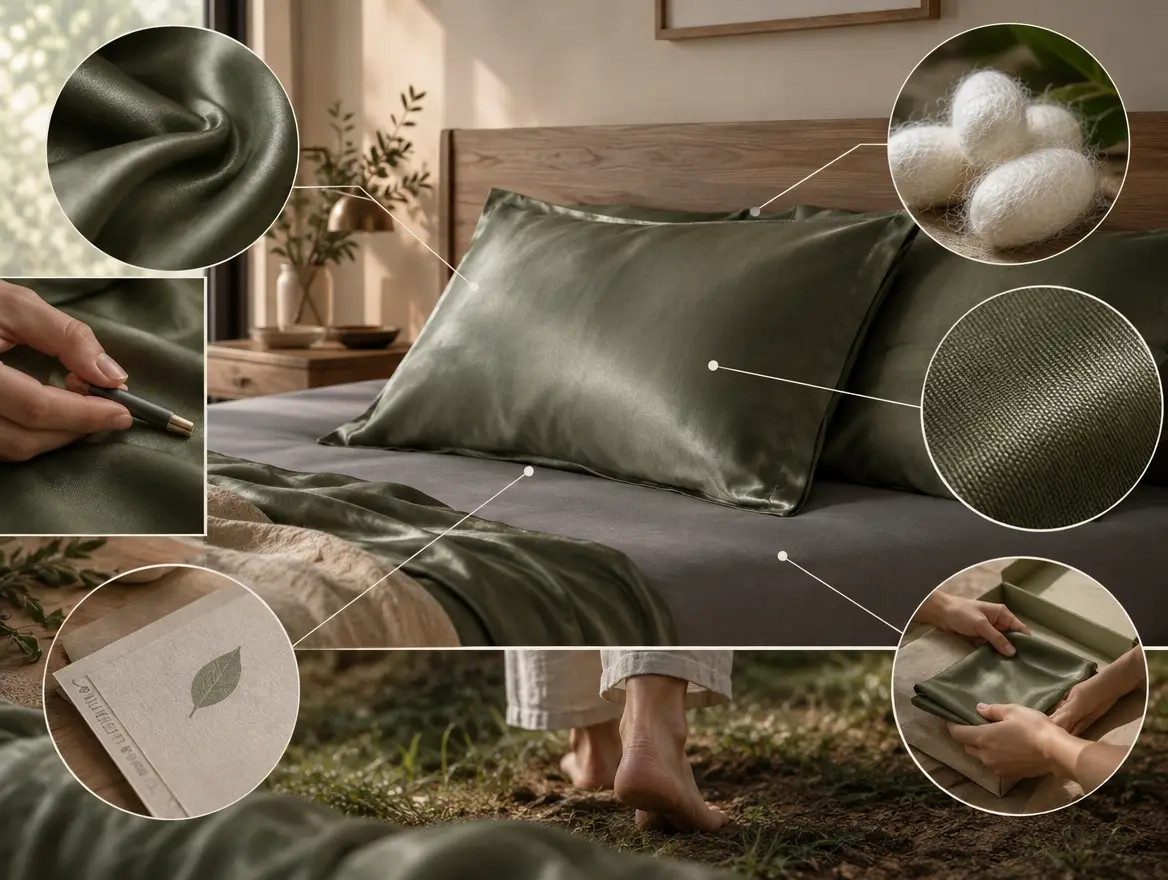
Questions to ask any silk seller
Use these questions on every listing. I want you to ask them of us too.
- What is the momme, and is it the weight of the finished fabric?
- What is the fibre? Is it 100% mulberry silk?
- What is the weave?
- Which certificate applies, what is its number and what does it cover?
- What do the returns and warranty terms say, in writing?
Certified to what standard, and what does it cover? That is the question behind every badge. Under the Australian Consumer Law, goods must also match their description, which is one reason to keep a screenshot of the listing you bought from.
OEKO-TEX Standard 100: what it covers
Our OEKO-TEX Standard 100 certificate number is SH025 231655. Our manufacturing partner is certified at Product Class I, the strictest class, which is the class for baby and toddler articles. The standard tests textiles for harmful substances. It does not measure momme, comfort or durability, and it says nothing about how a fabric affects sleep. OEKO-TEX also publishes a public Label Check tool, so you can confirm what a certificate lists rather than take our word for it.
GOTS scope certificate: what it covers
Our GOTS scope certificate for the silk is USB TEX-4007-GOTS-2509. A scope certificate shows that a facility is audited to the Global Organic Textile Standard for named processes and product categories. A transaction certificate is different. It ties a specific shipment of goods to that certified supply chain. We hold the scope certificate for the silk, not transaction certificates, so we make no organic claims about the silk. The GOTS website lists how the system works and maintains a public database where you can search for certified operators.
RoHS: not a silk certificate
Our RoHS compliance certificate, CHHB26080392392, applies to our grounding sheets only. RoHS restricts hazardous substances in electrical and electronic equipment. It has no bearing on silk, and nobody should imply it does. If you want the full breakdown of how the two certificates differ, our article titled OEKO-TEX Standard 100 and RoHS on a Grounding Sheet: What Each Certificate Actually Covers goes through it line by line.
A rough home check on momme
There is also a sanity check you can try at home. Measure the flat dimensions of a pillowcase and work out its total fabric area, counting both sides. Weigh it on kitchen scales and divide grams by square metres. Seams, hems and the envelope overlap add weight, so your result will read a little high. It is not a lab test. But if a case marked 22 momme comes out far from the 95 g/m² region, ask the seller why.
Care That Protects the Weight
Wash silk by hand in cool water with a pH-neutral detergent, rinse well and air dry away from direct sun. Heat, harsh alkaline detergents and tumble drying damage silk fibres and dull the finish, which defeats the point of paying for weight. Gentle care keeps the fabric you bought.
- Check the care label first. Follow the maker's instructions if they differ from the general guidance here.
- Hand wash in cool water. Swish gently. Do not scrub or wring.
- Use a pH-neutral detergent. Avoid bleach, and avoid detergents with enzymes. Silk is a protein fibre, and enzymes can attack it.
- Rinse thoroughly. Leftover detergent leaves silk dull and stiff.
- Press out water, do not twist. Roll the case in a clean towel.
- Air dry in the shade. Direct sun and dryers both age the fibre.
- Rotate two cases. Less frequent washing of each one is kinder to the silk.
Why I Regard Momme as a Claim to Check, Not a Badge to Trust
Momme is a useful number, but it is a claim like any other. I see it as something to check, not a badge to trust. Weight tells you how much silk is in the fabric. It does not tell you what is in the dye, what the finish contains or what was independently tested.
When I started, I was choosing natural fabrics for my own skin. Then I found grounding and went down the rabbit hole. What struck me was the conversation. Everyone argued about whether grounding works. Almost nobody talked about the textile you sleep on for eight hours a night. I could not find a brand with the quality, materials and look I wanted in my own home, so I built one.
That is why I keep two kinds of claim apart. The first is what the fabric is made of and what it has been tested for: 22 momme mulberry silk, OEKO-TEX Standard 100, a GOTS scope certificate. The second is what any of it does for sleep. That second question is open. I would rather say so than blur the two into one sentence.
Choosing independent testing meant higher cost and a more complicated supply chain. I accepted that because I did not want customers to trust us because we have written 'premium' on a website. I wanted something behind the word. Published certificate numbers are that something, and they only work if you check them.
Here is my contrarian position. If I had to choose between five more momme and a clearly documented certificate, I would take the certificate. Heavier silk with no testing information is a bigger gamble than a sensible 22 with numbers you can verify. And turn the same questions on us. Which standard, what exactly was tested, what does the certificate cover? If an answer is thin, tell me. Questions about returns and terms go straight to me.
Check the Numbers, Then Choose Your Colour
Check the certificate numbers yourself before you buy. Our OEKO-TEX Standard 100 certificate is SH025 231655, and our GOTS scope certificate for the silk is USB TEX-4007-GOTS-2509. Then choose olive green or natural white in 22 momme mulberry silk, and read the returns and warranty terms on the product page first.
If you want a deep, muted tone, there is the 22 momme mulberry silk pillowcase in olive green. If you prefer something lighter and softer, there is the 22 momme mulberry silk pillowcase in natural white. We also make a silk eye mask for those who want the same feel on the face.
If you are also weighing up a grounding sheet, we offer a silk and grounding sheet bundle as a secondary option. The grounding sheet is organic bamboo, OEKO-TEX Standard 100 certified, woven with 10% silver thread, because the silver has a job to do: conduct. It comes with a tester pen in every box, a 90-night trial from delivery and a one-year warranty. Test it before you believe it. Sleep on it for 90 nights, decide later. For a closer look at the fabric itself, see our article titled Bamboo vs Cotton Grounding Sheets: What the Fabric Actually Changes.
References
- OEKO-TEX, STANDARD 100 by OEKO-TEX
- OEKO-TEX, Label Check
- Global Organic Textile Standard (GOTS), Official website
- ACCC, Consumer rights and guarantees
Take this with you
Caring for mulberry silk, in your inbox.
How to wash, dry and store 22 momme mulberry silk pillowcases and eye masks so they stay smooth for years.
Questions people ask
What does momme mean in silk?
Momme is a Japanese unit of silk weight. In modern textiles, 1 momme is roughly 4.34 grams per square metre, so 22 momme is about 95 g/m². It measures how much silk is in the fabric, not its quality, fibre or weave.
What is the best momme for a silk pillowcase?
There is no single best figure, but 19 to 25 momme covers most pillowcases. 19 is lighter and softer, 22 is denser and more opaque while keeping its drape, and 25 is heavier and generally more durable with less fluidity. Many people settle on 22 for everyday use.
Does a silk pillowcase help with hair frizz?
Some sleepers report less frizz and fewer tangles on waking, usually attributed to the smooth surface reducing friction. That is a reported experience, not a clinical finding, and results vary with hair type.
Is a higher momme silk warmer to sleep on?
Momme measures density, not temperature, and there is no test data here comparing how warm different weights sleep. Silk often feels cool on first touch. Hot sleepers should judge it on their own bed over several weeks.
How do I wash a 22 momme silk pillowcase?
Follow the care label first. As general guidance, hand wash in cool water with a pH-neutral detergent that has no enzymes, rinse well, press water out with a towel and air dry in the shade. Avoid bleach, wringing and tumble drying.