Grounding · 23 Oct 2026 · 16 min read
How to Test a Grounding Sheet With a Tester Pen (and What the Light Tells You)
Learn how to test a grounding sheet with the tester pen: where to test, what the light means, how to fix a failed test and when to use your 90-night trial.
By Jade Castle, founder. Wellness product, not a medical device.
Part ofThe setup and care guide
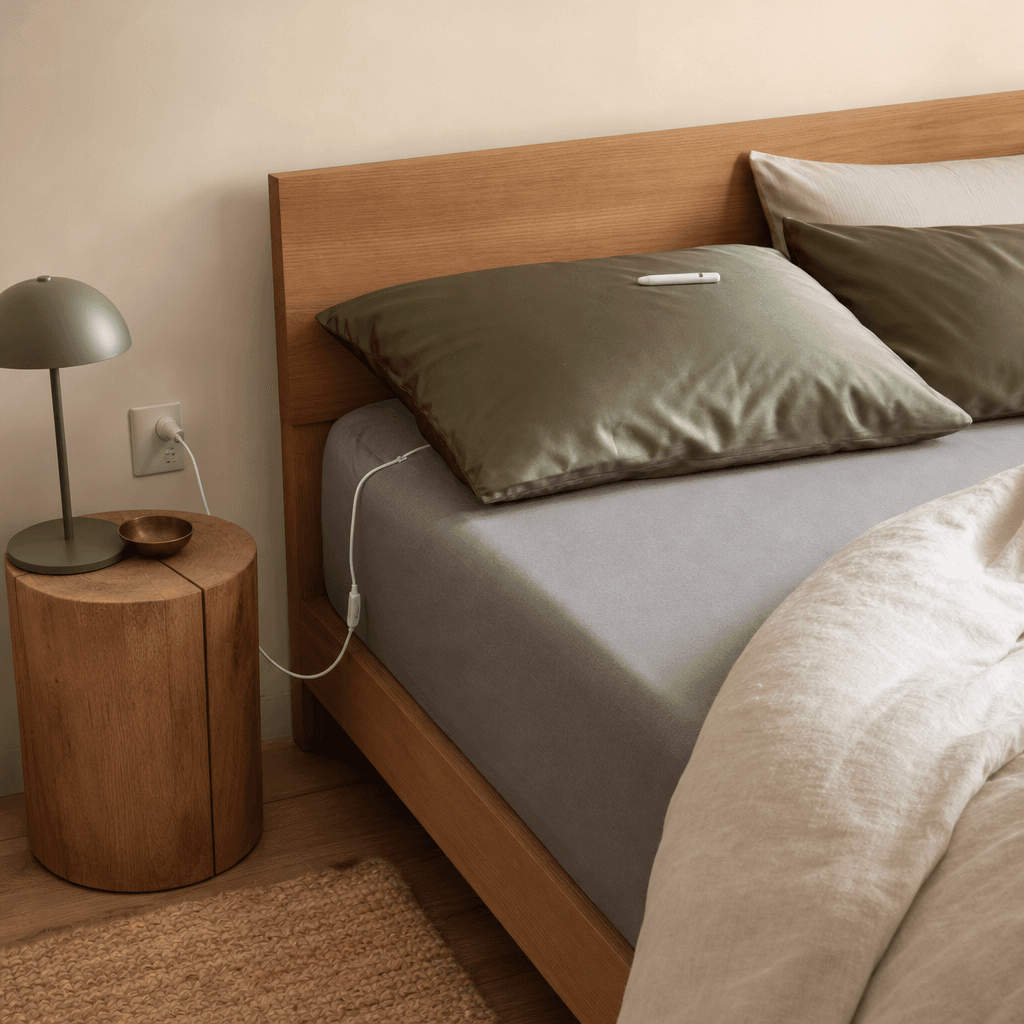
To test a grounding sheet, connect the cord to the sheet and the earth connection as your in-box instructions describe, then touch the tester pen to several points across the sheet. If the light comes on, a conductive path exists from that spot through the cord to earth. No light means checking the chain.
Most people take a brand's word that a grounding sheet is conductive. You shouldn't have to. That is why every Organic Earthing grounding box includes a tester pen, and why I'd rather you check what you bought than trust a product page, including ours.
This guide covers what the pen can and cannot tell you, how to test at setup, how to read the light, how to work through a failed test, and how to re-test over time. It finishes with the part most guides skip: judging the textile itself.
Key Takeaways
- The tester pen confirms one thing only: a conductive path from the sheet, through the cord, to the earth connection.
- It does not measure anything about your body, your sleep or the effects of grounding.
- Test several points across the sheet at setup, not just one corner.
- Light on means a path is present. No light means working through the chain: pen battery, cord, snap or clip, then the outlet.
- Re-test after washing and every few weeks, because residue and wear can affect results.
- A passing test says nothing about the fabric. Ask what the textile is made of and what it was tested for.
Summary Table
| Stage | What you do | What it tells you | What it does not tell you |
|---|---|---|---|
| Setup | Connect cord and pen as the in-box card describes, test multiple points | A conductive path is present across the sheet | How you will sleep |
| Reading the light | Light on or off at each point | Whether the chain is intact at that spot | Anything about your body |
| Fixing a failed test | Work through pen, cord, clip, outlet in order | Where the break in the chain sits | Whether the sheet is faulty (until the chain is ruled out) |
| Over time | Re-test after washing and every few weeks | Whether the path is still present | A durability guarantee |
| Beyond the light | Read the certificates and what they cover | What the textile was tested for | What grounding does for sleep |
What a Tester Pen Checks, and What It Cannot Tell You
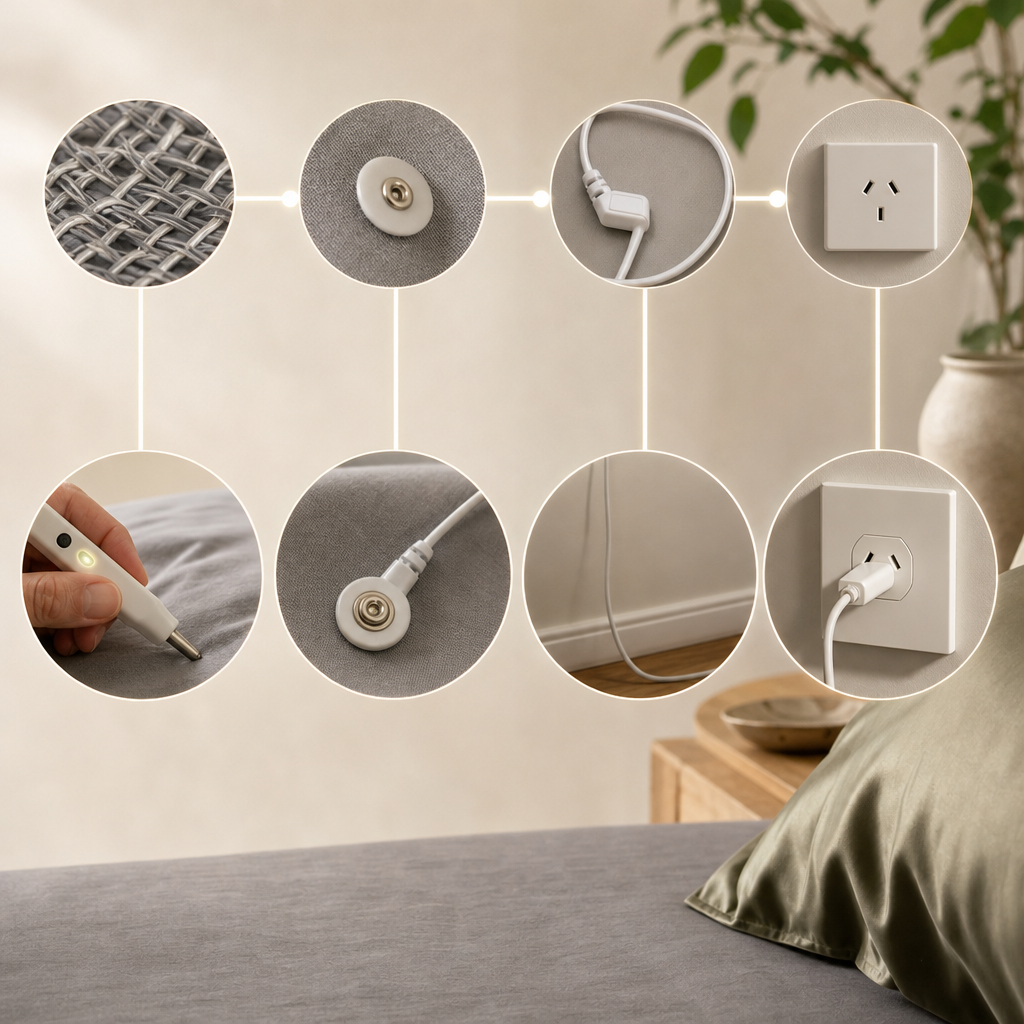
A tester pen checks one thing: whether there is a conductive path from the sheet, through the cord, to the earth connection. It does not measure anything about your body, your sleep or how well grounding works for you. It is a continuity check on the product, nothing more.
Think of it the way an electrician thinks about a cable. Is there an unbroken route from point A to point B? Here, A is a spot on your sheet and B is the earth connection. If the route is intact, the light comes on.
The sheet is built around that route. Bamboo on its own is not conductive enough, so fine silver fibres are woven through the organic bamboo (10% silver thread, per our product specification) rather than coated on top. The silver has a job to do: conduct. The cord connects the sheet to the earth pin of a wall socket. No power flows through the sheet. Only the grounding connection is used.
Here is what the pen cannot tell you:
- Anything about your body. It does not read you. It reads the sheet and cord.
- Whether grounding helps your sleep. That is a separate, open question. The small published studies have not settled it, and I've set out what they can and cannot show in Do grounding sheets work?
- Whether the fabric is safe against your skin. A conductive sheet and a well-made sheet are two different claims.
This is a wellness product, not a medical device. I can tell you what the fabric is made of, what it has been tested for, and how to check the connection yourself. I won't tell you what grounding does to your body, because the pen cannot show it and I can't promise it.
How to Test a Grounding Sheet at Setup
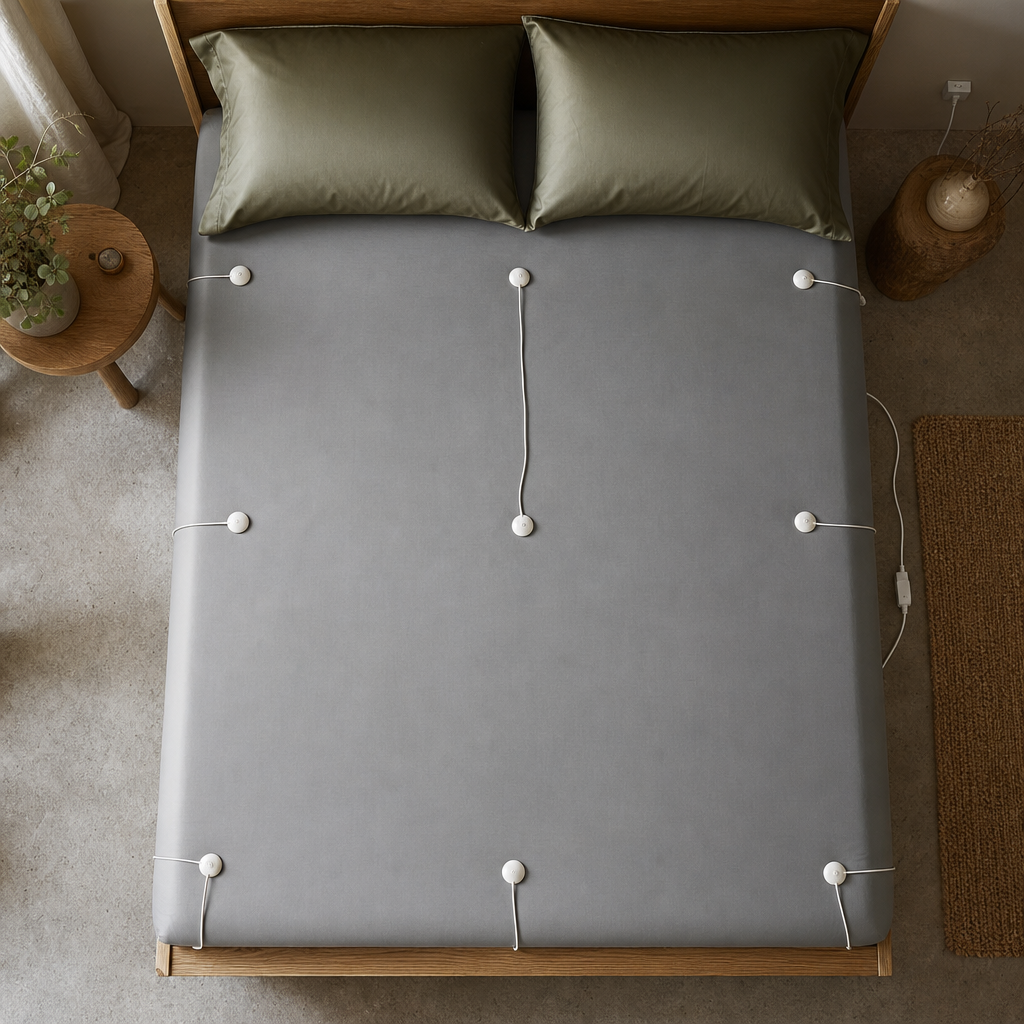
Test at setup by fitting the sheet flat and dry, connecting the cord as your in-box card describes, then touching the pen to the sheet at several points: head end, centre, foot end, both edges and corners. A light at one corner only proves that corner. Test the whole bed.
Your in-box instructions are the authority on how to connect the pen. The steps below describe the logic so you know why each one matters.
- Read the in-box card first. Connection details can vary by product, so follow the card over any general guide, including this one.
- Fit the sheet on the mattress. Pull it smooth and make sure it is dry. Test the sheet surface itself, not through another layer.
- Attach the cord to the sheet. Push the snap or clip on fully until it is seated. A half-attached connector is one of the most common reasons for a failed first test.
- Connect the cord to the earth connection. For Australian homes, that is the earth pin of a wall socket, as the instructions describe. Seat the plug fully.
- Connect the pen as instructed and touch the first point. Watch for the light.
- Repeat across the sheet. Head end, the middle where your torso sits, the foot end, both sides and each corner.
- Write down the result. A phone note with the date is enough. You want something to compare against later.
Why several points? Because a light at the corner nearest the cord proves a path from that corner. It says nothing about the middle of the bed, where you actually lie. Testing a spread of points is the only way the result means anything for the whole sheet.
One safety note. The earth connection relies on your outlet being correctly wired. If you are unsure about a socket, particularly in an older home, have a licensed electrician check it. Your state's electrical safety regulator, such as Energy Safe Victoria, publishes guidance for householders.
If you are still choosing a sheet, the certified fitted grounding sheet comes with the tester pen in the box, so you can run this exact check on night one.
Reading the Light: What On and Off Actually Mean
Light on means a conductive path is present between the point you touched and the earth connection. Light off means the path is broken somewhere in the chain, or the pen itself is not working. The light is a yes or no answer to one narrow question. Read it that way.
Do not read more into a bright or dull light than the pen's card allows. The pen confirms presence of a path. It does not grade it, and I'd be making numbers up if I told you otherwise. If the light flickers or behaves inconsistently, count that as a fail and work through the chain below.
| Result | What it suggests | What to do next |
|---|---|---|
| Light on at every point | A conductive path is present across the sheet | Record the result and carry on |
| Light on at some points, off at others | The path is present in places but not everywhere | Re-seat the clip, re-test, then contact us if it persists |
| Light off at every point | The break is likely in the shared chain (pen, cord, clip or outlet) | Work through the chain in order |
| Light flickers or is inconsistent | An unreliable connection somewhere | Re-seat every connection and try another outlet |
The pattern matters more than any single result. Off everywhere points to something shared by every test: the pen, the cord, the clip or the socket. Off in only one area points to that part of the sheet.
Grounding Sheet Not Conducting: How to Fix a Failed Test
If the pen shows no light, work through the chain in order, easiest check first: pen battery, cord seated, snap or clip attached, then the outlet earth. Most failed tests come from one loose or flat link, not a faulty sheet. Change one thing at a time and re-test after each.
Here is the order I'd follow:
- The pen. Confirm the pen itself works using the check on your in-box card. A flat battery looks exactly like a dead sheet, so rule it out first.
- The cord. Make sure it is fully seated at both ends. Look along its length for kinks or damage.
- The snap or clip. Detach it and push it back on firmly. Check the contact point on the sheet is clean and dry.
- The outlet. Try a different wall socket. If one socket fails and another passes, the problem is the first socket's earth, not the sheet. If you suspect a wiring fault, call a licensed electrician.
- A second point on the sheet. Re-test head, centre and foot. If only one area fails, note which one.
If you have worked through all five and the light still stays off, the sheet may be at fault. That is what the trial and warranty are for. Every grounding product comes with a 90-night trial from delivery and a 1-year warranty (returns in reasonable condition, return postage on the customer). Sleep on it for 90 nights, decide later. If a sheet will not pass a check you can run yourself, send us the details and your test notes. Questions about returns go straight to me.
These terms sit alongside your rights under the Australian Consumer Law, which the ACCC explains on its consumer guarantees pages.
One expectation to set. Passing the test confirms the connection. It does not predict how you will sleep. Some people notice something in the first week, many notice nothing until the third, and both are normal. That is why the trial runs 90 nights and not seven.
Testing Over Time: After Washing and Every Few Weeks
Re-test after washing and every few weeks, because the test result at setup is a snapshot, not a guarantee. Residue on the fibres and ordinary wear can both affect whether a sheet still passes. A quick repeat check, recorded against your setup notes, tells you whether anything has shifted.
Why might a result change? Two likely reasons.
Residue. Fabric softener, body lotions and body oils can all leave a film on fibres. Because the silver fibres do the conducting, anything that coats the textile surface is a reasonable suspect when a sheet that passed starts to fail. I can't give you a lab figure for how much residue causes a problem, so I won't. I'd simply keep softener away from the sheet, follow the care instructions that come with it, and notice if you start using a new heavy lotion at night.
Wear. Fabric ages. Friction, repeated washing and pulling at the clip area can all affect a textile over time. I don't offer a durability guarantee, and nobody honestly can for a product that depends on how you wash and use it. A re-test is how you find out where your own sheet stands.
A sensible routine:
- Test at setup and keep the notes.
- Re-test after a wash, using the same points as before.
- Re-test every few weeks as a habit, and any time the sheet has been stored or moved.
- If a sheet that passed now fails, work through the chain before assuming the sheet is the problem.
Fabric choice shapes how a sheet washes and wears, and I've covered that in more detail in our post Bamboo vs Cotton Grounding Sheets: What the Fabric Actually Changes.
Beyond the Light: Judge the Textile Too
The tester pen proves the sheet conducts. It says nothing about what the sheet is made of or what it has been tested for. Judge the textile as well, because it is what touches your skin every night for around eight hours. Ask of any grounding brand: certified to what standard, and what does it cover?
I keep two kinds of claim apart, and I'd encourage you to do the same when you read any product page.
Claim one: what the fabric is and what it has been tested for. This can be checked against documents.
Claim two: what grounding does for sleep. This is an open question, and the small studies have not settled it.
When those two get blurred into one sentence, you lose the ability to check anything. So here is claim one for our grounding sheets, with the numbers:
- Materials: organic bamboo woven with 10% silver thread. Our product specification states 10%. The competitor listings I've seen state 5% or less.
- OEKO-TEX Standard 100, certificate SH025 231655. This is a textile standard that tests for harmful substances. Our manufacturing partner is certified at Product Class I, the strictest class, which is the class set for products used closest to skin.
- RoHS compliance certificate CHHB26080392392 (grounding sheets). RoHS is a restricted-substances regime that covers materials such as lead, mercury and cadmium. This is separate testing on the grounding bedding, and you should read the certificate for its exact scope.
Notice what those certificates do not say. Neither says anything about sleep. Neither says a sheet is "better". They say a specific thing was tested against a named standard, and you can look up the number.
Here is how I'd question any grounding brand, including ours:
- What is the sheet actually made from?
- What makes it conductive, and what conductive material is used?
- Can you test the conductivity yourself?
- How does it connect to ground?
- What testing or documentation does the company actually have, certified to which standard, covering what?
The pen answers question three. The certificates answer question five. If a brand can't answer all five plainly, that tells you something.
Why the Pen Is in the Box: Verify Before You Trust
A grounding sheet is a $419 decision made online, by people who can't feel the fabric or know how they will sleep until it is on their own bed. I built the offer around that gap. The tester pen, the certificate numbers and the 90-night trial lead every product page, because they let you check instead of believe.
Here is the position I hold that most of the category doesn't. Everyone argues about whether grounding works. Almost nobody talks about the textile you are sleeping on. I came to grounding after I had already become conscious of what I put against my skin, so I started from the fabric. When I began selling, I wanted to know what was in the products and have independent testing behind it, particularly for harmful or restricted substances. I chose OEKO-TEX Standard 100 and separate RoHS testing, accepting higher cost and a more complicated supply chain. The result is that I can publish certificate numbers instead of adjectives.
I don't want customers to trust us because we've written "premium" on a website. I'd rather you question us. Certification language is specific, and a badge can look impressive with very little behind it. The more shoppers ask what a certificate covers, the better the whole category gets.
The same logic explains why we don't lead with price hooks. A certified product at this price can't argue with a clearance voice. The offer is proof: certificate numbers, a tester pen, 90 nights to decide and a year of warranty. Test it before you believe it.
If that is how you like to buy, choose a sheet you can verify on night one: the certified fitted grounding sheet. It comes with a tester pen in the box, certificate numbers published on the page, a 90-night trial and a 1-year warranty. We're an Australian-owned, family-run brand selling globally, and I read the questions that come in.
References
- OEKO-TEX, STANDARD 100 by OEKO-TEX
- European Union, Directive 2011/65/EU on the restriction of hazardous substances in electrical and electronic equipment (RoHS)
- Energy Safe Victoria, electrical safety information for households
- ACCC, Consumer rights and guarantees
Take this with you
Your first 30 nights, in your inbox.
What people usually notice in the first month on a grounding sheet, week by week, and why you get 90 days rather than 14.
Questions people ask
Is my grounding sheet working?
The tester pen answers a narrow part of that question. If the light comes on at several points across the sheet, a conductive path is present from the sheet through the cord to the earth connection. It cannot tell you anything about your body or your sleep.
Where on the sheet should I test?
Test several points, not just one corner. Check the head end, the centre where your torso sits, the foot end, both edges and the corners. A light at one spot only proves the path from that spot.
What should I do if the pen shows no light?
Work through the chain in order: pen battery, cord seated at both ends, snap or clip attached, then the outlet earth. Try a different socket and re-test several points. If everything checks out and there is still no light, contact us and use the trial or warranty.
How often should I re-test a grounding sheet?
Test at setup, after washing, and every few weeks as a habit. Residue from fabric softener, lotions or body oils and general wear can affect results. Re-testing shows where your own sheet stands, but it is not a durability guarantee.
Can I test a grounding sheet without the tester pen?
A multimeter set to continuity can also check for a path, but you need to know how to read it, and the pen is designed for this exact job. Start with the pen and follow your in-box instructions.
If the light comes on but I notice nothing, is the sheet faulty?
Not necessarily. The pen confirms the connection, not any effect on sleep. Some people notice something in the first week, many notice nothing until the third, and both are normal. That is why the trial runs 90 nights.