Grounding · 24 Oct 2026 · 19 min read
Are Grounding Sheets Safe to Plug In? The Earth Pin, the Resistor and Your Socket
Are grounding sheets safe to plug in? See what the earth pin connects, what the resistor does, why your socket matters and which certificates cover what.
By Jade Castle, founder. Wellness product, not a medical device.
Part ofThe setup and care guide
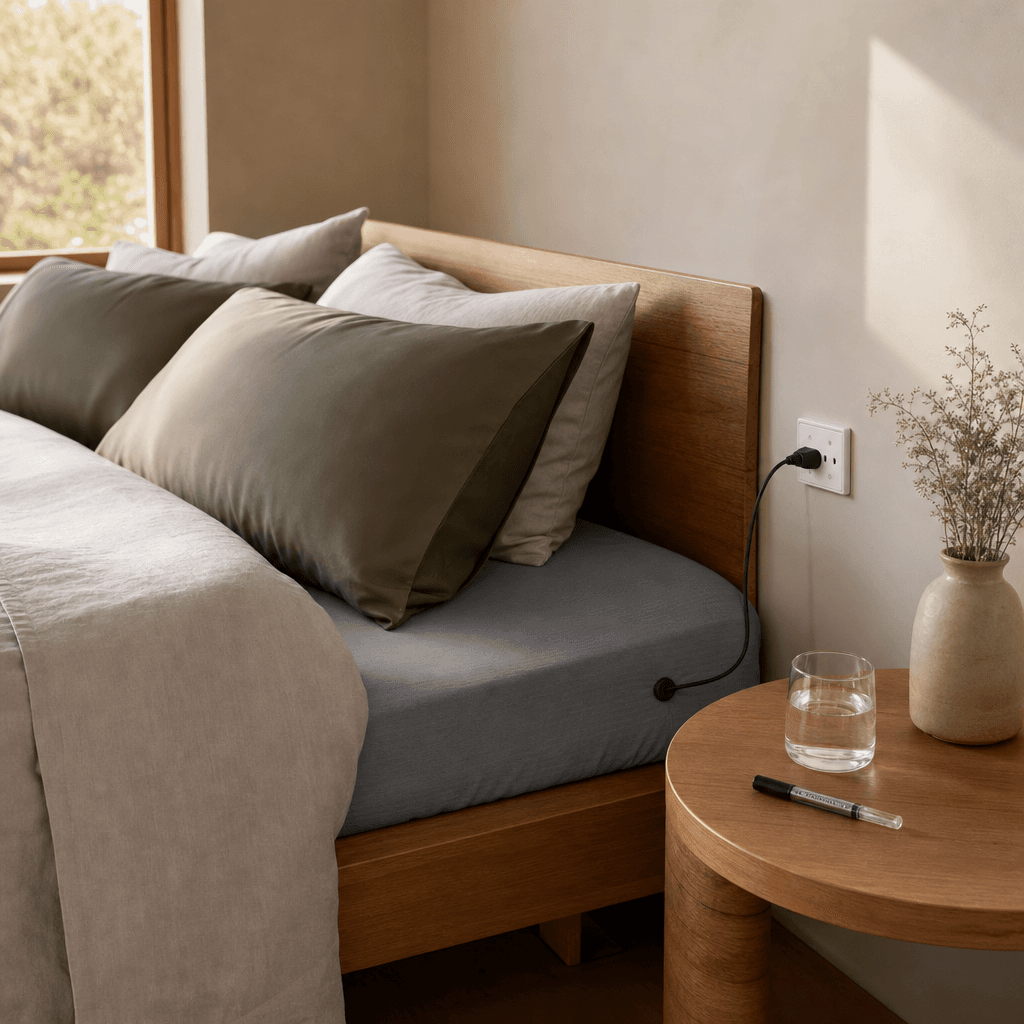
Yes, when it is built and used as intended. Only the earth pin of the plug connects to the sheet's cord. The power pins are blank and carry no current to the sheet. A built-in resistor sits in the cord, and the socket itself must be properly earthed.
Hesitating before you plug bedding into a wall socket is reasonable. I would worry more about anyone who didn't. I'm Jade, founder of Organic Earthing, and this article answers the question the way I'd want it answered if I were the buyer: what connects, what sits in between, what your socket has to do, and what has actually been tested. I will question our claims along with everyone else's.
One boundary first. A grounding sheet is a wellness product, not a medical device. I won't tell you what grounding does to your body. Where benefits come up, I will only describe what people report.
Key Takeaways
- Only the earth pin is connected to the cord. The two power pins are blank and carry no current to the sheet.
- A resistor is built into the cord. I'm not quoting a value here, and you should ask any brand, including us, for theirs.
- The sheet relies on a properly earthed socket. Check it with the tester pen in the box, and ask a licensed electrician if you are unsure about your wiring.
- The correct plug for your country ships in the box. Improvised adaptors can drop the earth connection.
- OEKO-TEX Standard 100 (SH025 231655) and RoHS (CHHB26080392392) cover harmful and restricted substances. Neither is an electrical safety approval.
- Inspect the cord and plug, keep the cord tidy and keep the sheet dry. You have 90 nights from delivery to test it and decide.
Summary Table
| Question | Short answer | What to check yourself |
|---|---|---|
| What connects to the socket? | The earth pin only | Power pins are blank on the plug |
| What sits in the cord? | A built-in resistor | Ask any brand for the value and the reason for it |
| What does the socket need? | A properly earthed outlet | Tester pen first, then a licensed electrician if unsure |
| Which plug do I use? | The one shipped for your country | Do not improvise adaptors |
| What do the certificates cover? | Textile and restricted substances | They are not an electrical safety approval |
| What habits matter? | Inspect, tidy, keep dry | Stop using the sheet if the cord or plug is damaged |
What actually connects to the wall socket?
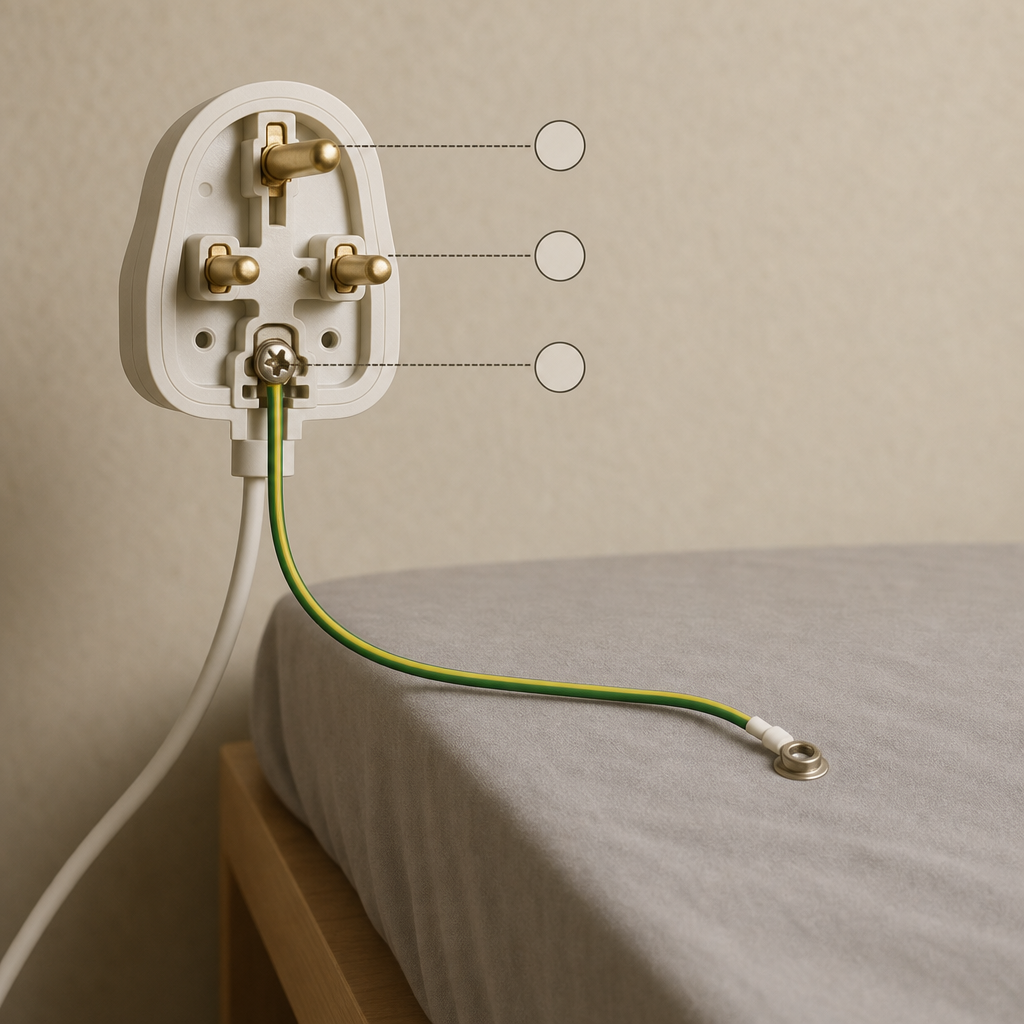
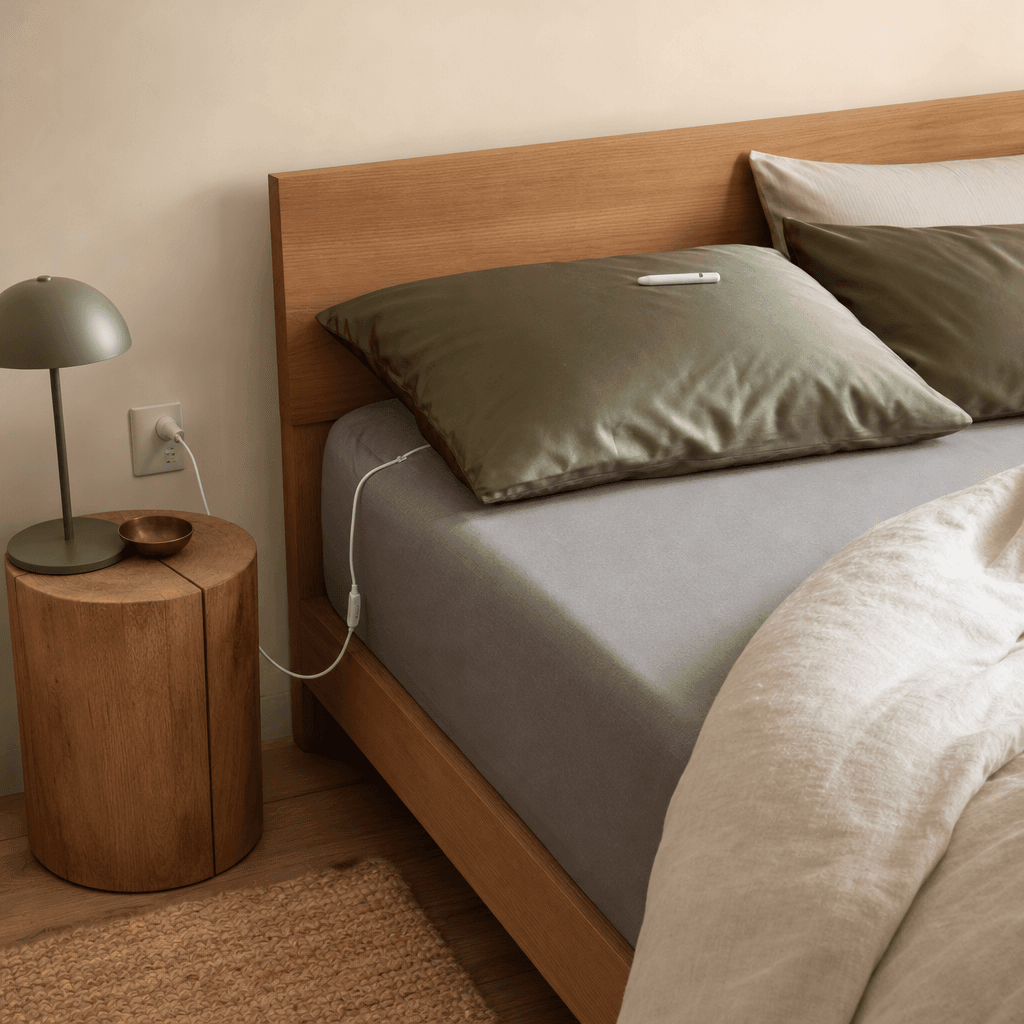
Only the earth pin connects to the sheet. A grounding sheet's cord ends in a plug, but the two power pins are blank and carry no current to the sheet. Only the earth pin is connected to the cord, and its job is to give the sheet a connection to the earth line, not to supply power.
That is the whole electrical idea, and it is worth saying plainly because most of the worry comes from picturing mains power running through your bed. It doesn't. Think of a normal appliance plug. Every pin is wired to something. On a grounding sheet plug, the power pins are there so the plug sits correctly in the socket, and they are blank. Nothing travels from them to the fabric.
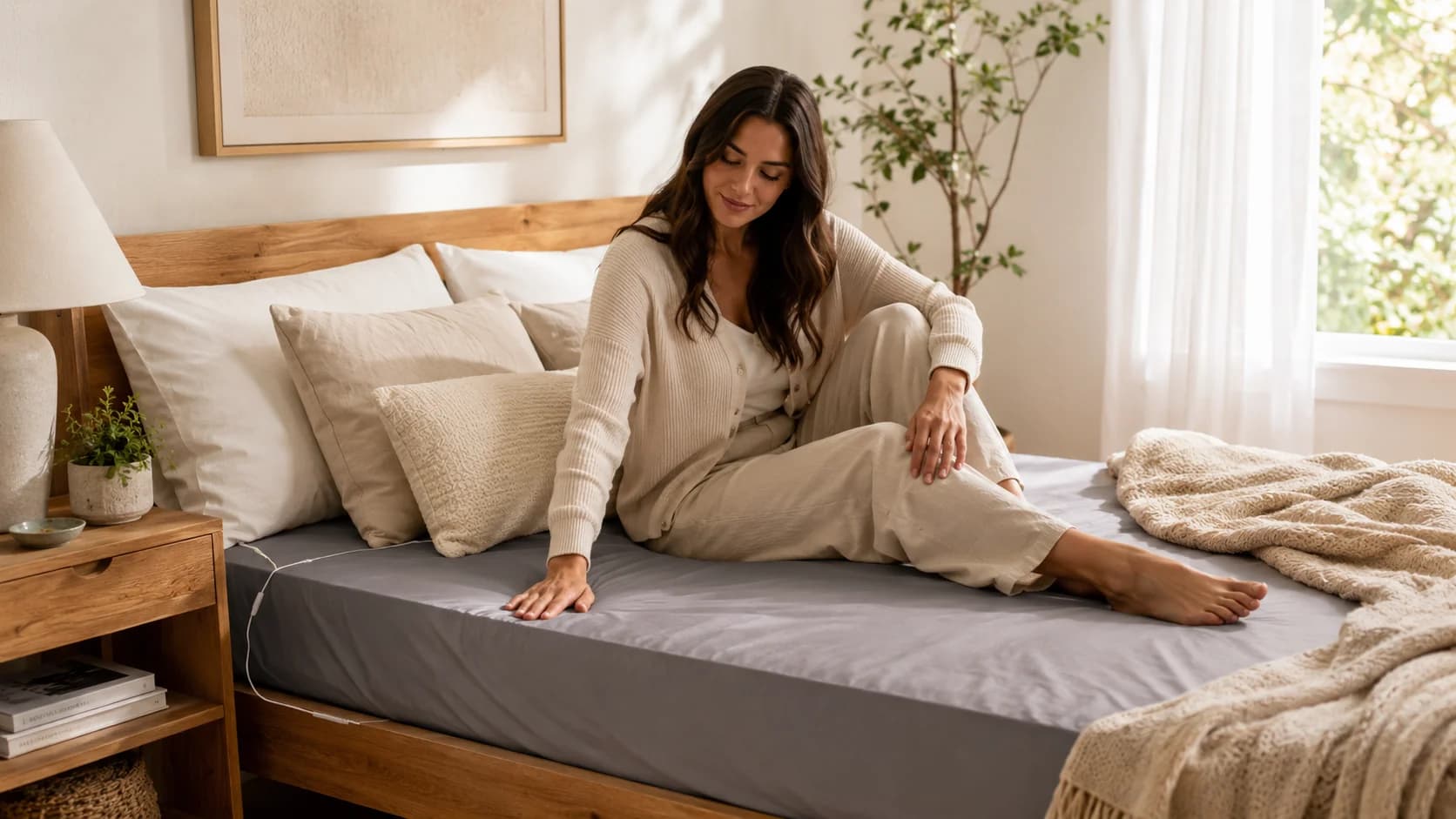
The sheet itself is bamboo with fine silver fibres woven through it. Bamboo on its own is not conductive enough to ground a body, and I did not want a sheet people put up with just because it grounds. So the silver is woven through the bamboo (10% silver thread) rather than coated on top. The silver has a job to do: conduct. The bamboo keeps the softness, breathability and moisture handling that matter to hot sleepers. A cord connects the sheet to the earth pin of the wall socket. No power flows. Only the grounding connection is used.
I'm describing our design. Please don't take my word for it. That is the reason a tester pen goes in every box, and I come back to it below. Test it before you believe it.
What does the built-in resistor do, and where does it sit?
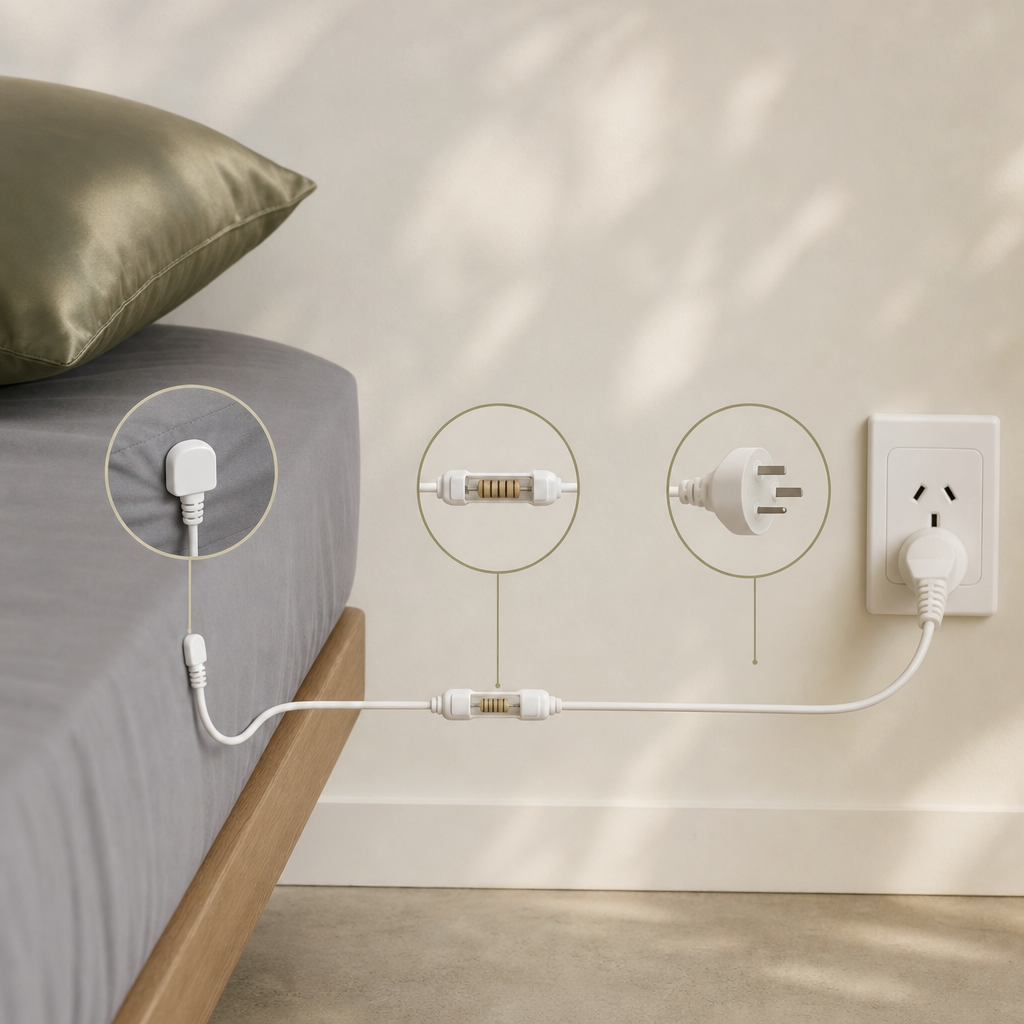
The resistor is a small electrical component built into the cord that runs from the sheet to the earth pin. It adds resistance to the connection between you and the earth line. I'm not quoting a value in this article. Ask any brand, including us, for the value and the reason it was chosen.
A resistor does one simple thing: it makes it harder for current to flow along a path. In a grounding cord it sits between you and the earth line, so the connection is not a bare, direct run of conductor from the sheet to the earth pin. It is a design measure. It is not a guarantee that every possible fault in every home is harmless, and nobody should sell it to you as one.
Here is why I'm careful with numbers. A resistor value without documentation behind it is exactly the kind of figure I'd tell you to distrust on another brand's page. If I print a number, it should sit next to a specification you can ask to see. So the useful questions are these:
- What is the resistor value, and where in the cord is it fitted?
- Why was that value chosen?
- Is the cord and plug assembly the same on every unit, or does it vary by batch?
A brand that answers those directly is worth more than one that says "safe" in bold. And a resistor does not replace a sound socket. That is the next question.
Why does your socket matter as much as the sheet?
The sheet relies on a properly earthed outlet. If the earth connection behind the socket is missing or wired incorrectly, the sheet has nothing sound to connect to. Check it with the tester pen included in every box, and if you are unsure about your home's wiring, ask a licensed electrician before you plug in.
The sheet is only half the circuit. The other half is the wiring in your wall, which no product can control. Older homes, and homes renovated in stages, can have sockets that were never earthed or were wired incorrectly. Melbourne has plenty of houses like that, and a rental is a case where you may not know the history at all.
The tester pen is your first check. Our guide, How to Test a Grounding Sheet With a Tester Pen, walks through it step by step, so I won't repeat it here. Use the pen on the first night, before you settle into the sheet.
The pen has limits. It is a simple indicator, not an electrician's test. If the result is unclear, or the socket is loose, discoloured, warm, cracked or has ever tripped a circuit, stop and call a licensed electrician. In Australia, electrical work must be done by a licensed electrician. Do not open a socket or rewire it yourself to make a sheet work. Energy Safe Victoria publishes electrical safety guidance for Victorian households, and your state or territory regulator does the same.
While the electrician is there, ask whether your circuits have a safety switch (an RCD). That is separate protection in your switchboard, and it is worth knowing about whether or not you own a grounding product.
Which plug comes with a grounding sheet in each country?
The correct plug for your country ships in the box, so you do not need an improvised adaptor. Australia and New Zealand use the Type I plug, the UK uses Type G, and the US and Canada use Type B. The sheet's earth connection is made through the plug that fits your socket.
We're an Australian-owned, family-run brand selling globally, so this comes up often. Sockets differ by country, and the earth pin is positioned differently on each. The table below shows the earthed plug type for common regions. The plug type letters come from the International Electrotechnical Commission's world plugs guide.
Source: IEC, World Plugs
| Region | Earthed plug type | What this means for your sheet |
|---|---|---|
| Australia and New Zealand | Type I | Matching plug ships in the box |
| United Kingdom | Type G | Matching plug ships in the box |
| United States and Canada | Type B | Matching plug ships in the box |
| Continental Europe | Type E or F, depending on the country | Matching plug ships in the box |
If you are not sure which plug your order includes, ask before you plug anything in.
Why improvised adaptors are a bad idea
A grounding sheet only works as intended if the earth pin reaches the earth terminal in the socket. Many travel adaptors and cheap converters do not carry an earth connection, and some are not wired the way they look. If the earth path is broken, you have a sheet that is not connected to anything. That defeats the purpose, and it can leave you assuming something is working when it isn't.
So do not stack adaptors, do not force a plug into a socket it doesn't fit, and do not cut or rewire a plug. If you are moving countries, or you ordered for one country and are now using the sheet in another, contact us first.
Certified to what standard, and what does it cover?
Two certificates sit behind the sheet: OEKO-TEX Standard 100 (SH025 231655) for harmful substances in the textile, and RoHS compliance (CHHB26080392392) for restricted substances in the grounding bedding. Neither is an electrical safety approval, and neither says anything about what grounding does. Certified to what standard, and what does it cover?
I came to grounding through caring about what touches my skin, so I judge the textile and its test reports first. A certificate number is a starting point for questions, not the end of them. Here is what each one means, and what it does not.
OEKO-TEX Standard 100 (SH025 231655)
OEKO-TEX Standard 100 is an independent testing and certification system for textiles. It tests for harmful substances. Our manufacturing partner is certified at Product Class I, the strictest class, which OEKO-TEX sets for articles intended for babies and toddlers. The certificate number is SH025 231655, and it sits on every product page.
What it covers: harmful substances in the textile materials listed on the certificate.
What it does not cover:
- The electrical safety of the cord, resistor or plug
- Whether a fabric is organic
- How the sheet performs or how long it lasts
- Anything about what grounding does for sleep
You can check a certificate on OEKO-TEX's own website using its Label Check tool. Do that. A badge can look impressive with very little behind it, and I'd rather you verify ours than take it on trust.
RoHS compliance (CHHB26080392392)
RoHS stands for Restriction of Hazardous Substances. It began as a European Union framework that limits certain substances, such as lead and mercury, in electrical and electronic equipment. Our grounding sheets have a RoHS compliance certificate, number CHHB26080392392. It exists because the grounding side of the product involves conductive materials and a cord, and I wanted separate testing on restricted substances there, not just on the fabric.
What it covers: restricted substances, for the grounding sheets named on the certificate.
What it does not cover: shock safety. A RoHS result is a substances test. It is not a statement that the cord has passed an electrical safety assessment. Keep those two ideas separate when you read any brand's page, including ours.
GOTS scope certificate on the silk
If you are weighing grounding against silk for cooler nights, note that our mulberry silk sleepwear is a different product with a different document. It has a GOTS scope certificate, USB TEX-4007-GOTS-2509. That is a scope certificate, not a transaction certificate. It tells you about the certified scope of the supply chain, not that a given item has gone through a certified transaction. I keep the claim exactly that narrow.
The 10% silver thread
The silver thread in our grounding sheets is 10% in the product specification. Competitors state 5% or less. That is our product data, and I'll add a caveat. A higher silver percentage does not prove better conductivity on your bed. That is why you can check it yourself with the pen when you first set up the sheet, and again over time.
What are sensible habits for using a plug-in grounding sheet?
Inspect the cord and plug regularly, keep the cord tidy and away from where it can be pinched or tripped over, and keep the sheet dry. If you see damage such as a cracked plug, exposed wire or a frayed cord, stop using it and contact us.
None of this is complicated. It is the same care you would give any cord in a bedroom.
- Check the cord and plug. Look along the whole length, and look at the plug body and pins. Stop if you see cracks, bent pins, scorch marks or exposed wire.
- Keep the cord tidy. Route it so it isn't pulled tight, trapped under furniture or caught under the mattress. Loose coils that can snag a foot are as much a problem as a tight cord.
- Keep the sheet dry. Do not use it damp, and keep drinks and spills away from the plug and socket. Follow the care instructions supplied with the sheet, and unplug before you handle it for washing.
- Test it at setup, and again over time. Use the tester pen when you first set the sheet up. Check again from time to time. I won't tell you to test after every wash, and I won't give you a durability guarantee, because no honest brand can promise either.
- Plug into the wall directly. Keep the connection simple and short, to a socket you have confirmed is earthed.
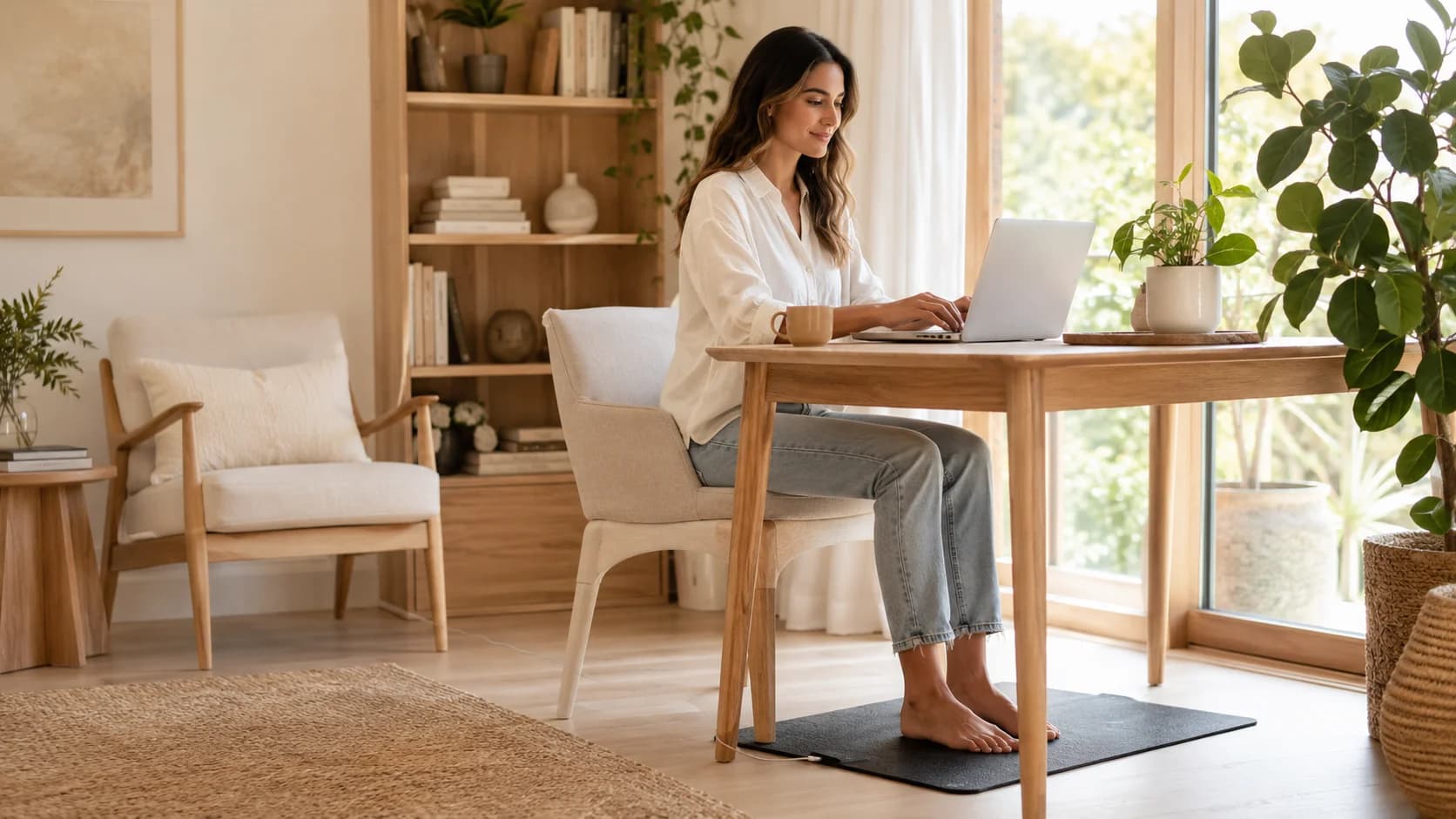
If you want to compare formats before you decide, we have written about Fitted vs Flat Grounding Sheet, and the flat grounding sheet and the grounding mat have their own product pages.
What can't I tell you, and why do the two kinds of claim stay separate?
Safety and certification claims are about what the product is made of and what has been tested. Whether grounding changes sleep is a separate, open question: the published studies are small and have limits. I keep the two apart because blurring them is how a badge ends up doing a job it was never meant to do.
I call this the two kinds of claim. The first kind is what the fabric is: organic bamboo, 10% silver thread, and for the silk, 22 momme mulberry. The second is what it has been tested for: OEKO-TEX Standard 100 for harmful substances, RoHS for restricted substances in the grounding bedding, and the GOTS scope certificate for the silk. The third is a different matter entirely: what grounding does for sleep.
On that third one, I can only tell you what people report. Some people say they notice something in the first week. Many notice nothing until the third. Both are normal, which is why the trial runs 90 nights. Some notice nothing at all. A wellness product, not a medical device: if you have a health condition, or an implanted medical device, talk to your doctor before you change what you sleep on.
What should you ask any grounding brand, including us?
Ask five things of any grounding brand: what is the sheet made from, what makes it conductive, can you test it yourself, how does it connect to ground, and what testing or documentation exists. Here is how we answer each, and where you should keep pushing.
- What is the sheet made from? Organic bamboo with 10% silver thread. Push on: what is the rest of the fabric, and where is the full composition stated?
- What makes it conductive? Fine silver fibres woven through the bamboo, not coated on top. Push on: what percentage, and is it stated in a specification?
- Can you test the conductivity yourself? Yes. A tester pen comes in every grounding box. Push on: is that true of every brand you are comparing?
- How does it connect to ground? By a cord with a built-in resistor to the earth pin of a properly earthed wall socket. The power pins are blank. Push on: the resistor value, and what the cord was assessed against.
- What testing or documentation exists? OEKO-TEX Standard 100 (SH025 231655) and RoHS (CHHB26080392392). Push on: certified to what standard, and what does it cover? As above, neither is an electrical safety approval.
The point of the list is that it should apply to us as well. If a brand dodges question four, that tells you something.
Test it before you believe it
At $419, a grounding sheet is a decision made online, by people who can't feel the fabric or know how they will sleep until it is on their own bed. So the offer is proof you can check at home, not a price cut.
- A tester pen in every box. Test your socket and the sheet with it on the first night.
- Certificate numbers on every product page.
- A 90-night trial from delivery. Sleep on it for 90 nights, decide later. Returns need to be in reasonable condition, and return postage is on you.
- A 1-year warranty.
Our certified fitted grounding sheet is the place to start, and our guide Grounding Sheets in Australia: What to Check Before You Buy covers the Australian-specific points in more detail.
Why I judge the plug question and the textile question together
I started Organic Earthing before I had heard of grounding. I had become conscious of what I put against my skin, clothing and fabrics first, and I chose natural materials where I could. Then I found grounding and went down the rabbit hole. What struck me was how the whole category argued about whether grounding works, and almost nobody talked about the textile you sleep on for eight hours a night.
That is my contrarian position, and I hold it. Judge a grounding product first on what is touching your skin every night, and on what it has been tested for. The plug question belongs in the same frame. Both are product questions with checkable answers: what is it, what is it connected to, and what has been tested. Neither depends on settling whether grounding works.
It also cost us something. I wanted independent testing behind what I sold, particularly for harmful or restricted substances. So I chose OEKO-TEX Standard 100, with my manufacturing partner certified at Product Class I, and separate RoHS testing on the grounding bedding. That meant higher cost and a more complicated supply chain. The result is that I can publish certificate numbers instead of adjectives. I don't want customers to trust us because we've written 'premium' on a website. I want there to be something behind it.
Here is the uncomfortable part, and I'd rather say it than have you find it. The certificates answer the textile and substances questions. They do not answer every electrical question, and I've said so above. If you want to know more about the cord, the resistor or the plug, ask me. You will get a straight answer, including 'that isn't covered by the certificates' when that is the truth. Questions about returns go straight to me too.
I would like more customers to read certificates this closely. It would be better for the whole category. A $419 product can't argue with a clearance voice, so we don't use one. The offer is proof you can check: certificate numbers, a tester pen, 90 nights to decide and a year of warranty. That is the premium, transparent end of grounding.
Check the certificates yourself, then try the certified fitted grounding sheet for 90 nights. Test your socket with the included pen on the first night.
References
- Energy Safe Victoria, electrical safety information for Victorian households
- OEKO-TEX, STANDARD 100 by OEKO-TEX and the Label Check tool
- European Commission, Restriction of Hazardous Substances (RoHS) Directive
- IEC, World Plugs
- Global Organic Textile Standard (GOTS), standard and certification information
Take this with you
Your first 30 nights, in your inbox.
What people usually notice in the first month on a grounding sheet, week by week, and why you get 90 days rather than 14.
Questions people ask
Are grounding sheets safe to plug in?
A grounding sheet is designed so that only the earth pin connects to the cord, the power pins are blank, and a resistor is built into the cord. It also relies on a properly earthed socket. Test the socket with the tester pen, and ask a licensed electrician if you are unsure about your wiring.
Does a grounding sheet use mains power or give you a shock?
No power is supplied to the sheet, because the power pins are blank and only the earth pin connects. No product can promise zero risk in every home, though, because the wiring behind the wall is outside the product. Stop using the sheet if the cord or plug is damaged, and call an electrician if a socket seems faulty.
How do I know my socket is properly earthed?
Use the tester pen included in every box as a first check. It is an indicator, not an electrician's test. If you are unsure about your home's wiring, or the result is unclear, ask a licensed electrician to check the socket.
Can I use a travel adaptor with a grounding sheet?
We don't recommend it. The correct plug for your country ships in the box, so you shouldn't need one. Some adaptors do not carry the earth connection, which means the sheet would not be connected to ground. If you have moved countries, contact us first.
What certificates does the grounding sheet have?
OEKO-TEX Standard 100, certificate SH025 231655, covers harmful substances in the textile, and our manufacturing partner is certified at Product Class I. RoHS compliance, certificate CHHB26080392392, covers restricted substances in the grounding sheets. Neither is an electrical safety approval, and neither makes a claim about what grounding does.