
Grounding · 19 Nov 2026 · 17 min read
Do Grounding Mats Work? What a Mat Does, What the Tester Pen Shows and What Research Has Measured
A grounding mat gives skin a conductive path to a socket's earth pin. See what the tester pen shows, what small studies measured and what is not known.
By Jade Castle, founder. Wellness product, not a medical device.
Part ofThe grounding mat guide
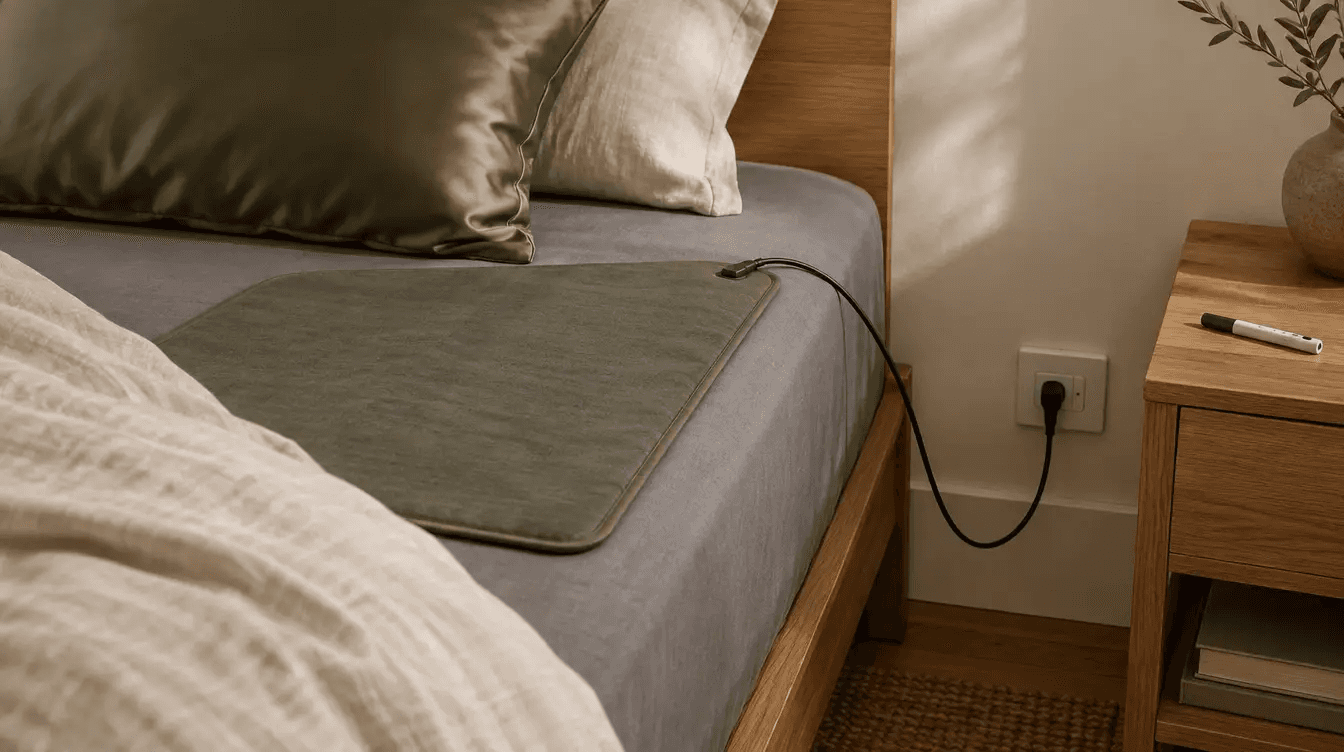
A grounding mat does one thing you can check: it gives your skin a conductive path to the earth pin of a socket, and the tester pen in the box shows whether that path is live. Beyond that connection, research consists of small studies, and many people notice nothing at all.
I'm Jade Castle, founder of Organic Earthing, an Australian-owned, family-run brand selling globally. I sell grounding products, so read everything below knowing that. My aim is to keep three things apart: what a mat physically does, what small studies have measured, and what nobody knows yet.
A grounding mat is a wellness product, not a medical device. I will report what studies measured and what people say they notice. I will not tell you what grounding does to your body, because that is exactly the open question.
Key Takeaways
- A mat's job is mechanical and checkable: a conductive surface, a cord and a connection to a socket's earth pin.
- The tester pen tests the connection. It does not test whether you will sleep better.
- Check the socket before you blame the mat. A socket that is not properly earthed gives the mat nothing to connect to.
- The published studies are small, few have been repeated, and some authors have links to the grounding industry.
- Many people notice nothing. That is a common report, not a sign you did it wrong.
- Judge the textile first, then question every brand, including ours. Ask: certified to what standard, and what does it cover?
Summary Table
| Question | What can be checked | Where it stands |
|---|---|---|
| Is there a conductive path from the mat to the socket? | Yes, with the tester pen | Checkable at home, any time |
| Is the socket earthed? | A licensed electrician can confirm | Check before setup, especially in rentals |
| Is the fabric tested for harmful substances? | Certificate number, standard and scope | Documented, but verify what the certificate covers |
| Do small studies show something? | Read each paper's design and limits | Small samples, few replications |
| Does grounding improve sleep? | Not established | An open question |
| Will you notice something? | Only you can tell | Some do, many do not |
Do Grounding Mats Work? The Short Answer
A mat works as a conductor: it connects your skin to the earth pin of a socket, and you can confirm that with the tester pen. Whether that connection improves sleep or anything else is not established. The research is small and the mechanism is unproven.
That split matters because most articles on this topic blur it. They either declare that grounding works, or dismiss the whole thing without reading the studies. Neither helps a buyer who wants to make a sensible decision.
This guide covers the physical part, then the research, then the gaps, then what people report, then how to judge any mat before you buy. I have used the same questions on my own products. Where the answer to a question is we don't know, I say so.
What a Grounding Mat Physically Does
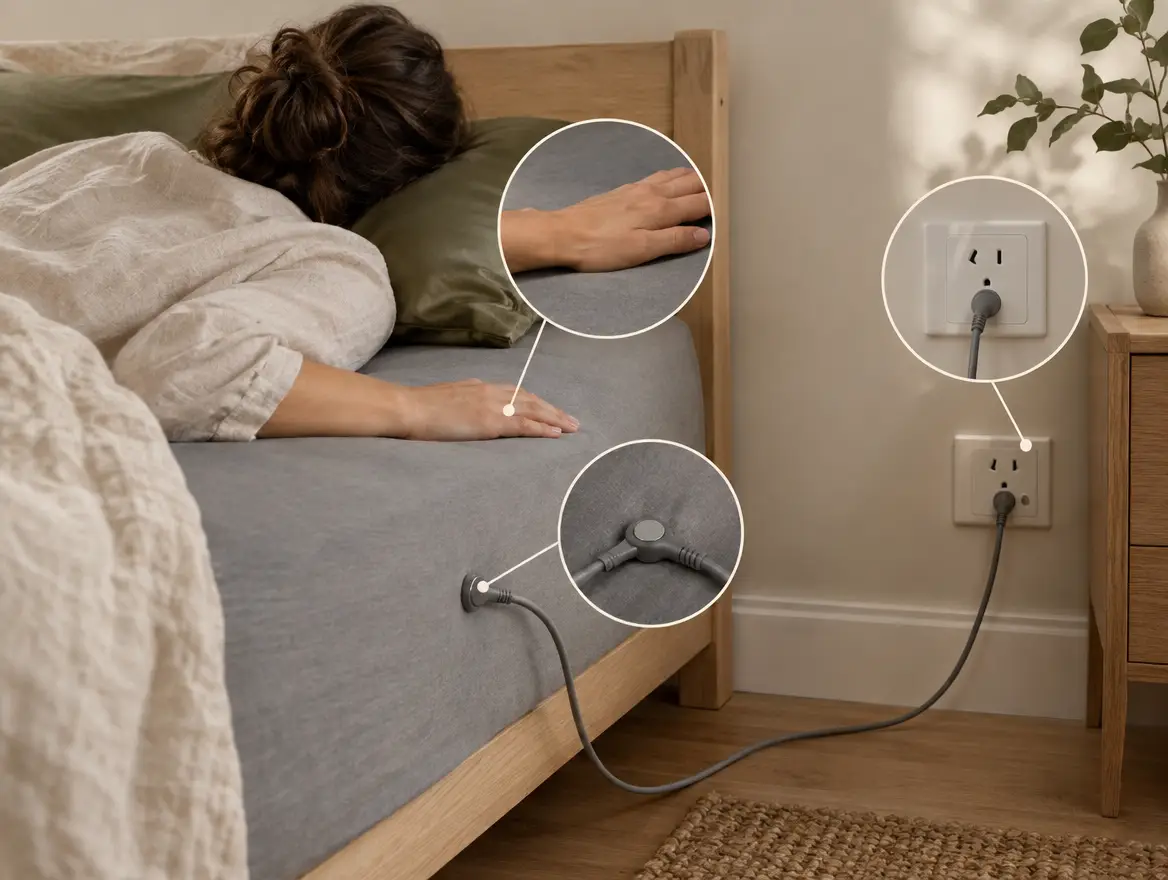
A grounding mat has three parts: a conductive surface your skin touches, a cord, and a connection to the earth pin of a wall socket. Its only function is to link your skin to that earth connection. No power flows through it, and only the grounding connection is used.
The conductive surface
The surface is a material that conducts electricity well enough to carry that link. Not every soft fabric does. Bamboo on its own, for instance, is not conductive enough to ground a body. That is why conductive material has to be built into the surface, and why the question what makes it conductive, and what conductive material is used? is the first one to ask any brand.
For our grounding sheets, fine silver fibres are woven through the bamboo as 10% silver thread, rather than coated on top. The silver has a job to do: conduct. The 10% silver figure and the RoHS certificate (CHHB26080392392) apply to the sheets, not to the mat. I mention them here only so you can see how the sheet is built. For the mat, read the product page for its materials and ask the same questions of us.
The cord and the earth pin
The cord runs from the mat to a plug that connects only to the earth pin of a socket. The earth pin is the part of your home wiring connected to the earth. If the socket is wired correctly, the mat shares that connection. If the socket is not, the mat has nothing to connect to, however well made it is.
How to confirm the path with the tester pen
Every grounding box we ship includes a tester pen. The method is simple, and the instructions in the box come first. In outline, you connect the cord to the socket, touch the pen to the mat surface, and the pen indicates whether the path is live.
The pen answers one question: is this surface connected to the earth pin? It says nothing about sleep, health or how you will feel. It also cannot tell you whether the socket itself is wired properly beyond what it detects, which brings us to the next point.
Check conductivity when you first set it up, and again over time. I would not say after every wash, and I would not call the pen a durability guarantee. It is a check you can repeat whenever you want to know the connection is still there.
Why to check the socket first
If the pen shows nothing, do not assume the mat is faulty. A common cause is the socket. Older homes, some extensions and some rentals may have sockets that are not correctly earthed. Before you blame the mat, try a different socket and re-read the setup steps.
If you suspect a wiring fault, ask a licensed electrician to check it. Do not open a socket yourself. If you rent, ask your property manager or landlord before arranging any electrical work. I cover the socket check for renters and the steps for a grounding sheet that is not working in separate guides on this site.
What Small Studies Have Measured
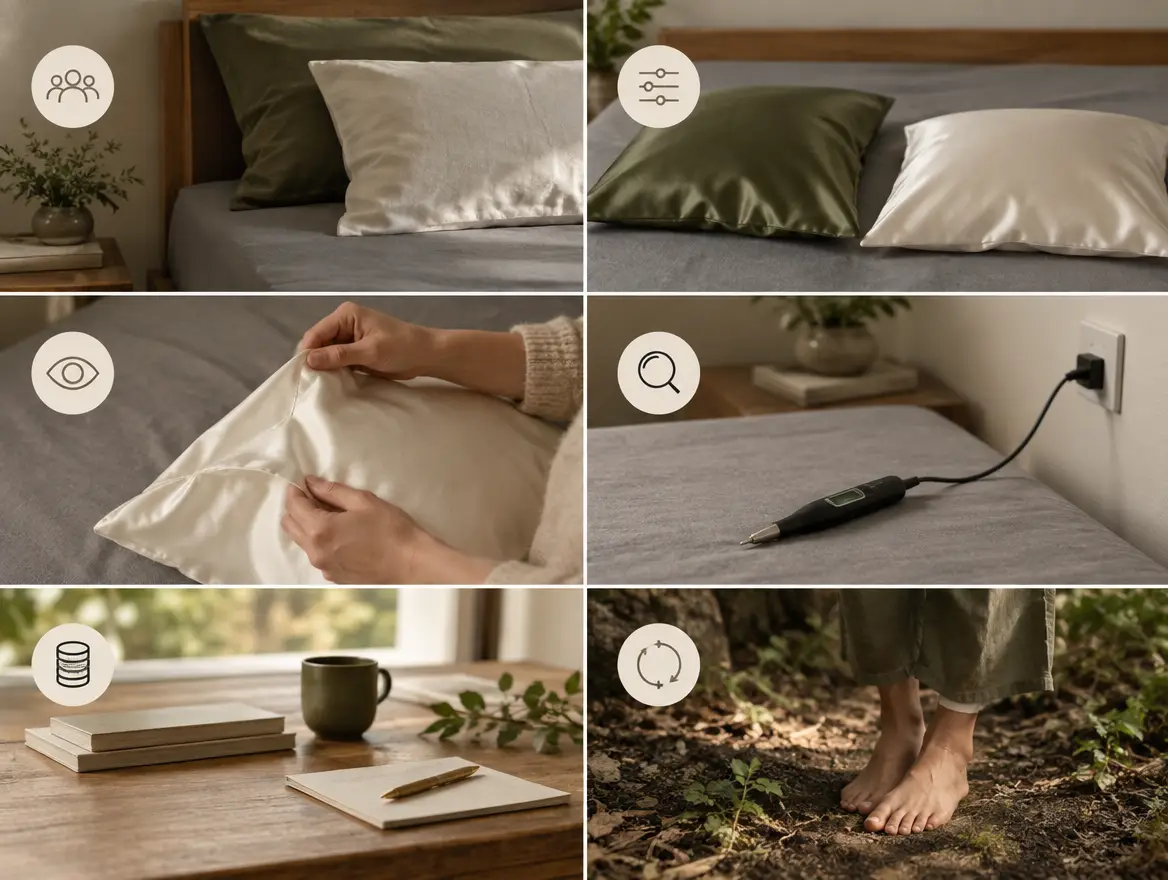
Published grounding studies are small, and each one measured something narrow, such as a hormone level, a sleep questionnaire or a pain rating. Read each as a description of one design in one group of people, not as a result that applies to you.
Our evidence page lists the studies we point to. For each, it gives the source link, the sample size, the design (controlled, blinded or neither), what was measured and its limits. I keep those details on that one page so they stay in one place and can be corrected. I have not restated every figure here, and I do not summarise any study as a result.
An example of what you will find
The 2012 paper by Chevalier and colleagues in the Journal of Environmental and Public Health is widely cited in this area. It is a review, which means it gathers and discusses earlier work rather than running a new trial. A review can be useful for orientation. It is not the same as a large, independent, repeated experiment, and it carries the limits of the studies it draws on.
How to read any grounding study
When you open a study, run it through the same checks every time:
| Check | Why it matters |
|---|---|
| Sample size | Small groups can show differences that disappear with more people |
| Controlled or not | Without a comparison group, you cannot separate the effect of the intervention from everything else |
| Blinded or not | If participants know whether they are grounded, expectation can colour what they report |
| What was measured | A hormone sample, a questionnaire and a diary are different kinds of evidence |
| Who funded it and who wrote it | Links to a product company do not make a study wrong, but you should know about them |
| Was it repeated | A single study is a starting point, not a settled answer |
None of this means the studies are worthless. It means they are early. A fair reading is that people have asked an interesting question and the answers so far are tentative.
What Is Not Known
Several things are unknown: whether the small findings hold in larger groups, whether independent teams can repeat them, and how grounding would work at all. There is no established mechanism. Anyone who states what grounding does to your body is claiming more than the evidence supports.
Small samples
Small studies are easy to run and hard to generalise. A handful of participants cannot represent every age, sleep pattern and household. They are useful for deciding whether a larger study is worth doing.
Few replications
Science earns confidence by repetition. When different teams, in different places, find the same thing under tight conditions, confidence grows. In grounding research, that body of repeated work is thin.
Author links to the industry
Some authors in the grounding literature have links to companies that sell grounding products. That is worth knowing, and you can check the disclosure statement in each paper. I am in the same position as a seller, which is why I would rather you read the papers than take my word.
No established mechanism
A proposed explanation is not an established one. Until a mechanism is demonstrated and independently confirmed, the honest position is that how or whether grounding affects sleep is an open question.
This is also why I describe our products as a wellness product, not a medical device. We make no claims about any health condition. If you have a health concern, a GP is the right person to ask, not a product page. In Australia, the TGA regulates therapeutic goods and explains what counts as one.
What People Report, Including Nothing
People report a range of experiences with grounding products, and noticing nothing is one of the most common. Read reports as reports: honest accounts of what individuals felt, not evidence of cause. Both a quiet first month and a noticeable first week are normal.
Why reports are not the same as results
Sleep is affected by temperature, stress, caffeine, mattress, season and what happened yesterday. When you add a new product to your bed, you also change your routine and your expectations. A report tells you what one person experienced. It cannot tell you why.
That applies in both directions. A glowing review does not prove an effect, and a flat one does not prove there is none.
The first 30 nights
Some people notice something in the first week, many notice nothing until the third week, and a good number notice nothing at all. I won't promise you a timeline, because I can't. What I can say is that all of those outcomes are normal, which is why our trial runs 90 nights rather than a fortnight.
A practical way to use that time: keep your routine steady, make a short note each morning, and run the tester pen check at setup and now and then after. If you notice nothing by the end of the trial, that is a valid answer, and returning the product is a reasonable choice.
If you are a hot sleeper
If you are 50+ and weighing a mat against sheets for cooler nights, the question is partly about the textile. A mat is a separate layer, and sheets are the bedding you sleep in. Which feels better depends on what each is made from, so read the materials on the product page and ask the same questions below. For the sheet side of the comparison, see do grounding sheets work.
How to Judge a Mat Before Buying
Judge the textile first, then question every brand, ours included. Ask what standard a product is certified to, what was tested and what the certificate covers. A badge on a product page is a starting point for questions, not an answer.
Questions to ask any grounding brand
These are the questions I would ask, and I want you to ask them of us as well:
- What is it actually made from?
- What makes it conductive, and what conductive material is used?
- Can you test the conductivity yourself?
- How does it connect to ground?
- What testing or documentation does the company have? Certified to which standard, and what does it cover?
If a brand cannot answer these plainly, that tells you something. If it answers with adjectives instead of standards and certificate numbers, that tells you more.
What OEKO-TEX Standard 100 tests, and its limits
Our products carry OEKO-TEX Standard 100 certificate SH025 231655. The certificate is held through our manufacturing partner, who is certified at Product Class I, the strictest class. OEKO-TEX Standard 100 tests textiles for harmful substances. It does not test whether a product is conductive, how long it lasts, or whether it improves sleep.
Scope matters too. A certificate covers the articles and materials listed on it, not everything a brand sells. So check that the product you are buying is covered, and check the certificate number against the issuing body's own verification tools. We publish our certificate numbers so you can do exactly that.
For the grounding sheets, there is a second document. The RoHS compliance certificate CHHB26080392392 relates to restricted substances in the sheets. It does not describe the mat, and I would not want you to read it that way.
Words that need a standard behind them
Words like organic, certified, tested and chemical-free are specific in certification, and loose on a product page. Attach the word certified to a named standard and a number. If it is not followed by one, ask why. Also check any company's refund terms in writing, because those matter as much as the badge.
Test it before you believe it
The offer I can stand behind is proof you can check yourself:
- A tester pen in every box, so you can see the conductive path for yourself.
- A 90-night trial from delivery. Sleep on it for 90 nights, decide later. Returns need to be in reasonable condition, and return postage is on you.
- A 1-year warranty.
- Certificate numbers published on the site.
These sit alongside your rights under Australian Consumer Law, which the ACCC explains on its website. We do not lead with price promotions. A certified product cannot argue with a clearance voice, and I don't want customers to trust us because we've written premium on a website.
If you want to see the mat itself, start with the certified grounding mat page, or browse the wider grounding mats range.
Why I Think the Textile Deserves More of the Argument
The grounding category argues about whether grounding works, and almost nobody talks about the textile you are lying on for eight hours a night. I think that is backwards. Whether grounding does anything for sleep is open. What touches your skin every night is a question with an answer you can check.
I came to this through materials, not grounding. I had become conscious of what I put against my skin, so I was already choosing natural fabrics where I could. When I found grounding, I could not find a product that combined it with the quality and aesthetic I wanted in my own home. What I saw was clinical, generic or sold on price.
When I started selling grounding products, I wanted to know what was in them, with independent testing behind it, particularly for harmful or restricted substances. So I chose OEKO-TEX Standard 100 and separate RoHS testing on the grounding bedding, and I accepted higher cost and a more complicated supply chain. The result is that we can publish certificate numbers instead of adjectives.
That is the idea I call two kinds of claim, and I keep them apart in every article:
- What the product is and what it has been tested for. Materials, certificate numbers, standards, scope. These are checkable.
- What grounding does for sleep. Small published studies, their sample sizes and their limits. This is an open question.
Mixing the two is how a good certificate ends up lending credibility to a health claim it never covered. An OEKO-TEX certificate says nothing about sleep. A study about sleep says nothing about whether the fabric was tested for harmful substances.
My contrarian position is simple: question every brand's claims, mine included. A badge can look impressive with very little behind it. If shoppers asked certified to what standard, and what does it cover? more often, the whole category would be better for it. That is the premium, transparent end of grounding I am trying to build, and it only works if you can check it.
References
- Chevalier G, Sinatra ST, Oschman JL, Sokal K, Sokal P. Earthing: Health Implications of Reconnecting the Human Body to the Earth's Surface Electrons. Journal of Environmental and Public Health, 2012
- OEKO-TEX, STANDARD 100 by OEKO-TEX
- European Commission, Restriction of Hazardous Substances (RoHS) Directive
- ACCC, Consumer rights and guarantees
- Therapeutic Goods Administration, Australian Government
Take this with you
Your first 30 nights, in your inbox.
What people usually notice in the first month on a grounding sheet, week by week, and why you get 90 days rather than 14.
Questions people ask
Do grounding mats really work?
A mat reliably does one thing: it connects your skin to a socket's earth pin, which the tester pen can confirm. Whether that improves sleep or anything else is not established. Published studies are small, few have been repeated, and many people notice nothing. It is a wellness product, not a medical device.
How do I check a grounding mat is working?
Connect the cord to a socket, then use the tester pen from the box on the mat surface, following the included instructions. If the pen shows no connection, try another socket first, because the socket may not be earthed. Check at setup and again over time.
Can I use a grounding mat in a rental?
Often yes, because the mat plugs into an existing socket and needs no installation. The risk is a socket that is not properly earthed. Test with the pen, try another socket, and if you suspect a wiring fault, ask your landlord or property manager to have a licensed electrician check it.
Is a grounding mat a medical device?
We sell grounding mats as a wellness product, not a medical device, and we make no claims about any health condition. If you have a health concern, speak to your GP. The TGA explains how therapeutic goods are regulated in Australia.
Should I choose a grounding mat or grounding sheets?
The connection principle is the same, but the product is different: a mat is a separate layer, and sheets are the bedding you sleep in. Compare the materials, what each is certified to and what it covers. For hot sleepers, the textile matters, so read the product pages closely.
How long before I notice anything?
There is no reliable timeline. Some people notice something in the first week, many notice nothing until the third week, and some notice nothing at all. All are normal, which is why our trial runs 90 nights from delivery.