Silk · 24 Nov 2026 · 15 min read
Silk vs Satin Pillowcase: What the Label Means and How to Tell Them Apart
Satin is a weave and silk is a fibre. Learn how to read a pillowcase label, spot 'silk-feel' wording and ask the right questions before you buy online.
By Jade Castle, founder. Wellness product, not a medical device.
Part ofThe silk guide
Satin is a weave and silk is a fibre, so a 'satin' pillowcase can be polyester, nylon or silk. To tell them apart, read the fibre content line and percentage on the label first, not the product name or the shine.
Search for a silk pillowcase in Australia and you will see 'silk', 'satin', 'silk satin' and 'silk-feel' listed side by side, often in near-identical photos. The words overlap, so the confusion is understandable. It is not a shopper's fault when two very different fabrics wear the same name.
This guide answers one question only: how do you read the label and tell the two apart? I'm Jade Castle, founder of Organic Earthing. I judge a fabric on what it is made of and what it has been tested for, and I think you should question every label, including ours. I'll also be fair to satin throughout, because it has a real place.
Key Takeaways
- Satin describes how a fabric is woven. Silk describes what the yarn is made of. They are two different questions.
- Shine alone cannot identify the fibre. Polyester satin often looks glossier than silk.
- The fibre content line is the first thing to read. '100% mulberry silk' names a fibre and a share. 'Satin finish' and 'silk-feel' do not.
- When a label is vague, ask for the fibre percentage, the momme weight, the certificate number and what that certificate covers.
- Silk feels breathable and softens with gentle washing. Polyester satin is sturdier and easier to machine wash. Both are fair choices for different households.
Summary Table: What Common Label Wording Usually Means
| Label wording | What it usually means | What to check next |
|---|---|---|
| 'Full mulberry silk' | Silk fibre, named and stated as the full content | Momme weight, certificate number and scope |
| 'Silk satin' | Silk fibre woven in a satin weave | That the fibre line actually says silk, and whether it is a blend |
| 'Satin' on its own | A weave, with the fibre unstated | The fibre content line, which is often polyester or nylon |
| 'Satin finish' | A look or a finished surface, not a fibre | The fibre content line |
| 'Silk-feel' or 'silky' | A handle that imitates silk, often polyester or nylon | Whether silk appears anywhere in the fibre line |
| 'Certified' with no number | A claim, not yet evidence | The standard, the number and what it covers |
Weave Versus Fibre: Why Shine Tells You Nothing About What a Pillowcase Is Made Of
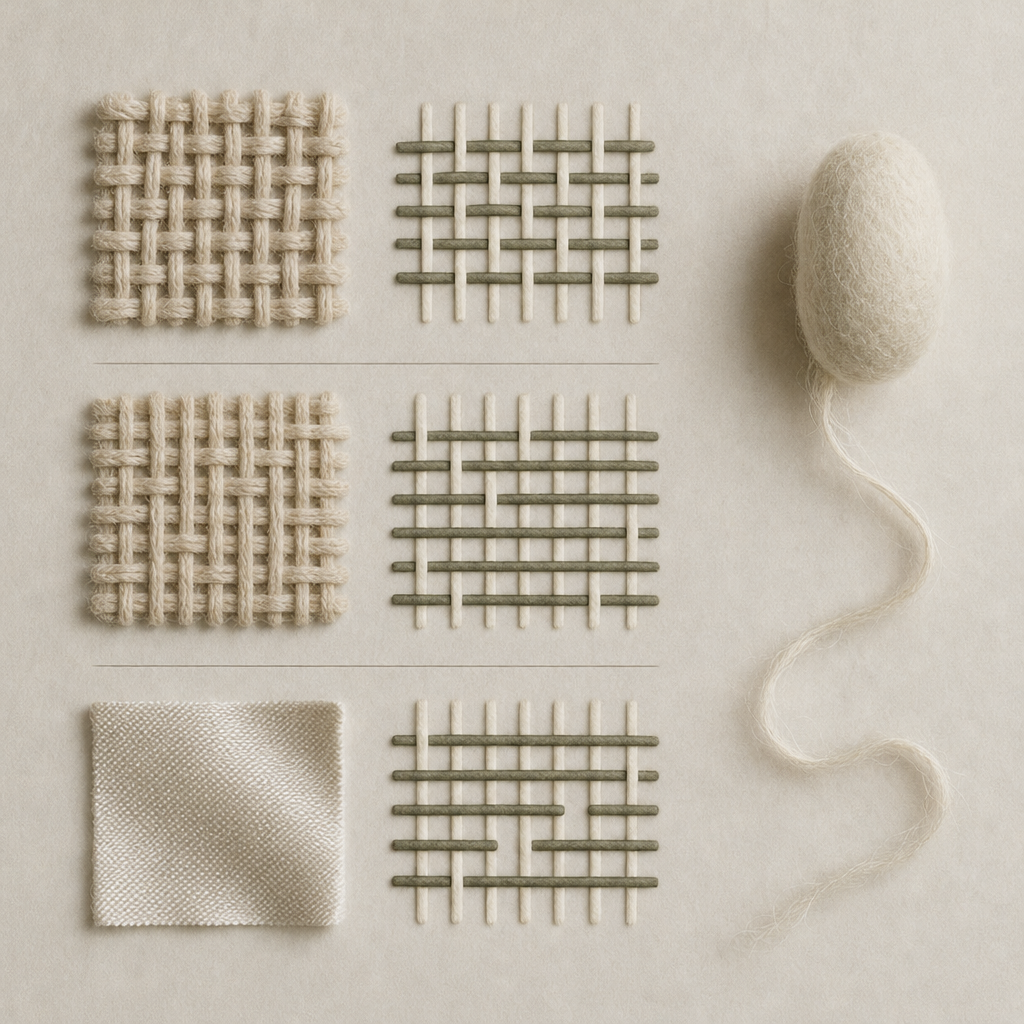
A weave is how yarns cross each other. A fibre is what the yarn is made of. Satin is a weave that floats yarns over several others, which creates a smooth, reflective face. Silk is a natural protein fibre from silkworm cocoons. Because any filament yarn can be woven as satin, shine cannot identify the fibre.
In a plain weave, yarns pass over one and under one, like a basic grid. In a satin weave, each yarn floats over several others before it is tied down. Those long floats lie flat and catch light evenly. That is where the glossy face and slippery handle come from. Britannica describes satin as a weave, not a fibre.
Historically, satin was woven from silk, and that is where the confusion starts. Today the same weave is used with man-made filament yarns such as polyester and nylon, and with silk. You may also see 'charmeuse', which is a lightweight satin-weave fabric. Again, the fibre is a separate question from the weave.
This means there are two questions to ask of any pillowcase:
- How was it woven? Satin, or something else.
- What is it made of? Only the label, and the paperwork behind it, can answer that.
A photo answers neither reliably. Polyester satin often looks glossier than silk, because man-made filaments are uniform and smooth. Silk tends to have a softer, deeper glow. Gloss is not a grade of quality in either direction, and it is a poor way to identify a fibre.
If you want to see what silk looks like when it is woven this way, have a look at our silk pillowcases and eye masks. Then judge them the way this guide suggests: by the fibre line, not the sheen.
How to Read a Silk or Satin Pillowcase Label
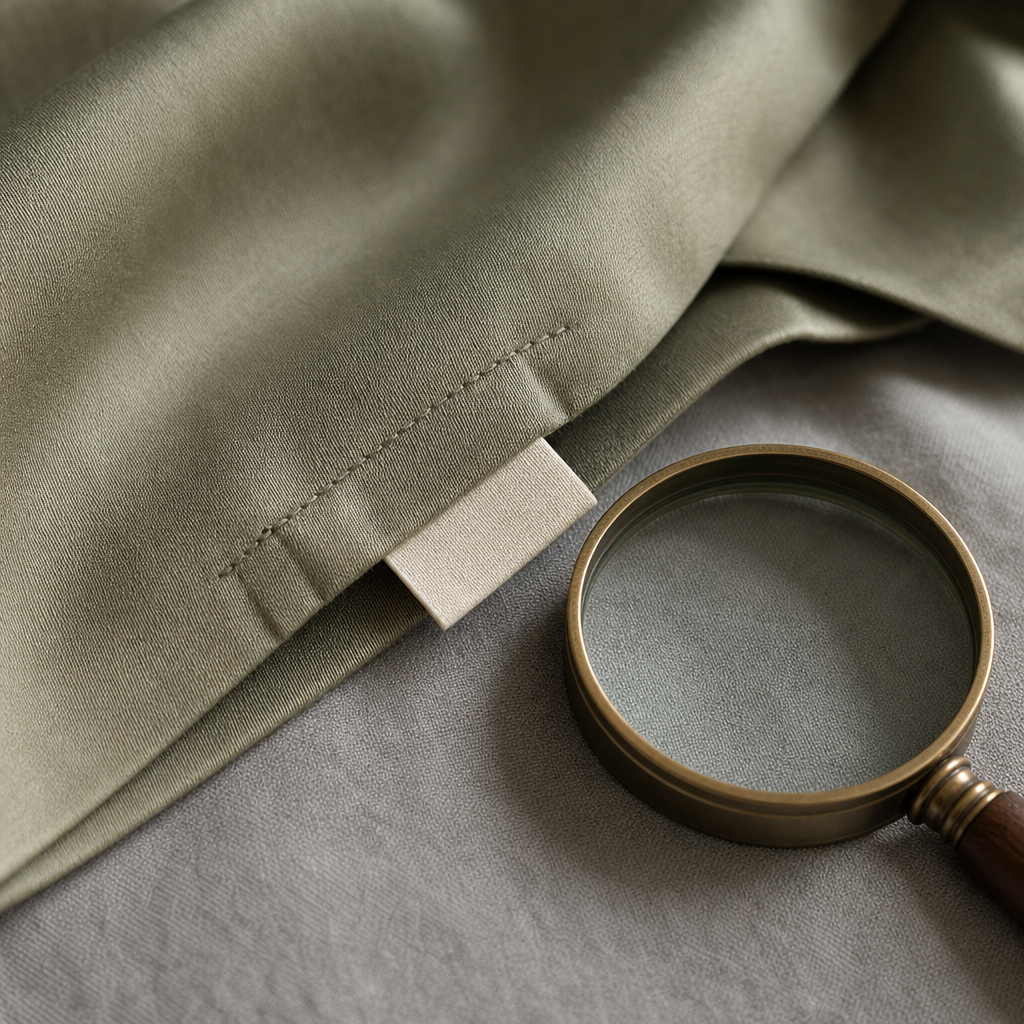
Read the fibre content line first. '100% mulberry silk' names the fibre and the share. 'Silk satin' usually means silk fibre in a satin weave. 'Satin finish' and 'silk-feel' describe look and handle, and they often point to polyester or nylon. Only a stated fibre percentage settles the question.
The product title is written to attract a click. The fibre content line is written to describe what you are buying. Where they disagree, believe the fibre line, and if there is no fibre line, you have found your first gap.
'100% mulberry silk'
This names the fibre and the percentage in one phrase. Mulberry silk comes from silkworms fed on mulberry leaves, and it is the most widely cultivated silk used in bedding. According to Britannica, silk is a natural fibre produced by silkworms. It is the strongest wording you can find, but it is still a claim. The next questions are weight and documentation, which we cover below.
'Silk satin'
This usually means silk fibre in a satin weave, which is a perfectly good fabric. The catch is that the phrase is sometimes used loosely. Check that the fibre line says silk, and check whether it is silk alone or a blend with something else.
'Satin finish' and 'satin' on its own
Both describe a weave or a surface look. Neither names a fibre. 'Finish' can also describe how a fabric was processed after weaving, so it says even less about what the yarn is. When satin is sold without a fibre line, it is most often polyester or nylon, but 'most often' is not a label. Look for the line.
'Silk-feel', 'silky' and 'faux silk'
These describe how the fabric handles, not what it is. They are most often used for polyester or nylon. That is not a flaw. A seller who writes 'silk-feel polyester satin' is being straightforward. The problem only arises when the shopper reads 'silk' and assumes a fibre.
Where to look
Check the product page specification, the tag sewn into the pillowcase, and the packaging. All three should agree. If a listing offers adjectives and no fibre composition, regard that as missing information, not a minor detail. In Australia, the ACCC publishes guidance on false or misleading claims, and Australian Consumer Law applies to goods sold online. That is a useful backstop, but it is quicker to check before you buy.
What to Ask When the Label Is Vague
Ask four things: the fibre percentage, the momme weight, the certificate number and what that certificate covers. A seller with real documentation answers quickly and specifically. Vague replies, or replies that only repeat the marketing line, are information too.
These are the questions I would ask any brand, and I would want you to ask them of us.
- What is the fibre, and what percentage? 'Silk' is not an answer. '100% mulberry silk' is. A blend should state each fibre and its share.
- What is the momme weight? Momme is a silk measurement, so it should appear on silk and not on polyester. I explain what the number means in our journal guide to 22 momme silk pillowcase weight, so I won't repeat it here. For label reading, the point is simple: a stated momme weight is a sign the seller is describing silk as silk is described.
- What is the certificate number? A badge on a page is not a number. A number can be checked. OEKO-TEX provides online tools for verifying its certificates and labels, so ask for the number and look it up.
- What does the certificate cover? Certified to what standard, and what does it cover? A certificate can relate to a fabric, a factory or a finished product. A logo on a page does not say which.
One point trips up many label readers. A certificate and a fibre are separate questions. OEKO-TEX Standard 100 is a test for harmful substances in textiles. It tells you the textile was tested against that standard. It does not tell you the fibre is silk. You need the fibre line for that, and the certificate for the other.
Feel and Washing: How Silk and Polyester Satin Differ Day to Day
Silk feels breathable and softens with gentle washing. Polyester satin is sturdier and easier to machine wash. Neither is wrong. The choice comes down to whether you value the handle of a natural fibre or the low-fuss routine of a synthetic one, and how much effort you will put in each week.
Feel. Silk is a natural fibre with a soft, fluid handle. Many people find it feels breathable against the body, and it tends to soften with gentle washing. Polyester satin has a slick, uniform glide and holds its shape well. Some people love that glide. Others find synthetic fabrics feel warmer at night, since polyester absorbs less moisture than natural fibres.
That last point matters if you are a hot sleeper, and it deserves honesty. Temperature at night depends on your bedding, your room, your mattress and your own body. A pillowcase is one small part of that. If you run warm, the fibre is worth weighing, but I won't promise any fabric will change your night.
Washing. Silk asks for a gentler routine:
- Cool water and a gentle cycle, ideally in a wash bag, or hand wash.
- A mild detergent made for delicates or silk.
- No wringing, and dry away from direct sun.
Our silk guide covers the full routine step by step. Polyester satin is more forgiving. Most can go in the machine on a standard gentle cycle, they dry quickly and they tolerate a rougher household routine. Always follow the washing instructions on the tag, whatever the fibre.
Be honest with yourself about the routine you will actually keep. A silk pillowcase that is washed gently lasts well. A silk pillowcase thrown in a hot wash with towels will not. If that second household is yours, polyester satin is the sensible choice, and there is nothing second-rate about it.
When Satin Is a Fair Choice
Polyester satin is a fair choice when budget, kids' rooms, travel or low-fuss washing matter most. It is smooth, durable and forgiving. Both smooth weaves offer less friction, less frizz and fewer sleep creases than rougher fabrics, so you do not need silk to get those things.
Here is where I would happily recommend satin:
- Budget. Polyester satin costs less to make, so it usually costs less to buy. If you are trying a smooth pillowcase for the first time, it is a reasonable way to find out whether you like the feel.
- Kids' rooms. Sticky hands, spills and constant washing are tough on any fabric. A sturdy satin that survives the machine is a practical pick.
- Travel. It packs small, dries quickly and does not need babying in a hotel bathroom.
- Low-fuss washing. If you want to toss it in with the rest of the bedding, satin suits you.
The smooth weave is doing the work in all of these. Less friction as your head moves, less frizz and fewer sleep creases come from the surface being smooth, which satin delivers whatever the fibre. We compare silk with cotton for sleep in a separate journal piece, because the gap between a smooth weave and a rougher one is where most of the difference lies.
The only condition I would add is that you buy satin knowing it is satin. A pillowcase labelled '100% polyester satin' that is priced and described as such is an honest product. I would rather you buy that than a vaguely labelled 'silk' you cannot verify.
What Ours Are: 22 Momme Mulberry Silk With OEKO-TEX Standard 100
Our pillowcases are 22 momme mulberry silk with OEKO-TEX Standard 100 certification (certificate SH025 231655). That is the whole claim. The fibre is silk, the weight is 22 momme, and the certificate is to a named standard with a number you can look up.
Two kinds of claim sit in that sentence, and I keep them apart. One is what the fabric is: mulberry silk, at 22 momme. The other is what it has been tested for: OEKO-TEX Standard 100, which tests textiles for harmful substances. I make no health claims about either. A pillowcase is a wellness product, not a medical device, and I write as a founder and a mother, not a clinician.
Now put any label next to ours. Compare the fibre line, the momme weight, the certificate number and what the certificate covers. If another label answers all four, good. If it answers fewer, you have learned something.
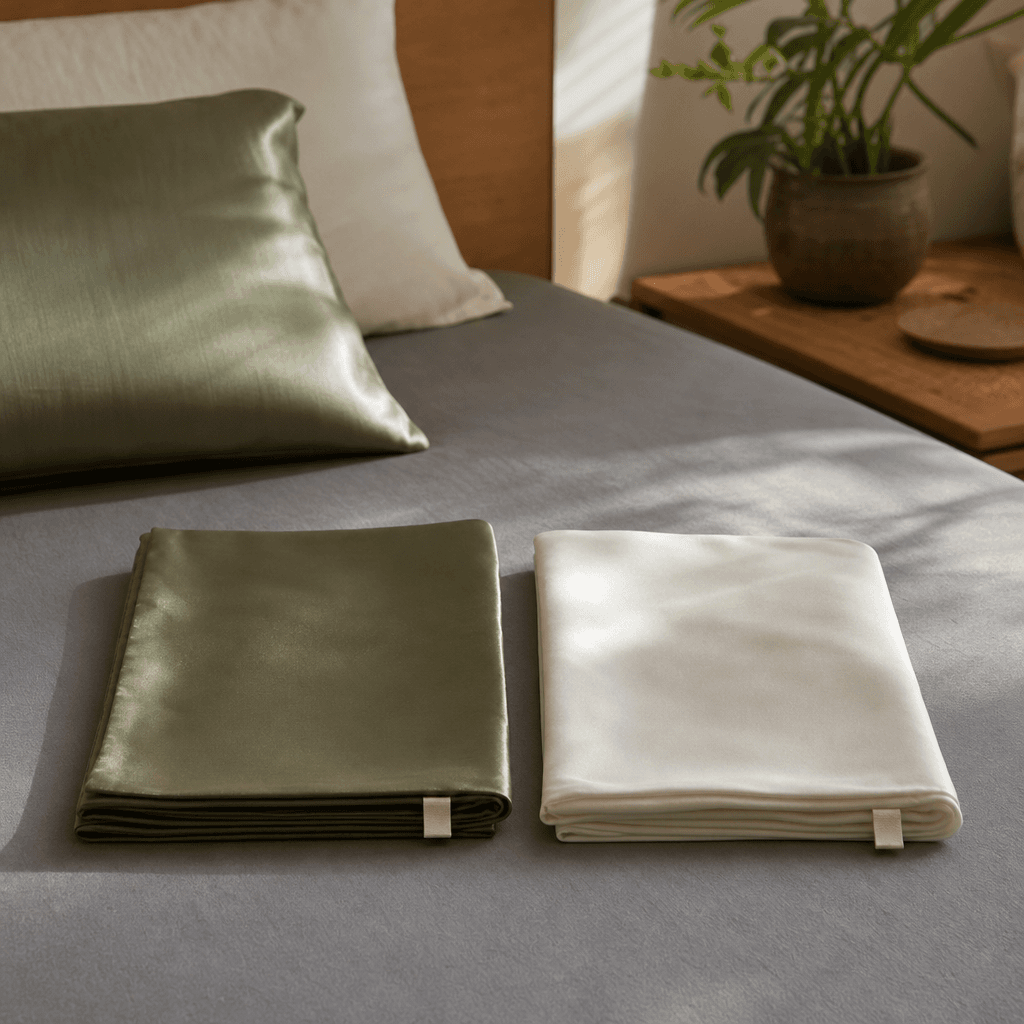
When you are ready, view the mulberry silk pillowcase in natural white or the mulberry silk pillowcase in olive green. Both come with a 90-night trial: sleep on it for 90 nights, decide later. You can also browse everything we make.
Why I Judge the Textile First, and Why You Should Question Our Label Too
Before I started Organic Earthing, and before I had even heard of grounding, I was already choosing natural fabrics for my own skin. I had become conscious of what touches your skin every night, and I wanted to know what was in the things I slept on and wore. That habit came before the brand, and it is the reason the brand exists.
When I did find grounding and went down the rabbit hole, I noticed something odd. Everyone argued about whether grounding works. Almost nobody talked about the textile you lie on for eight hours a night. Products felt clinical, generic or led with price. I wanted to know what was in what I was selling, with independent testing behind it, particularly for harmful or restricted substances.
So I chose OEKO-TEX Standard 100, and I accepted a higher cost and a more complicated supply chain to get it. The result is that we can publish certificate numbers instead of adjectives. I don't want customers to trust us because we've written 'premium' on a website. I want there to be something behind it that you can check.
That is also why I'd push you to question every label, including ours. Words like 'certified', 'tested' and 'natural' can sound identical whether there is a lot behind them or very little. Certified to what standard, and what does it cover? Consumers asking that more often would be good for the whole category, and for us.
Here is my contrarian view for this topic. A well-labelled polyester satin pillowcase is a better purchase than a vaguely labelled 'silk' one. Honesty about the fibre beats a prestige word you cannot verify. Silk is lovely, and I'm biased, but the label decides whether you are buying what you think you are buying.
References
- Britannica, Satin
- Britannica, Silk
- OEKO-TEX, official website: STANDARD 100 and certificate checks
- ACCC, False or misleading claims
Take this with you
Caring for mulberry silk, in your inbox.
How to wash, dry and store 22 momme mulberry silk pillowcases and eye masks so they stay smooth for years.
Questions people ask
Is satin the same as silk?
No. Satin is a weave and silk is a fibre. Silk can be woven as satin, but polyester, nylon and other filament yarns can be woven as satin too. The fibre content line on the label tells you which one you are buying, so check that before the product name.
Is a 'silk satin' pillowcase real silk?
Usually it means silk fibre in a satin weave, but the phrase is sometimes used loosely. Check the fibre content line for a stated silk percentage. If the line says polyester or lists no fibre at all, the words 'silk satin' are describing a look rather than the material.
Which is cooler, a silk or a satin pillowcase?
It varies by person and by room. Silk is a natural fibre that many sleepers find breathable, while polyester satin absorbs less moisture and can feel warmer to some. Your bedding, bedroom temperature and mattress matter as much. No pillowcase can be promised to change how warm you sleep.
How can I tell if a pillowcase is real silk?
Start with the fibre content line on the tag and product page, looking for '100% silk' or '100% mulberry silk'. Then ask for the momme weight, the certificate number and what the certificate covers. Feel and shine alone are unreliable, because man-made satin can imitate both.
Can I machine wash a satin pillowcase?
Most polyester satin can be machine washed on a gentle cycle, and it dries quickly. Silk generally needs cool water, a mild detergent and no wringing. Whatever the fibre, follow the washing instructions on the pillowcase's own tag, since finishes and blends differ.