Grounding · 5 Oct 2026 · 19 min read
Grounding Sheet Colours and Materials: What Changes, What Doesn't, and How to Check
Colour is styling. Material decides comfort, conductivity and what touches your skin. Learn how to check bamboo, silver thread and certificates yourself.
By Jade Castle, founder. Wellness product, not a medical device.
Grounding sheet materials matter more than colour. Colour is a styling choice and should not change conductivity. The base fabric decides comfort and breathability, the woven silver thread decides conductivity, and independent certificates show what the textile has been tested for. Check the fabric, the silver content and the certificate numbers before you pick a colour.
I started Organic Earthing before I had heard of grounding. I had already become conscious of what I put against my skin, so I was choosing natural fabrics where I could. When I did find grounding, I could not find bedding that matched the materials and the look I wanted in my own home. Most of what I saw was clinical, generic or led with price.
This guide is for the reader who checks labels, reads the returns policy and doubts big claims. It covers what colour does and does not change, how base fabrics compare, what silver thread does, how to read certificates (including ours), and how to test a sheet yourself. Nothing here is a health claim. A grounding sheet is a wellness product, not a medical device.
Key Takeaways
- Colour is a styling decision. Dye should not change conductivity, but dyes and finishes are a good reason to check textile certification.
- The base fabric is what you feel for eight hours. Organic bamboo, cotton and synthetic blends differ in feel, breathability and moisture handling.
- Bamboo alone is not conductive enough. The silver thread has a job to do, and weave and ratio decide how well it does it. Ours is 10% silver thread.
- Ask of every certificate: certified to what standard, and what does it cover? Apply that to us as well.
- Test it before you believe it. A tester pen comes in every box, with a 90-day trial from delivery and a 1-year warranty.
Summary Table
| Factor | Does it change conductivity? | What it changes | How to check |
|---|---|---|---|
| Colour and dye | Should not | Look of your bedroom, plus a question about dyes and finishes | Check the certificate covers the textile you are buying, then use the tester pen |
| Base fabric (bamboo, cotton, synthetic) | Not on its own | Feel, breathability, moisture handling, warmth | Read the fabric composition and the fibre processing details |
| Silver thread | Yes, it is the conductive material | Whether the sheet can carry a grounding connection | Ask for the silver percentage, how it is woven, and test with the pen |
| Textile certification (OEKO-TEX harmful substances standard) | No | What the textile has been tested for in terms of harmful substances | Look up the certificate number with the issuer |
| Compliance testing (RoHS) | No | Restricted substances testing on the grounding bedding | Ask for the certificate number and scope |
| Silk pillowcase pairing | Not a grounding component | Comfort and temperature feel at face level | Check momme weight and certification scope |
Does Grounding Sheet Colour Affect Conductivity?
No. Colour should not change how a grounding sheet conducts. Conductivity comes from the silver thread woven through the fabric and its connection to ground, not from the dye. What colour does change is styling, and it is a reason to check what dyes and finishes the textile has been tested for.
The logic is simple. A grounding sheet conducts through fine silver fibres running through the weave. Dye colours the bamboo yarn. It does not replace the silver, and it is not the conductive path. So choosing one colour over another should not make a sheet more or less conductive.
I will add one caveat, because I am sceptical of tidy claims too. Logic is not proof. The only way to know that your sheet in your colour is conducting is to test it. That is why every box includes a tester pen. Use it on whichever colour you choose.
Why colour is still worth thinking about
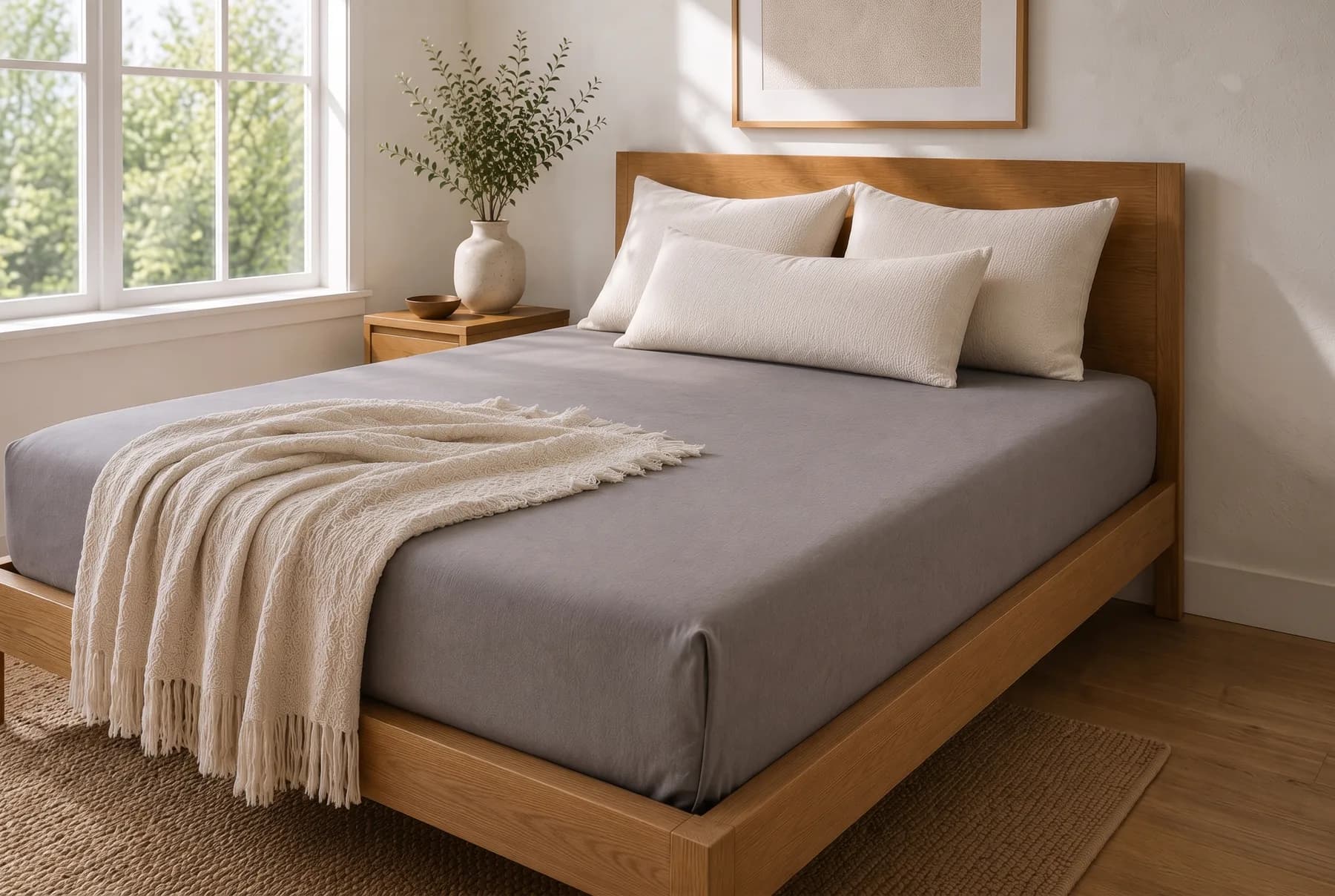
Colour is a legitimate buying criterion. You are putting a large piece of fabric in the centre of your bedroom. I wanted grounding bedding that looked like it belonged in a home, not in a clinic. If a colour suits your room, that is a good reason to choose it.
Dye is also the point where I would slow down and ask questions. Textiles are dyed and finished with chemicals, and what is left in the fabric ends up against your skin. That is what touches your skin every night.
This is where certification earns its place. OEKO-TEX Standard 100 tests textiles for harmful substances, and its testing includes colourants. So the useful question is not "which colour conducts best?" It is "does the certificate cover this textile, and can I look it up?"
OEKO-TEX runs a public Label Check on its website where you can enter a certificate number and see what it covers. Our current colour range is shown on the organic bamboo grounding sheet product page. I have not listed colours here, because the range can change and the product page is the source of truth.
Which Base Fabric Is Best: Organic Bamboo, Cotton or Synthetic Blends?
For most sleepers, organic bamboo is a strong base for a grounding sheet. It is soft, breathable and handles moisture well. Conventional cotton is comfortable but can feel heavier when damp. Synthetic blends tend to hold heat and feel less breathable. The base fabric is what you feel for eight hours, so it deserves most of your attention.
The category argues endlessly about whether grounding works. Almost nobody talks about the textile. That is the wrong order. You spend roughly a third of your life with your skin on this fabric. Judge the textile first.
Organic bamboo
Bamboo fabric is known for a smooth, soft hand and for moving moisture away from the skin. Those two traits matter most for hot sleepers, including the 50+ reader who wants cooler, more breathable bedding. Our sheets are organic bamboo, OEKO-TEX Standard 100 certified. Those are two separate statements, and I keep them separate on purpose.
Here is the honest caveat on the word "bamboo". Bamboo fabric is usually made by processing the plant into a fibre, so how it is processed matters. Ask any brand how the fibre is made and what the textile has been tested for. A brand that cannot answer is telling you something.
The word "organic" is not covered by OEKO-TEX. OEKO-TEX Standard 100 is about harmful substances in the finished textile, not farming methods. I will come back to this in the certificates section.
Conventional cotton
Cotton is familiar and comfortable, and plenty of people sleep well on it. As a base for grounding it has the same problem as bamboo: it does not conduct on its own, so it needs a conductive material added. Cotton can also feel heavier and slower to dry than bamboo, which some hot sleepers notice.
If you prefer cotton, apply the same questions. What is the conductive material, how much of it is there, and what has the textile been tested for?
Synthetic blends
Synthetic blends are often cheaper and durable. They also tend to trap heat and feel less breathable against skin. For a hot sleeper, that is the wrong trade. If a grounding sheet is a blend, check the fibre percentages on the label and ask what the non-natural component is.
A grounding sheet that you put up with because it grounds is a poor outcome. I did not want to make that product. I wanted a sheet you would choose even if you took the grounding out.
What this means for hot sleepers
If you run warm, start with breathability and moisture handling, then check the silver and the certificates. I cannot promise that any sheet will make your nights cooler. Room temperature, mattress, doona and sleepwear all play a part. But the base fabric is the layer closest to you, and it is the easiest one to get right.
What Does 10% Silver Thread Do in a Grounding Sheet?
Silver thread is the conductive part of a grounding sheet. Fine silver fibres woven through the bamboo carry the connection from the cord to your skin, while the bamboo keeps the sheet soft and breathable. Our sheets contain 10% silver thread. Weave and ratio matter because they decide how continuous the conductive path is.
Bamboo on its own is not conductive enough to ground a body. So the silver has a job to do, and it does only that job. The bamboo handles softness, breathability and moisture. Neither material is there because it sounds good in marketing.
Woven through, not coated on top
Our silver fibres are woven through the bamboo. They are not coated over the surface. A coating sits on the outside of the fabric, and you would reasonably ask what happens to it with use. A woven fibre is part of the textile structure.
I will not overstate this. I do not claim that weave guarantees durability, and I do not tell customers to expect a fixed lifespan. What I recommend is checking conductivity when you first set the sheet up and again over time. That is a check, not a guarantee.
Why the ratio matters
The silver percentage tells you how much of the fabric is conductive material. Ours is 10%, which is our product specification. The competitors we have looked at state 5% or less. That is our own comparison, so check it against the brands you are considering.
A higher percentage does not prove a better sheet on its own. Ratio and weave work together, and the real test is whether the sheet conducts when you check it. But if a brand will not tell you the percentage, ask again. It is a basic specification.
How it connects to ground
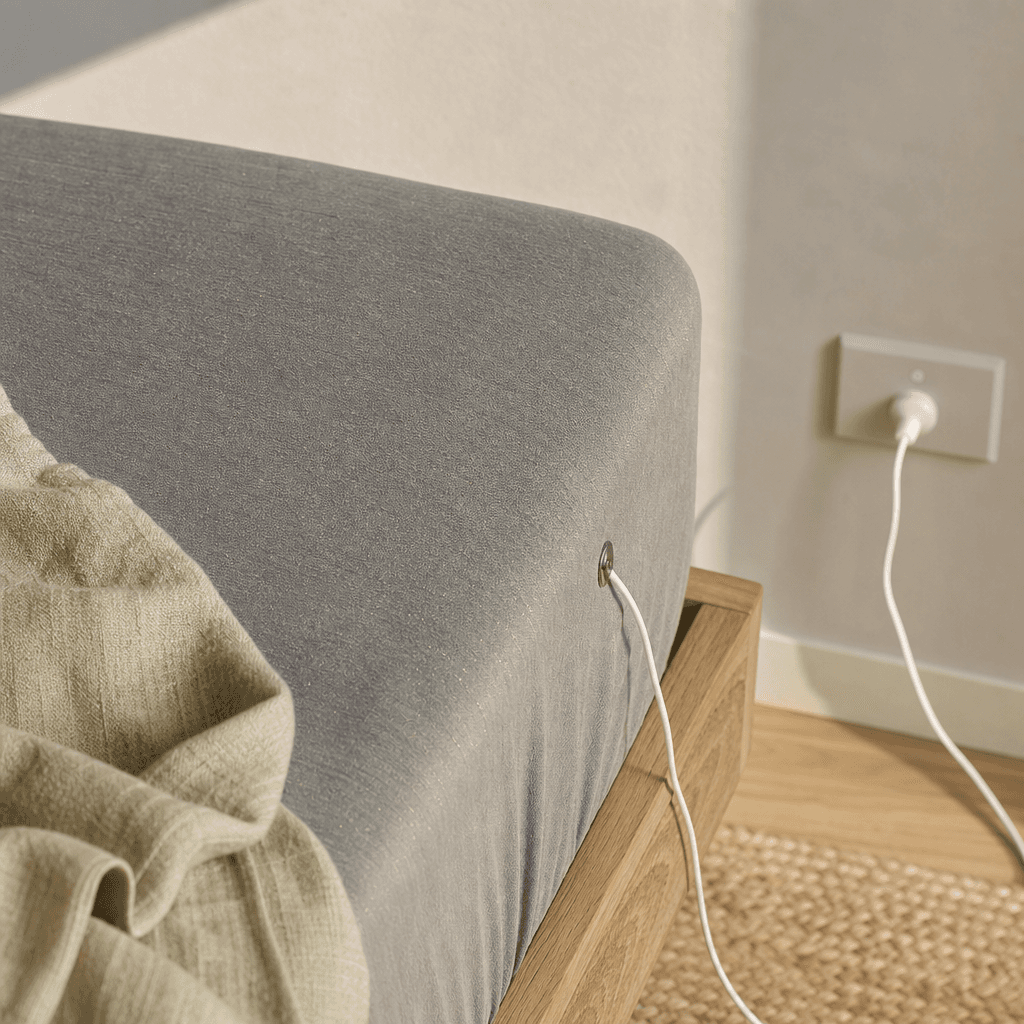
A grounding sheet connects by a cord to the earth pin of a wall socket. No power flows through it. Only the grounding connection is used. If a brand's sheet connects differently, ask how, and check that the connection suits Australian sockets and wiring.
Some brands use stainless steel or other conductive fibres rather than silver. That is a legitimate design choice. The point is that you should know which conductive material you are sleeping on and how it is built into the fabric.
How Do You Check Grounding Sheet Certificates?
Ask three things of any certificate: which standard is it, what exactly was tested, and what does it cover? A badge on a product page answers none of those. A certificate number you can look up answers all three. Apply the same questions to us, because certified to what standard, and what does it cover, is the right test.
Certification language is specific, and a badge can look impressive with very little behind it. I would rather you question us than believe a logo. Here is what we hold and what each document does and does not tell you.
Source: Organic Earthing's own certificate records (the brand's data). Verify numbers with each issuing body.
| Certificate | Number | Applies to | What it tells you | What it does not tell you |
|---|---|---|---|---|
| OEKO-TEX Standard 100 | SH025 231655 | Textiles across our products (manufacturing partner certified at Product Class I) | Tested for harmful substances | Anything about conductivity, farming methods or sleep outcomes |
| RoHS compliance | CHHB26080392392 | Grounding sheets | Restricted substances compliance testing on the grounding bedding | That the sheet is organic or that it grounds well |
| GOTS scope certificate | USB TEX-4007-GOTS-2509 | Mulberry silk range | The silk range sits within a GOTS scope | Anything about conductivity or sleep outcomes |
OEKO-TEX Standard 100 (SH025 231655)
OEKO-TEX Standard 100 is an independent testing and certification system for textiles. It tests for harmful substances in the finished product. Product Class I is the strictest class, designed for articles for babies and toddlers. Our manufacturing partner is certified at Product Class I, and the certificate number is SH025 231655.
Most grounding sheets on the market are cotton. Ours are organic bamboo woven with silver, and the fabric is tested under Standard 100. Do not take my word for it. Look up the number on the OEKO-TEX Label Check, and compare it with what other brands can show you.
RoHS (CHHB26080392392)
RoHS is a European Union directive restricting certain hazardous substances in electrical and electronic equipment. A grounding sheet has a cord and conductive components, so I wanted separate testing on the grounding bedding. Our RoHS compliance certificate number is CHHB26080392392.
This is compliance testing about restricted substances. It is not a performance claim, and it says nothing about grounding and sleep.
GOTS (USB TEX-4007-GOTS-2509) on the silk
GOTS is the Global Organic Textile Standard. Our GOTS document, USB TEX-4007-GOTS-2509, is a supplier scope certificate for the mulberry silk range.
This is why I use the word "certified" carefully. It should always attach to a named standard and a number you can check. If you see "certified" with no standard and no number, ask what it refers to.
Questions to ask any grounding brand
These are the five questions I would ask of Organic Earthing, and of anyone else:
- What is the sheet actually made from?
- What makes it conductive, and what conductive material is used?
- Can you test the conductivity yourself?
- How does it connect to ground?
- What testing or documentation does the company have, certified to which standard, covering what?
The Australian Competition and Consumer Commission (ACCC) publishes guidance for businesses on making environmental claims, and misleading claims can breach the Australian Consumer Law. That is a good reminder that vague words like "eco" or "chemical-free" should come with specifics.
How Do You Test a Grounding Sheet Yourself?
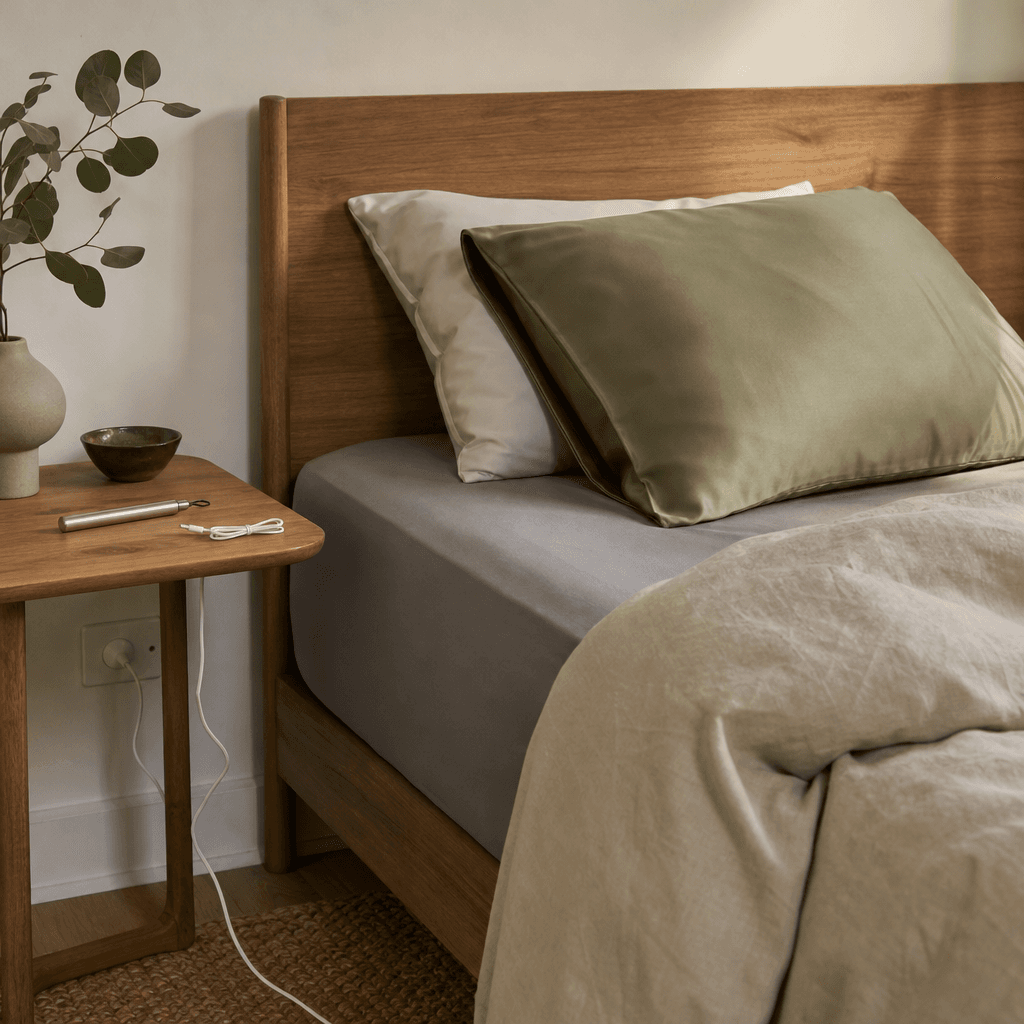
Use the tester pen that comes in every box. Set the sheet up as instructed, connect the cord to the earth pin of a wall socket, and check the pen shows a connection when you touch it to the sheet. Check at setup and again over time. The pen confirms the connection and nothing more.
This is the idea behind "test it before you believe it". A website can say anything. A pen in your hand lets you see conductivity for yourself, in your own bedroom, on the colour you chose.
When to check
Check when you first set it up. Then check again from time to time. I do not tell customers to check after every wash, and I do not offer a durability guarantee. Regular checks are simply how you stay informed about the sheet you own.
The 90-day trial and 1-year warranty
You have up to 90 days from delivery to try the sheet. If it is not for you, return it within that window for a refund. The sheet needs to be in reasonable condition and not damaged through misuse. Return shipping is on the customer. A 1-year warranty applies to every grounding product.
The trial is long on purpose. We'd rather you tested the sheet on real nights than took a product page's word for it, ours included, and the same 90 days apply on the product page, in the policy and at checkout. Sleep on it for 90 nights, decide later.
The first 30 nights
Some people notice something in the first week. Many notice nothing until the third. Both are normal, and it is one reason the trial runs 90 days. I will not promise you a timeline or a result.
Here is how I keep two kinds of claim apart. One is what the fabric is made of and tested for: organic bamboo, 10% silver thread, OEKO-TEX Standard 100, RoHS. Those are checkable. The other is what grounding does for sleep. The small published studies have not settled that question, and I treat it as open. A review such as Chevalier and colleagues (2012) in the Journal of Environmental and Public Health is an example of what the category cites, and it is worth reading critically.
What Should Hot Sleepers Pair With a Grounding Sheet?
Pair a bamboo grounding sheet with a 22 momme mulberry silk pillowcase. Both are natural fibres chosen for breathability and a smooth feel against skin, and together they cover the two surfaces closest to your face and body. This is a comfort pairing, not a treatment.
Momme is the unit used to describe the weight of silk fabric. A higher momme means a denser, heavier silk. Our pillowcases are 22 momme mulberry silk, and the silk range sits within the GOTS scope certificate noted above.
If you are a hot sleeper in your fifties or beyond and you are looking for cooler, more breathable bedding, this pairing is a sensible place to start. I cannot promise cooler nights. Your mattress, doona, room temperature and sleepwear all matter. But the sheet and pillowcase are the textiles closest to your skin, and choosing them well is within your control.
If you want both, a sheet and silk pillowcase bundle is available. It is backed by the same tester pen, 90-day trial and 1-year warranty as every grounding product. The bundles are not about a discount. They are about getting the pairing in one order.
If you are comparing fitted and flat styles, our separate post, Grounding Fitted Sheets vs Regular Fitted Sheets: What's Actually Different?, covers that question. This guide stays on materials and colour.
Why I Want You to Question Our Badges Too
I would rather a customer question us than trust a badge. I do not want customers to trust us because we have written "premium" on a website. I want there to be something behind it, and a certificate number you can look up is something.
I came to this from the textile side. I was conscious of what I put against my skin long before I had heard of grounding. When I found grounding and went down the rabbit hole, I could not find a brand that combined it with the quality, materials and look I wanted. So I built the other thing: the premium, transparent end of grounding.
When I started, I wanted to know what was in the products I was selling, and I wanted independent testing behind them, particularly for harmful or restricted substances. The category was talking only about whether grounding worked. I chose OEKO-TEX Standard 100 and separate RoHS testing on the grounding bedding. That meant higher cost and a more complicated supply chain. The result is that we can publish certificate numbers instead of adjectives.
Here is my contrarian position. Most people say a grounding product should be judged on whether grounding works. I say judge it first on what you are sleeping on: the textile, what it is made of and what it has been tested for. That question has an answer you can check today. The sleep question is still open, and I will not pretend otherwise.
I also do not lead with discounts. A certified, premium-priced product cannot argue with a clearance voice. The offer is proof: certificate numbers, a tester pen, 90 days to decide and a year of warranty. We are an Australian-designed, family-run brand selling globally, and I write this as a founder and a mother, not as a clinician.
So here is what I would do in your position:
- Check the certificate numbers yourself: SH025 231655 (OEKO-TEX Standard 100), CHHB26080392392 (RoHS) and USB TEX-4007-GOTS-2509 (GOTS, silk range).
- Choose a colour on the organic bamboo grounding sheet page. Treat it as a styling decision.
- Or take a sheet and silk pillowcase bundle, backed by the tester pen, 90-day trial and 1-year warranty.
Test it before you believe it.
References
- OEKO-TEX. STANDARD 100 by OEKO-TEX. https://www.oeko-tex.com/en/our-standards/oeko-tex-standard-100
- Global Organic Textile Standard (GOTS). https://global-standard.org
- European Parliament and Council. Directive 2011/65/EU on the restriction of the use of certain hazardous substances in electrical and electronic equipment (RoHS). https://eur-lex.europa.eu/eli/dir/2011/65/oj
- Australian Competition and Consumer Commission (ACCC). Environmental and sustainability claims guidance for business. https://www.accc.gov.au/business/advertising-and-promoting-your-business/environmental-and-sustainability-claims
- Chevalier G, Sinatra ST, Oschman JL, Sokal K, Sokal P. Earthing: Health Implications of Reconnecting the Human Body to the Earth's Surface Electrons. Journal of Environmental and Public Health, 2012. https://pmc.ncbi.nlm.nih.gov/articles/PMC3265077/
Take this with you
Your first 30 nights, in your inbox.
What people usually notice in the first month on a grounding sheet, week by week, and why you get 90 days rather than 14.
Questions people ask
Does colour affect grounding sheet conductivity?
No, it should not. Conductivity comes from the silver thread woven through the fabric and its connection to ground, not from the dye. Colour is a styling choice. Use the tester pen to confirm your sheet is conducting, whatever colour you choose.
What are grounding sheets made from?
It varies by brand. Ours are organic bamboo with 10% silver thread woven through the fabric. Bamboo provides softness, breathability and moisture handling, while the silver provides conductivity. Ask any brand what the base fabric is, what the conductive material is and how much of it is in the weave.
Are grounding sheets OEKO-TEX certified?
Some may be, so ask for the number. Our textiles are covered by OEKO-TEX Standard 100 certificate SH025 231655, with our manufacturing partner certified at Product Class I. Most grounding sheets are cotton; ours are organic bamboo with silver. You can verify the number with OEKO-TEX.
Is bamboo good for hot sleepers?
Many hot sleepers prefer bamboo because it is soft, breathable and handles moisture well. It is not a guarantee of cooler nights, because mattress, doona, room temperature and sleepwear also matter. Pairing a bamboo sheet with a 22 momme mulberry silk pillowcase is a sensible comfort combination.
How do I know if my grounding sheet is working?
Use the tester pen included in every box. Check when you first set up the sheet and again over time. The pen confirms the conductive connection. It does not measure sleep or any health outcome, and grounding is a wellness product, not a medical device.
What if I do not like the sheet?
You have up to 90 days from delivery to try it. Return it within that window for a refund, provided it is in reasonable condition and not damaged through misuse. Return shipping is on the customer. A 1-year warranty also applies to every grounding product.