Grounding · 29 Oct 2026 · 15 min read
OEKO-TEX Standard 100 and RoHS on a Grounding Sheet: What Each Certificate Actually Covers
What do OEKO-TEX Standard 100 and RoHS actually test on a grounding sheet? A plain-language decoder, plus how to check any certificate yourself, ours included.
By Jade Castle, founder. Wellness product, not a medical device.
Part ofThe grounding sheet guide
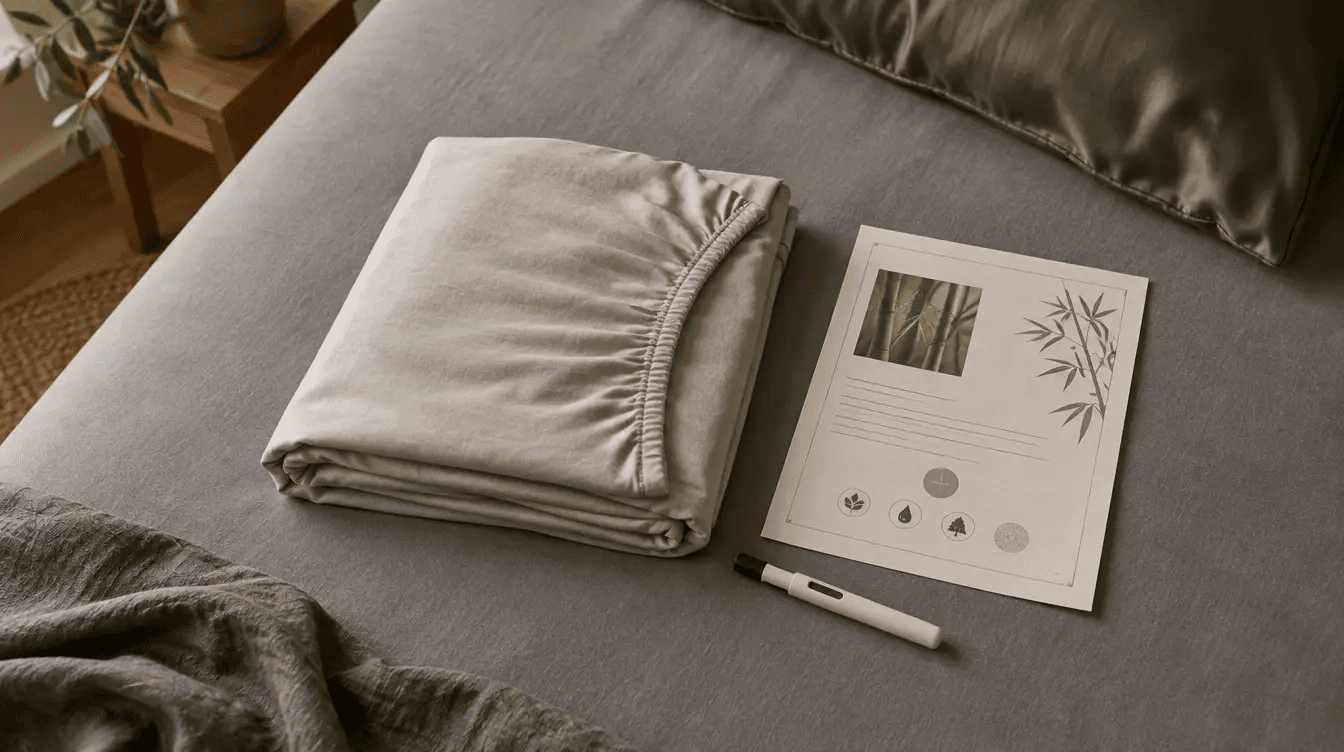
OEKO-TEX Standard 100 tests a textile, including its threads, for harmful substances. RoHS limits restricted hazardous substances in products with electrical components, which is why it is a sensible check on a grounding sheet's silver thread and cord. Neither certificate says anything about conductivity, sleep or what grounding does. Check each number yourself, and confirm what the certificate covers.
I became conscious of what touches my skin every night before I had ever heard of grounding. I was already choosing natural fabrics where I could. When I found grounding, I could not find a brand that talked about the textile at all. Everyone argued about whether grounding works. Nobody showed what the sheet was made from or what it had been tested for.
This article is the certificate decoder I wanted as a buyer. It explains what OEKO-TEX Standard 100 and RoHS each test, what they leave out, and how to look up any certificate number yourself. That includes ours. Please question our certificates the way you would question anyone else's.
Key Takeaways
- A badge is decoration until it comes with a certificate number, a named standard and a stated scope.
- OEKO-TEX Standard 100 tests textiles for harmful substances. Product Class I is the strictest class, written for articles used by babies and toddlers.
- RoHS restricts specific hazardous substances in products with electrical components. It is relevant to a grounding sheet because of the conductive silver thread and the cord.
- Neither certificate makes any claim about conductivity, sleep or what grounding does. Use a tester pen for conductivity.
- Our GOTS scope certificate covers the mulberry silk only, not the bamboo sheets. Precision about scope is the whole point of a certificate.
- You can verify an OEKO-TEX certificate online in a few minutes. Match the issuing body, the company and the product scope.
Summary: What Each Certificate Covers
| Certificate | What it tests or confirms | Why it matters on a grounding sheet | What it does not tell you |
|---|---|---|---|
| OEKO-TEX textile safety standard (Product Class I) | Textile materials and components tested for harmful substances | The fabric and thread sit against your skin for a full night | Anything about conductivity, sleep, fibre origin or factory conditions |
| RoHS | Restricted hazardous substances in products with electrical components | The sheet has conductive silver thread and a cord | Electrical safety performance, fabric dyes or any effect on sleep |
| GOTS scope certificate | A supplier is approved to process to the organic textile standard, for the products in its scope | Applies to our mulberry silk only | Anything about the bamboo sheets, or a specific batch (that needs a transaction certificate) |
| Tester pen (not a certificate) | Whether the sheet conducts at the moment you test it | Lets you see conductivity yourself | Harmful substances, or any outcome for your body |
Why is a badge not proof of anything?
A logo shows a brand wants you to think about testing. A certificate number lets you check that testing happened, who did it, which standard applied and what it covered. If a product page shows a badge without a number, a standard name and a scope, you have decoration, not proof.
Three questions sort most claims quickly. Certified to what standard? What exactly was tested? What does the certificate cover? Words like 'tested', 'certified' and 'natural' feel specific but are not. 'Certified' only means something when it attaches to a named standard and a number. 'Tested' only means something when you know the test, the lab and the sample.
The ACCC has published guidance on environmental and sustainability claims for businesses. The principle carries over to wellness bedding: a claim needs evidence behind it, and vague language does not count as evidence.
I keep two kinds of claim apart on everything we publish. The first is what the fabric is made of and what it has been tested for. The second is what grounding does for sleep. The first can be documented. The second is an open question, and the small published studies have not settled it. Blurring them in one sentence is how a certificate ends up sounding like a health claim.
What does OEKO-TEX Standard 100 actually test?
OEKO-TEX Standard 100 is an independent testing and certification system for textiles. Accredited institutes test materials for substances known to be harmful, then certify products that pass. Product Class I is the strictest class and is written for articles used by babies and toddlers, so it carries the tightest limits.
The system has four product classes, based on how closely a textile touches skin:
- Product Class I: articles for babies and toddlers, up to 36 months.
- Product Class II: articles with direct skin contact, such as bedding and underwear.
- Product Class III: articles with no direct skin contact, such as outer jackets.
- Product Class IV: decoration materials, such as curtains and furnishing fabrics.
According to OEKO-TEX (https://www.oeko-tex.com/en/our-standards/oeko-tex-standard-100), every component of an article must meet the criteria, not just the main fabric. That includes threads, labels and trims. This is why the silver thread matters to the certificate and not only to conductivity. The criteria cover substances such as certain dyes, heavy metals, formaldehyde and pesticide residues. Certificates are valid for a limited period and must be renewed, so a lapsed certificate is a real thing to check for.
Our OEKO-TEX Standard 100 certificate number is SH025 231655. Our manufacturing partner holds it at Product Class I, and it applies to all our products. I chose this route knowing it costs more and makes the supply chain more complicated. I wanted to know what was in what I was selling, and I wanted independent testing behind it.
Two clarifications matter here. First, Product Class I on an adult bed sheet does not mean we market bedding for babies. It tells you the textile was tested against the strictest set of limits the system offers. Second, OEKO-TEX Standard 100 is a test for harmful substances. It does not tell you how a fibre was grown, how a factory looks after its workers or how the product performs.
What does RoHS mean on a grounding sheet?
RoHS is a European directive that restricts specific hazardous substances in electrical and electronic equipment. A grounding sheet is a textile, but it has conductive silver thread and a cord, so it has electrical components. We test the grounding bedding against these limits. Our RoHS certificate number is CHHB26080392392.
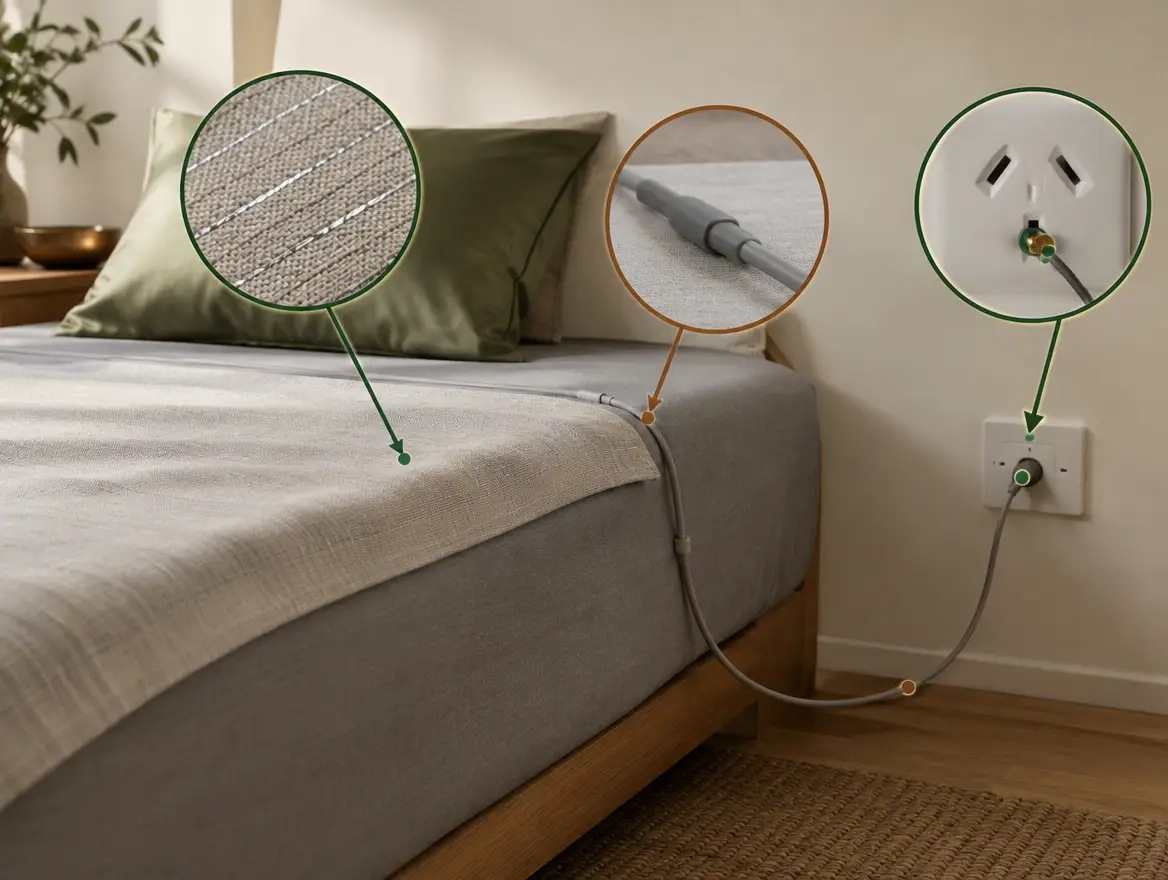
RoHS comes from the EU, not from Australian law, so I describe it honestly as a benchmark we have chosen to test against. According to Directive 2011/65/EU (https://eur-lex.europa.eu/legal-content/EN/TXT/?uri=celex%3A32011L0065), the restricted substances include lead, mercury, cadmium, hexavalent chromium and two groups of flame retardants. A later amendment added four phthalates. The directive sets maximum concentrations in each homogeneous material, generally 0.1% by weight, and 0.01% for cadmium.
In plain terms, RoHS asks whether the metal, plastic and wiring parts of a product contain restricted substances above set limits. On our sheet, those parts are the silver thread woven through the bamboo and the cord that connects to the earth pin of a wall socket. No power flows through the sheet. Only the grounding connection is used. If you want the full safety explanation, our guide Are Grounding Sheets Safe to Plug In? covers it.
RoHS and OEKO-TEX Standard 100 test different things. OEKO-TEX looks at the textile, and RoHS looks at the electrical components. They complement each other. They are also not interchangeable, so a brand showing only one of them has told you about only part of the product.
RoHS has no single public lookup like OEKO-TEX does. The practical check is to ask for the test report. Read the lab's name, the product description and the sample tested, and confirm it names grounding sheets and not a different product.
What do neither of these certificates claim?
Neither certificate says anything about what grounding does, how you will sleep or whether the sheet conducts. They are tests for substances, not outcomes. Conductivity is something you check yourself with a tester pen, and what grounding does for sleep remains an open question the small studies have not settled.
This is the gap where marketing tends to slip. A certificate for harmful substances sits next to a sentence about better sleep, and the reader's brain joins them. They are separate claims with separate evidence. Our grounding sheets are a wellness product, not a medical device. I describe only what people report, and I am a founder and a mother, not a clinician.
Conductivity is where the textile matters most. Bamboo on its own is not conductive enough to ground a body. So fine silver fibres are woven through the bamboo (10% silver thread) rather than coated on top. The silver has a job to do: conduct. The bamboo keeps the softness, breathability and moisture handling that hot sleepers care about. Neither material is there because it sounds good in marketing.
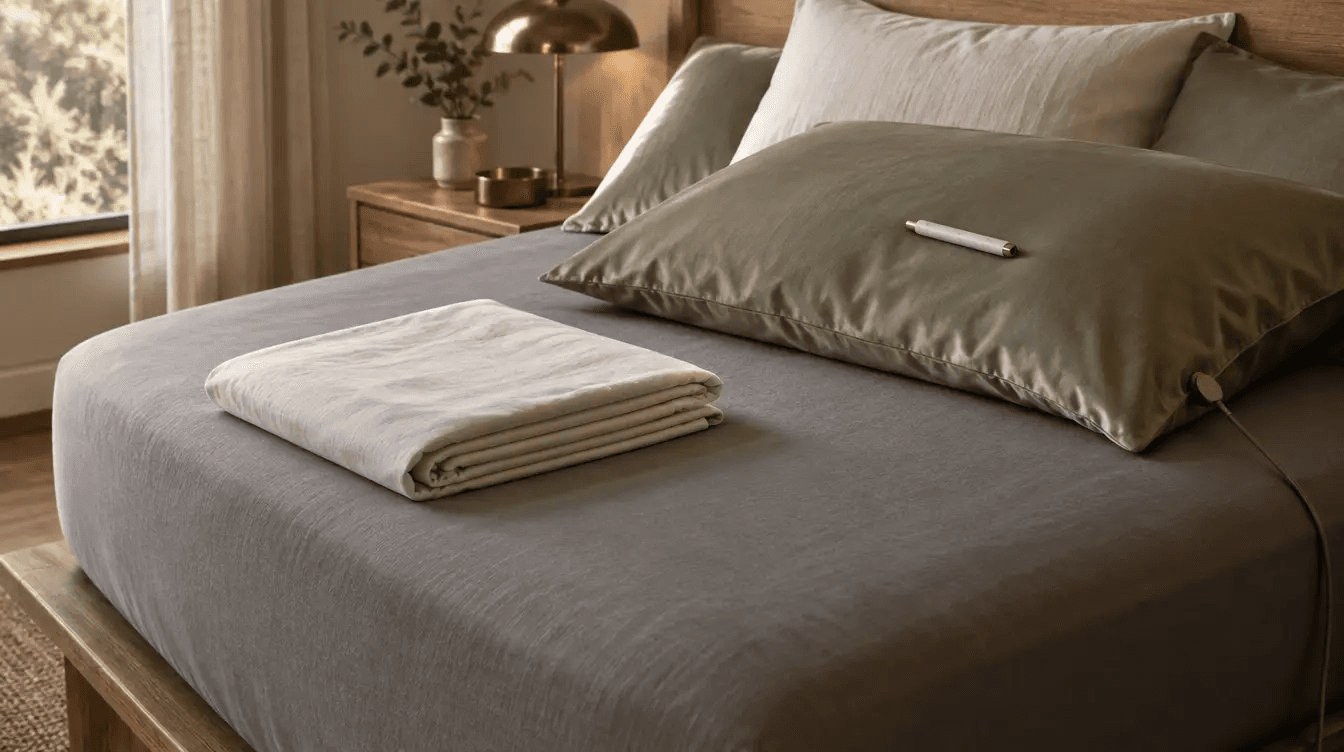
A certificate cannot confirm any of that, but a tester pen can. It is in every grounding box. Test the sheet when you first set it up, then check again over time. Our guide How to Test a Grounding Sheet With a Tester Pen walks through the steps. I would not describe this as a durability guarantee, and I would be wary of any brand that does.
Some people notice something in the first week. Many notice nothing until the third. Both are normal, which is why the trial runs 90 nights, not 30. Sleep on it for 90 nights, decide later.
Why does GOTS scope matter for silk but not bamboo?
GOTS is the Global Organic Textile Standard, which covers organic fibre content and processing. Our GOTS scope certificate, USB TEX-4007-GOTS-2509, covers the mulberry silk only. It does not cover the bamboo sheets. Scope matters because a certificate describes what a specific supplier is approved to process, not everything a brand sells.
There are two kinds of GOTS document, and they do different jobs. A scope certificate confirms a facility is approved to process certain products to the standard. A transaction certificate ties a specific shipment of goods to that approval. What we hold is a scope certificate. Until transaction certificates arrive, I keep the wording exactly as the document reads: a GOTS scope certificate for the silk. I do not stretch it into a broader claim about the product, and I do not attach it to the bamboo.
The bamboo sheets carry OEKO-TEX Standard 100 (Product Class I) and RoHS testing for the grounding components. That is a different certificate stack, and it is a complete one for what it tests. The phrase I use is organic bamboo, OEKO-TEX Standard 100 certified. The two parts of that phrase are separate facts, and 'certified' belongs only to the standard and number.
If you are a hot sleeper weighing bamboo against silk, the certificate story is different for each. Bamboo sheets bring OEKO-TEX and RoHS. The 22 momme mulberry silk brings OEKO-TEX plus the GOTS scope certificate. If you are researching a GOTS certificate for a silk pillowcase, check whether the document names that product category and that supplier, and whether it is a scope or a transaction certificate. Our silk pillowcase product page lists the numbers. For the fibre comparison, see our Bamboo vs Cotton Grounding Sheets guide.
You can search GOTS certificates yourself in the public database on the GOTS website. Look up the certificate number and read the product categories listed against it.
How do you verify an OEKO-TEX certificate yourself?
To verify a certificate, find the number, the issuing body and the product scope. Then enter the number in the OEKO-TEX label check online, confirm the company, product class and validity, and check that the listed articles cover the product you are buying. For RoHS, ask for the test report.
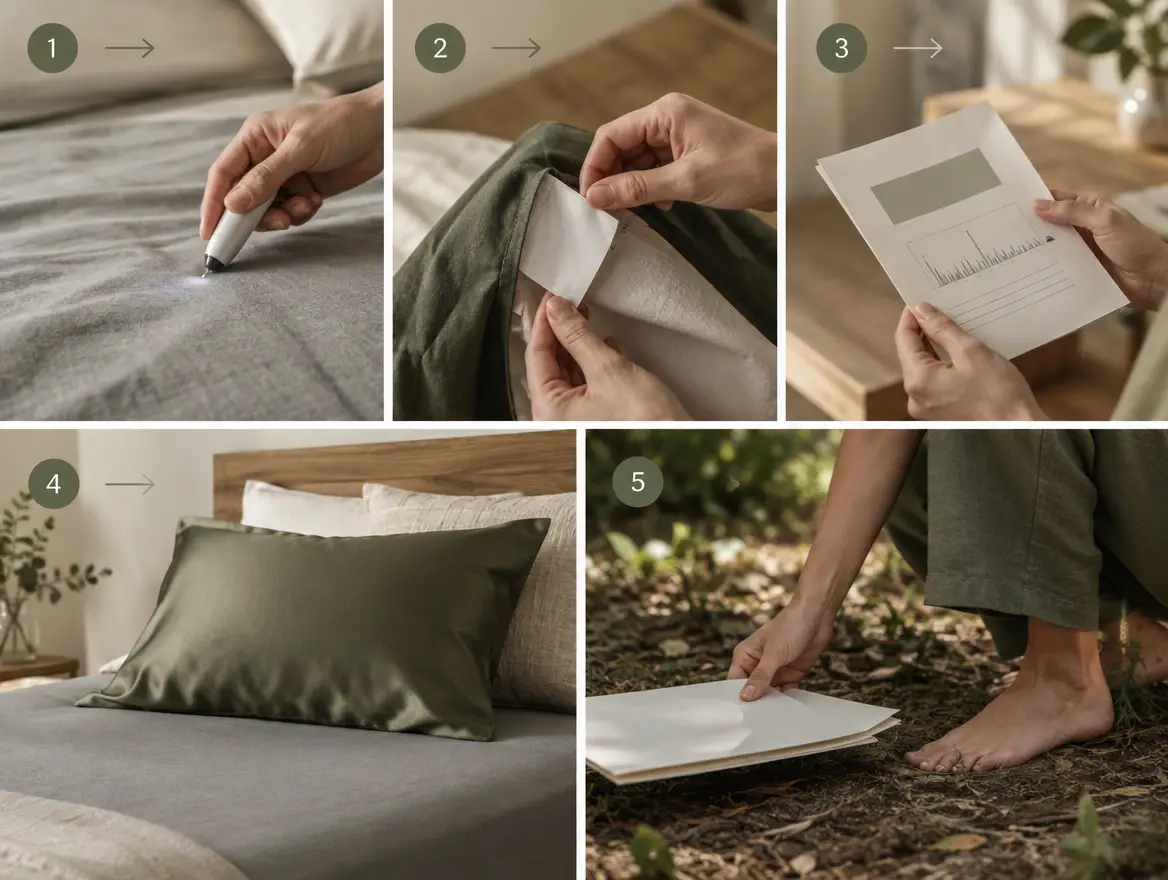
Here is the process I would follow as a buyer:
- Find the number. It should be on the product page or the label, written out. If it is only a logo, ask the brand for the number.
- Open the OEKO-TEX label check. It is on the OEKO-TEX website (https://www.oeko-tex.com/en/label-check). Enter the number exactly as printed.
- Read the result. Confirm the product class, that the certificate is still valid and who holds it. For ours, the holder is our manufacturing partner, so the company name will be theirs, not Organic Earthing. That is normal, but you should know to expect it.
- Match the scope. Check that the listed article types include fabric of the kind you are buying. A certificate for yarn does not automatically cover a finished sheet.
- Ask for the rest. For RoHS, request the report and check the lab, date and product description. For GOTS, search the database and check scope against the product.
If a brand cannot give you a number, cannot say what the number covers or gets defensive when you ask, that tells you something. Questions about ours come straight to me.
The offer behind this is simple. Read our certificate numbers, check them yourself, then test it before you believe it. The certified fitted grounding sheet comes with a tester pen in the box, a 90-night trial from delivery and a 1-year warranty. Returns need to be in reasonable condition, with return postage on the customer. There is no price cut to lead with, and I would rather it stayed that way.
Why I want you to question our certificates too
Most of the category argues about whether grounding works, and I think that is the wrong first question. You spend eight hours a night with your skin on the fabric, so I would judge a grounding sheet first on the textile: what it is made of and what it has been tested for. Then ask whether grounding is worth trying, with open eyes about how limited the evidence is.
That position has a practical consequence. I want to be the brand you question hardest. I don't want customers to trust us because we've written 'premium' on a website. I want there to be something behind it that a stranger can check from a couch in Melbourne at 10pm. Certificate numbers are that something. They are also a standing invitation to find a gap.
Here are the gaps I would look for, if I were you. The OEKO-TEX certificate is held by our manufacturing partner, not by us, so you have to read the scope carefully. The RoHS certificate has no public lookup, so you are relying on a report rather than a database. The GOTS document is a scope certificate for the silk, not a transaction certificate and not a statement about the bamboo. None of this is hidden. It is what the paperwork says, and I would rather you read it accurately than assume more.
A grounding sheet is a $419 decision made online, by people who cannot feel the fabric or know how they will sleep until it is on their own bed. A badge cannot carry that decision. Numbers you can check, a pen that shows conductivity and 90 nights to decide can. That is the premium, transparent end of grounding as I see it: not louder claims, but narrower ones that hold up.
References
- OEKO-TEX, STANDARD 100 by OEKO-TEX
- OEKO-TEX, Label Check
- EUR-Lex, Directive 2011/65/EU on the restriction of the use of certain hazardous substances in electrical and electronic equipment (RoHS)
- Global Organic Textile Standard, GOTS
- ACCC, Environmental and sustainability claims
Take this with you
Your first 30 nights, in your inbox.
What people usually notice in the first month on a grounding sheet, week by week, and why you get 90 days rather than 14.
Questions people ask
What does OEKO-TEX Standard 100 certified mean on a grounding sheet?
It means the textile, including its threads and components, was tested by an independent institute for harmful substances and passed the criteria for its product class. It is not a claim about conductivity, sleep or fibre origin. Our certificate number is SH025 231655, at Product Class I.
Is OEKO-TEX Product Class I only for baby products?
Product Class I is written for articles used by babies and toddlers, and it is the strictest class. A textile can be tested to it without being sold for babies. Our adult bedding is tested at this class because we wanted the tightest limits the system offers.
Does a RoHS certificate mean a grounding sheet is safe to plug in?
No. RoHS restricts hazardous substances in electrical components. It is not an electrical safety performance test. Our sheet connects by a cord to the earth pin of a wall socket, and no power flows through it. Our RoHS certificate number is CHHB26080392392.
How do I verify an OEKO-TEX certificate?
Use the label check on the OEKO-TEX website. Enter the certificate number exactly as printed, then confirm the company, product class, validity and the articles covered. Make sure the scope matches the product you are buying.
Are Organic Earthing's bamboo sheets GOTS certified?
No. Our GOTS scope certificate, USB TEX-4007-GOTS-2509, covers the mulberry silk only. The bamboo sheets are covered by OEKO-TEX Standard 100 at Product Class I, with RoHS testing on the grounding components.
Do any of these certificates prove a grounding sheet conducts?
No. None of them test conductivity. Use the tester pen included in every box to check it when you first set up the sheet and again over time.