Grounding · 21 Oct 2026 · 17 min read
Bamboo vs Cotton Grounding Sheets: What the Fabric Actually Changes
Bamboo or cotton grounding sheet? Compare feel, breathability, silver thread, certificates and care, plus how to test conductivity yourself with the tester pen.
By Jade Castle, founder. Wellness product, not a medical device.
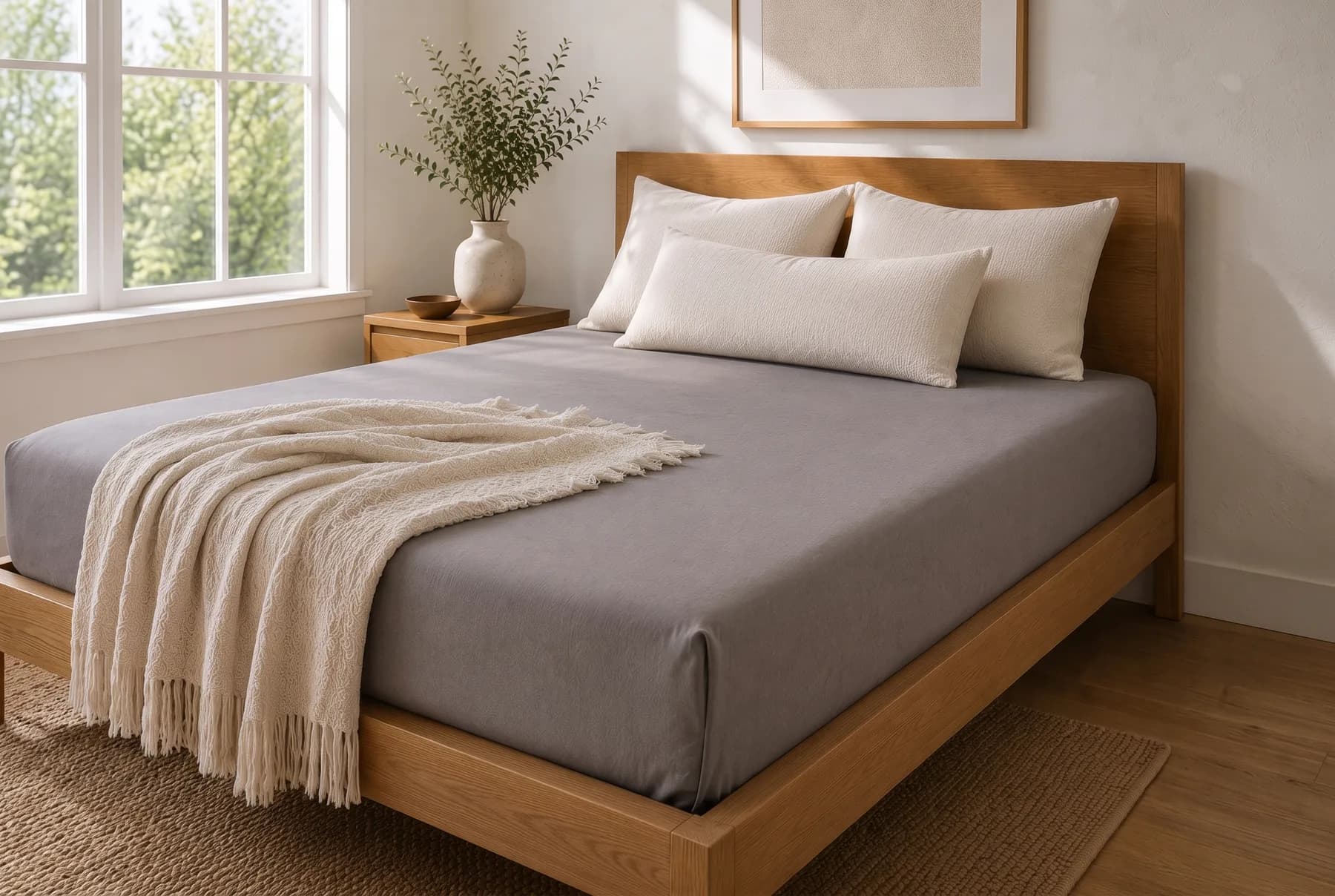
Bamboo and cotton grounding sheets do the same job: woven silver thread gives you a path to earth. The base fabric changes the feel, drape and how the sheet handles warmth and moisture. Bamboo usually feels smoother and softer, cotton crisper. Judge both on silver content, weave, and what each has been tested for.
Most grounding sheets on the market are cotton with silver thread. Ours are bamboo woven with 10% silver. I sell the bamboo version, so read this as a fibre comparison from someone with a stake in the answer, and check what I say against the tester pen, the certificates and the trial.
I started Organic Earthing before I had heard of grounding. I had already become conscious of what touches your skin every night: clothing, towels, sheets. When I found grounding, I could not find a brand that paired it with the materials and the look I wanted in my own home. This article stays on base fibre versus base fibre. It makes no claims about what grounding does for the body, because that is a separate, open question.
Key Takeaways
- A grounding sheet is a normal sheet with conductive silver thread woven in. The silver provides the path to earth, and the base fabric decides how the sheet feels to sleep on.
- Bamboo and cotton are both reasonable base fabrics. Bamboo tends to feel smoother with a fluid drape, and cotton tends to feel crisper and more structured.
- Silver percentage and weave matter more than the words on a product page. Our sheets use 10% silver thread, and you can check continuity yourself with the tester pen.
- Every certificate should be questioned: certified to what standard, and what does it cover? That includes ours.
- Care matters for both fibres. Follow the care label, and test again over time rather than assuming permanent performance.
Bamboo vs Cotton Grounding Sheets at a Glance
This table is qualitative. It compares the base fibre only, assuming silver thread is woven into both.
| Aspect | Bamboo with silver thread | Cotton with silver thread |
|---|---|---|
| Role of the silver | Provides the conductive path to earth | Provides the conductive path to earth |
| Typical hand feel | Smooth, soft, fluid drape | Crisper, more structured, varies by weave |
| Moisture handling | Takes up moisture readily, owners describe a cool, dry feel | Takes up moisture readily, owners who like it often cite a fresh, crisp feel |
| Warm nights | Often preferred by hot sleepers in owner feedback | Suits sleepers who like a lighter, crisper weave |
| What to ask about the fibre | Which process turns bamboo into yarn? | Which cotton type and weave? |
| Certificates to check | Standard, number and scope | Standard, number and scope |
| Care | Gentle wash, follow the care label | Gentle wash, follow the care label |
Same job, different base fabric: what is a grounding sheet made of?
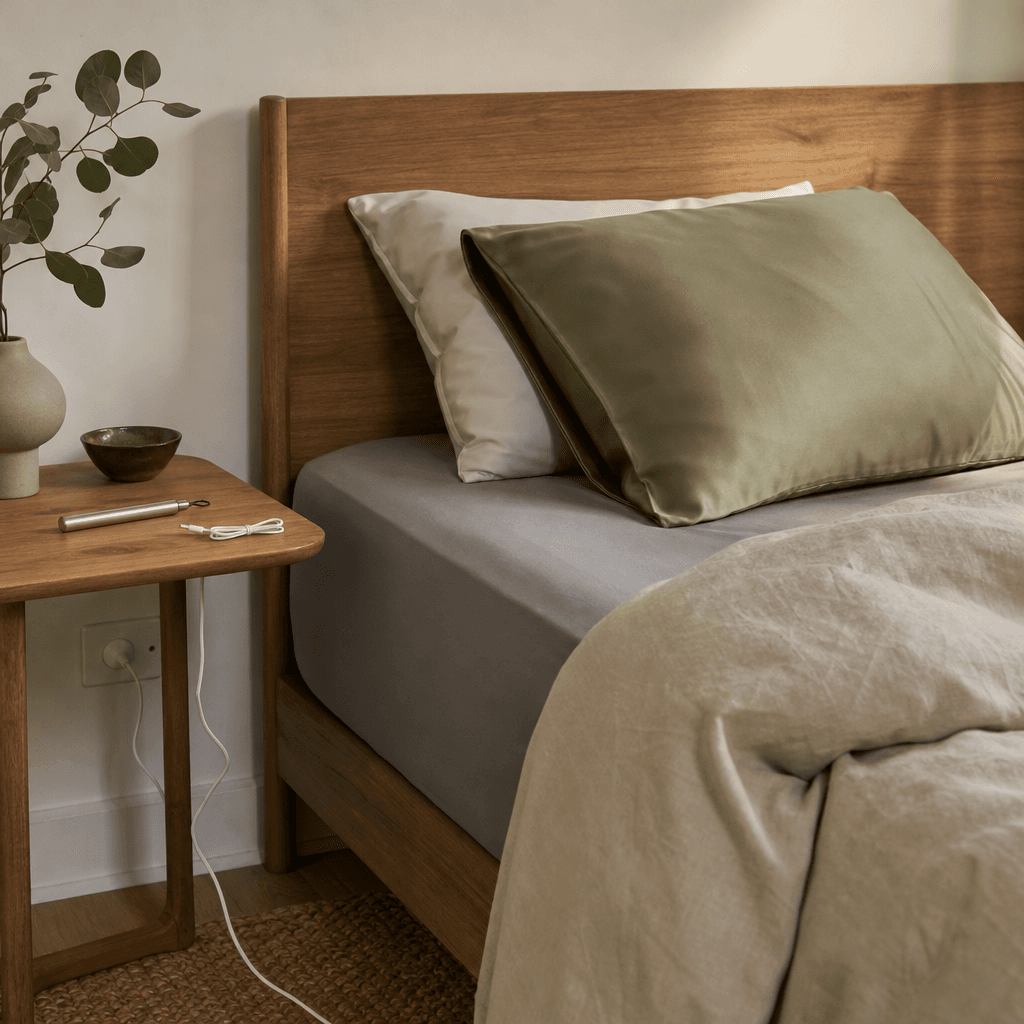
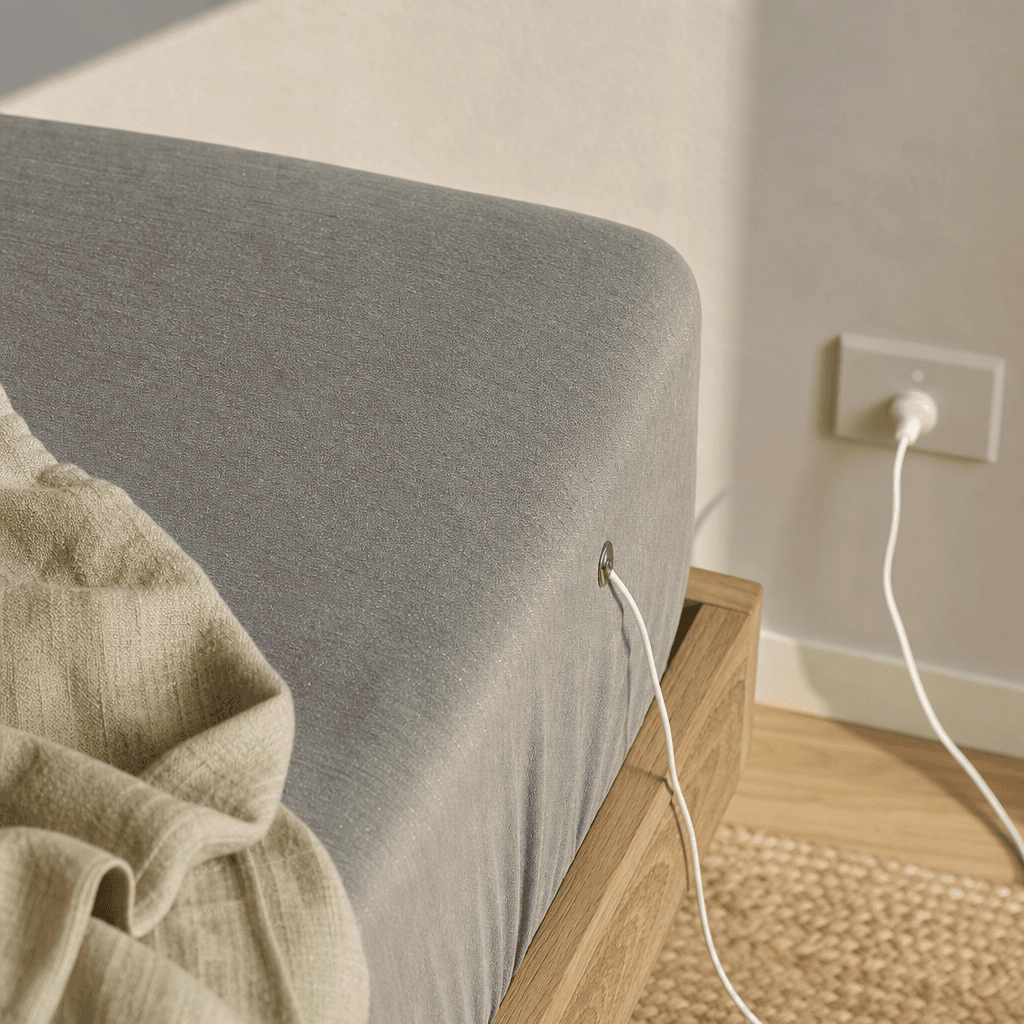
A grounding sheet is a bed sheet with conductive silver fibres woven through a base fabric, connected by a cord to the earth pin of a wall socket. The base fabric, bamboo or cotton, determines how the sheet feels and handles moisture. The silver has one job: provide the conductive path.
Neither bamboo nor cotton conducts well enough on its own to do this job. That is why every grounding sheet, whatever the fibre, relies on a conductive material. In our sheets, fine silver fibres are woven through the bamboo (10% silver thread) rather than coated on top. The cord connects to the earth pin of a wall socket. No power flows through the sheet. Only the grounding connection is used. I describe it plainly because this is a wellness product, not a medical device.
I did not want a grounding sheet that people put up with just because it grounds. Bamboo keeps the softness, breathability and moisture handling, and the silver does the conducting. Neither material is there because it sounds good in marketing.
A fair note on bamboo: most bamboo fabric is made by processing bamboo pulp into a cellulose yarn, and there are different processes for doing it. It is a reasonable question for any brand, us included. On the cotton side, ask about the type of cotton and the weave, because a percale and a sateen of the same fibre feel quite different.
This is where I suggest using five questions on any grounding brand:
- What is the sheet actually made from?
- What makes it conductive, and what conductive material is used?
- Can you test the conductivity yourself?
- How does it connect to ground?
- What testing or documentation does the company have, certified to which standard, covering what?
If you want a fuller checklist for the Australian market, our guide Grounding Sheets in Australia: What to Check Before You Buy goes through it in more detail.
Why silver conducts, and how to check it with the tester pen
Silver is one of the most conductive metals, so silver thread gives the sheet a path to earth that bamboo or cotton alone cannot provide. The silver percentage and the weave matter more than any marketing language. You can check continuity yourself with the tester pen included in every box.
The silver has a job to do, so the useful questions are practical. How much silver is in the fabric? How is it woven in? Does it run through the sheet in a way that keeps the conductive path continuous across the surface you lie on?
Our product specification is 10% silver thread. The figures I have seen competitors state are 5% or less. I am giving you that as our own specification and observation, not as an independent benchmark, and a higher percentage is not an automatic win. A lower percentage in a well-planned weave can still conduct. A high percentage means little if the sheet cannot be shown to conduct at all. This is why the test matters more than the number.
The tester pen is in every grounding box. The point of it is simple: you do not need to take our word for conductivity, or anyone else's. Here is how I suggest using it:
- Follow the instructions in the box when you first set up the sheet, with the cord connected to a properly earthed wall socket.
- Use the pen to see conductivity for yourself, on the sheet and at the connection.
- Check again over time. I do not tell customers to test after every wash, and I do not offer a durability guarantee. Regular checks tell you what your own sheet is doing.
- If you are unsure whether a socket is earthed, a licensed electrician can confirm it.
The same logic applies to a cotton sheet with silver. Whatever the base fibre, if a brand will not tell you what the conductive material is, or gives you no way to test the sheet, that tells you something.
Feel and drape: how do bamboo and cotton grounding sheets differ?
Bamboo fabric typically has a smooth, soft hand and a fluid drape, while cotton tends to feel crisper and more structured. Sleepers report preferences on both sides, and weave and weight change the result as much as fibre. Approach any absolute claim about either fabric with caution.
Here is what sleepers tend to report. People who prefer bamboo often describe a silky, smooth surface that moves with the body and settles over the mattress without stiffness. People who prefer cotton often describe a crisp, slightly textured feel they associate with a well-made hotel bed, and some find a smoother fabric too slippery.
Three caveats keep this honest:
- Weave matters. A sateen-woven cotton can feel smooth, and a plainer bamboo weave can feel less fluid than you expect.
- Silver changes the hand. Any fabric with metal fibres woven in will feel a little different from the same fabric without them. How much depends on how fine the silver is and how it is woven.
- Feel is personal. You cannot judge it from a product photo, which is a big reason I built a 90-night trial from delivery. You will know within a few nights whether you like the fabric on your skin.
If you are choosing a fitted sheet to live on your mattress, the drape also affects how well it sits and stays put. Our piece Grounding Fitted Sheets vs Regular Fitted Sheets covers that side of the decision.
Breathability and warm nights: how do the two fibres handle heat and moisture?
Bamboo and cotton are both cellulose-based fibres that take up moisture readily, so neither behaves like a plastic-feeling sheet on a warm night. Owners describe differences in how cool and dry each feels, but these reports vary with weave and room conditions. No fibre suits every sleeper.
I want to be careful here. I am not going to give you percentages for moisture absorption or temperature, because I do not have independent head-to-head testing of these two sheets to cite. What I can offer is how the textiles work and what owners tell us.
Textile properties. Both fibres absorb moisture from the skin and release it into the air. Breathability in a finished sheet depends on the yarn, the weave and the weight of the fabric. A loose, lightweight weave of either fibre will usually feel more airy than a dense, heavy one.
Owner feedback. Hot sleepers who choose bamboo often describe a cool feel on first contact and a sheet that does not cling. Some cotton owners prefer the lighter, crisper feel of a percale weave on warm nights and find it less clingy than a very smooth fabric. Both are real preferences. Neither is a rule.
For the 50+ hot sleeper weighing up fabrics for cooler nights, the sheet is one layer in a system. Your blanket, doona and sleepwear all change how warm you feel. Some of our customers pair the sheet with mulberry silk sleepwear, but that is a personal choice, not a requirement. I would rather you judge the sheet on its own for a few nights first.
If you are one of those readers who knows she runs hot, the practical approach is to look for breathable grounding sheets in a fibre you already like against your skin, then use the trial to confirm it on your own bed.
Certified to what? Question every certificate, including ours
A certificate only means something when you know the standard, the number and the scope. OEKO-TEX Standard 100 certificate SH025 231655 covers textiles tested for harmful substances. RoHS certificate CHHB26080392392 covers the grounding sheets for restricted substances. Neither says anything about how grounding affects sleep.
Certified to what standard, and what does it cover? Ask it of every brand, and ask it of us. A badge can look impressive with very little behind it, and I would rather a customer question Organic Earthing than believe a badge.
Here is exactly what we hold, and what each one means.
OEKO-TEX Standard 100, certificate SH025 231655. This is a testing and certification system for textiles, checking for harmful substances. The certificate applies to all our products, and our manufacturing partner is certified at Product Class I, the strictest class, which OEKO-TEX defines for articles for babies and toddlers. It tells you the textile was tested against the standard's limits for substances of concern. It does not tell you how soft the fabric is, whether the sheet conducts, or whether anything grounding-related works. You can also look up OEKO-TEX labels through the organisation's own Label Check tool, which I encourage.
RoHS compliance, certificate CHHB26080392392. RoHS is a restriction on certain hazardous substances in electrical and electronic products, such as lead, mercury and cadmium. We have this testing on the grounding sheets, because a grounding sheet is a textile with a conductive element and a connection to a wall socket. It is a separate test from OEKO-TEX, and it covers the grounding sheets named on the certificate. Read the certificate scope for the exact items tested.
What we do not claim. Our mulberry silk holds a GOTS scope certificate (USB TEX-4007-GOTS-2509). That is a scope certificate, not a transaction certificate, and it applies to the silk, not the bamboo grounding sheets. So I attach the word certified only to a named standard and a number.
This is the same for bamboo and cotton. Plenty of cotton sheets carry OEKO-TEX certification too, and the fibre does not decide whether a brand has testing behind it. What decides it is whether the brand will show you the number and let you read the scope. This is what I mean by two kinds of claim: what the fabric is made of and tested for is one thing, and what grounding does for sleep is another. The small published studies have not settled the second, and I will not blur the two in one sentence.
Care and longevity: how should you wash a silver-woven sheet?
Follow the care label supplied with your sheet. As a general rule for silver-woven fabrics, use a gentle cycle, skip bleach and skip fabric softener. The same approach suits bamboo and cotton versions. Check conductivity with the tester pen when you first set up and again over time.
Some practical points that apply to both fibres:
- Disconnect first. Unplug the cord and detach it from the sheet before washing, following the instructions in your box.
- Wash separately and gently. Silver-woven fabric is a technical textile, so avoid harsh handling, high heat and anything abrasive.
- Skip fabric softener and bleach. Both are commonly advised against for technical fabrics, and neither is needed.
- Dry with care. Let the sheet dry as the care label directs, and avoid anything that puts it under heavy strain.
On fibre differences: bamboo fabric is often handled more gently because of its soft hand, and cotton is generally seen as the sturdier, more familiar everyday fabric. I do not want to turn that into a durability claim. I do not offer one, and I would be wary of any brand that does for a fabric with metal woven through it.
What I do offer is a way to see for yourself. Test the sheet when it arrives, and test it again over time, for example at the change of season. If conductivity is not what it should be, you have a one-year warranty and a returns process that comes straight to me. Returns need to be in reasonable condition, with return postage on the customer.
Judge a grounding sheet on what you are sleeping on
Everyone argues about whether grounding works, and almost nobody talks about the textile you spend eight hours a night on. My position is to judge a grounding sheet first on the fabric: what it is made of, what it has been tested for, and whether you can verify the conductivity yourself.
That is where Organic Earthing came from. I became conscious of what I put against my skin before I ever heard of grounding. When I found it, the products I saw were clinical, generic or led with price, and none of them discussed the textile. I wanted to know what was in the products I was selling, with independent testing behind them, particularly for harmful or restricted substances.
That meant choosing OEKO-TEX Standard 100 and separate RoHS testing on the grounding bedding. It costs more and makes the supply chain more complicated. In return, I can publish certificate numbers instead of adjectives. I do not want customers to trust us because we have written 'premium' on a website. I want there to be something behind it.
A grounding sheet is a $419 decision made online, by people who cannot feel the fabric until it is on their own bed. A $419 certified product cannot argue with a clearance voice, so we do not lead with price tricks. The offer is proof you can check at home: certificate numbers on every product page, a tester pen in every grounding box and 90 nights to decide.
On expectations, I will not promise a timeline of results. Some people notice something in the first week, and many notice nothing until the third. Both are normal, which is why the trial runs 90 days. What you can judge from the first night is simpler: the feel, the drape, the warmth and whether the pen shows conductivity.
Test it before you believe it
The fabric is the part you can judge for yourself. Order the fitted bamboo grounding sheet or the flat bamboo grounding sheet, and test the silver with the included pen. Check the certificate numbers against what you have read here.
Then sleep on it for 90 nights, decide later. The 90-night trial runs from delivery, and the 1-year warranty covers the rest. There is no pressure to rush you, because the decision should be yours. We are an Australian-owned, family-run brand selling globally, and if you have a question about returns, it comes straight to me.
References
- OEKO-TEX, STANDARD 100 by OEKO-TEX
- OEKO-TEX, Label Check
- European Union, Directive 2011/65/EU on the restriction of hazardous substances (RoHS)
- Global Organic Textile Standard (GOTS), Standard overview
- ACCC, Environmental and sustainability claims guide for business
Take this with you
Your first 30 nights, in your inbox.
What people usually notice in the first month on a grounding sheet, week by week, and why you get 90 days rather than 14.
Questions people ask
Is bamboo better than cotton for a grounding sheet?
Neither is better for the grounding job, because the woven silver thread does the conducting in both. The base fabric changes feel, drape and how the sheet handles moisture. Bamboo tends to feel smoother and softer, cotton crisper. The better choice is the one you prefer against your skin, backed by testing you can read.
Do bamboo grounding sheets sleep warm or cool?
Owners who run warm often describe bamboo as cool to the touch and not clingy, but this varies with weave, weight and room conditions. Both bamboo and cotton take up moisture readily. There is no independent head-to-head data cited here, so use the 90-night trial to see how it suits you.
How do I know if my grounding sheet is conductive?
Use the tester pen included in every Organic Earthing grounding box. Follow the instructions in the box to check the sheet when you first set it up, then check again over time. Confirm the wall socket is properly earthed first, and ask a licensed electrician if you are unsure.
Does the silver percentage matter in a grounding sheet?
Yes, but it is not the whole story. Organic Earthing sheets use 10% silver thread, and the figures the brand has seen competitors state are 5% or less. The weave also matters, and the only reliable check is testing conductivity yourself.
What does OEKO-TEX Standard 100 certification cover?
It covers testing of textiles for harmful substances against the standard's criteria. Organic Earthing's certificate is SH025 231655, with the manufacturing partner certified at Product Class I. It does not cover comfort, conductivity or any effect of grounding on sleep. OEKO-TEX labels can be verified through the organisation's Label Check tool.
Can I wash a bamboo or cotton grounding sheet?
Yes, but follow the care label. Disconnect the cord first, use a gentle cycle, and avoid bleach and fabric softener. Check conductivity with the tester pen at set-up and again over time. There is no durability guarantee, but a 1-year warranty applies.