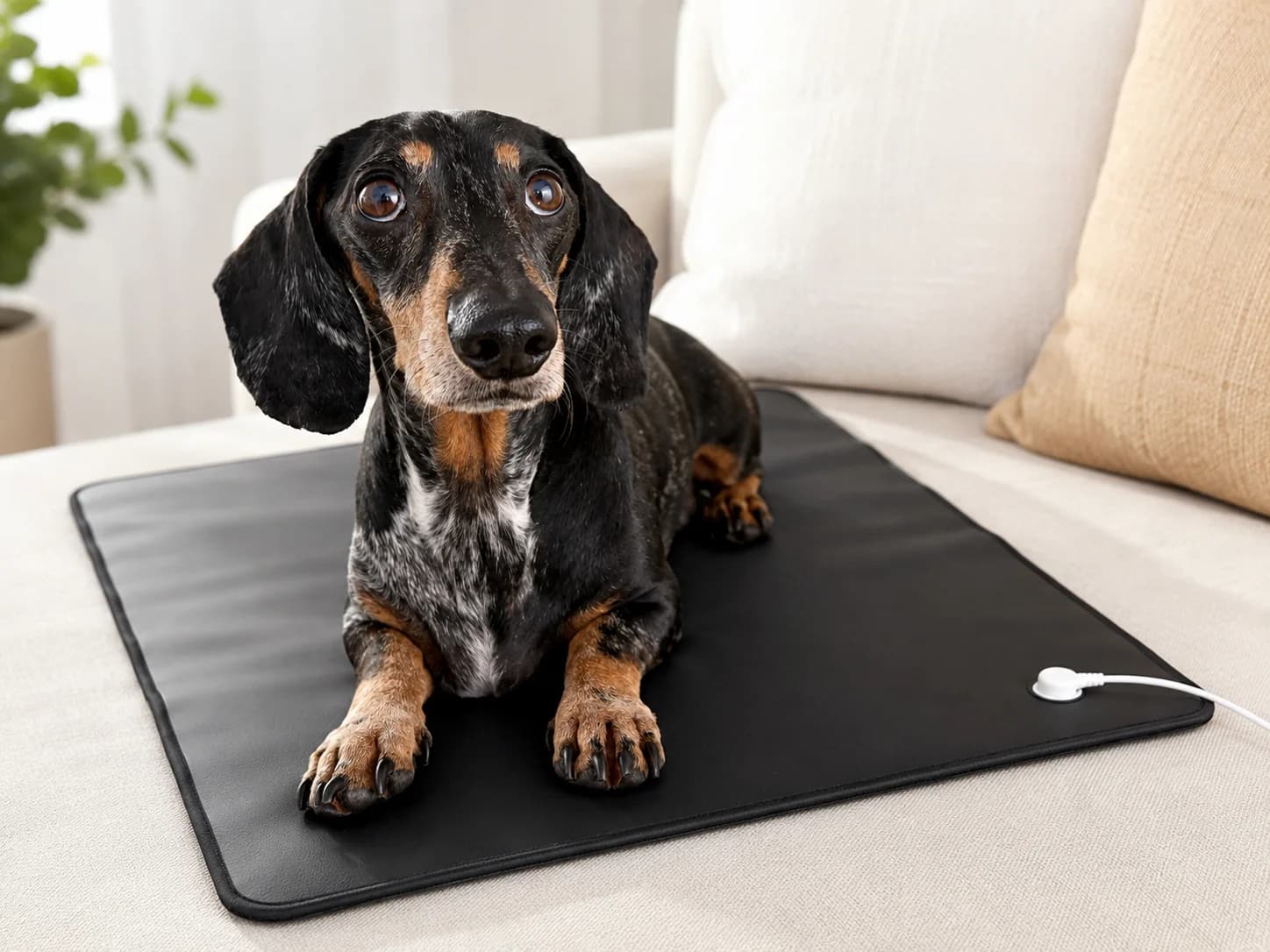
Pets · 10 Nov 2026 · 14 min read
Pet Grounding Mat for Dogs and Cats: Placement, Cords and Chewing
Practical setup guide: where a pet grounding mat goes, how to keep the cord away from teeth and claws, how to clean it, and what to ask before you buy.
By Jade Castle, founder. Wellness product, not a medical device.
Part ofThe pet guide
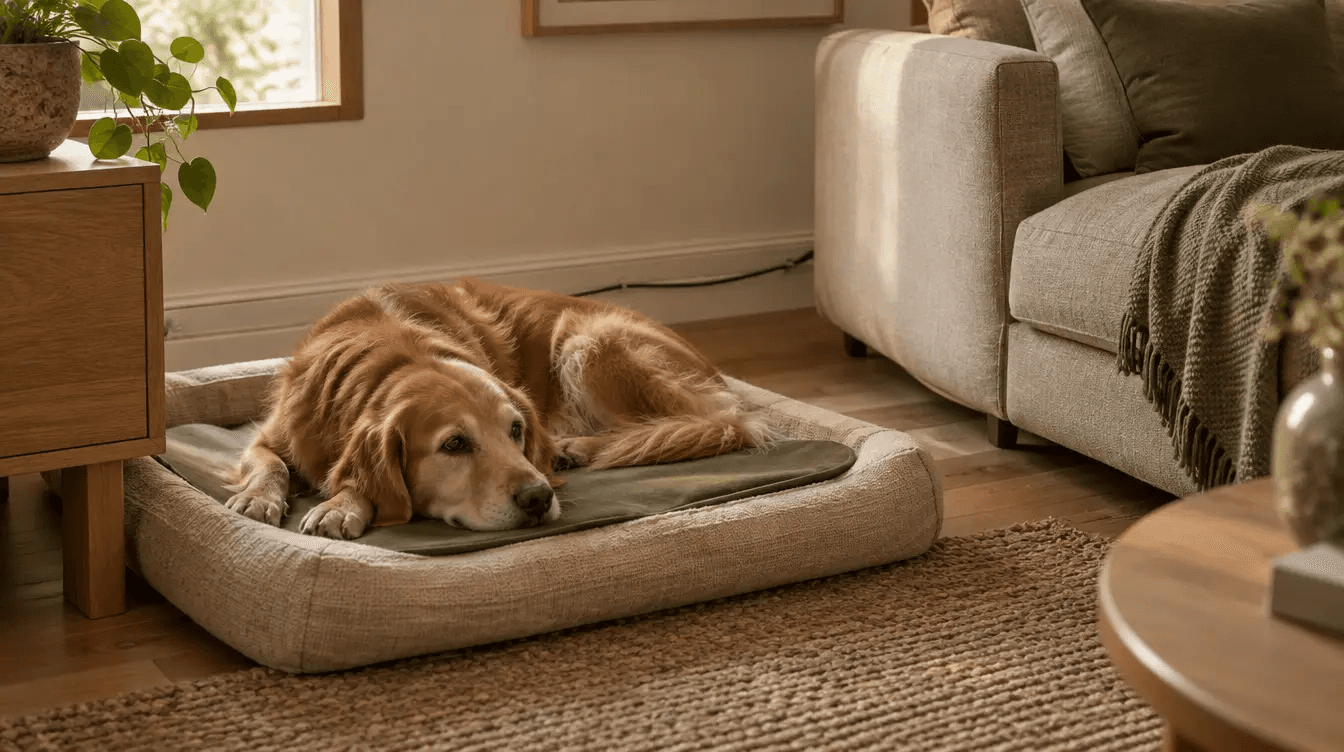
Place a pet grounding mat where your dog or cat already rests, such as their bed, the couch or a crate floor. Keep the cord behind furniture and out of reach, unplug it when your pet is unsupervised, and wipe the mat with a damp cloth only when unplugged.
Our grounding for pets guide covers what we claim and what we do not. This article is the practical follow-up: where the mat goes, how to keep the cord away from teeth and claws, and how to keep it clean. I'm Jade Castle, founder of Organic Earthing, and I judge any grounding product first on the textile and what it has been tested for. The argument about whether grounding works can wait until you know what your pet is lying on.
A quick framing note. This is a wellness product, not a medical device. I make no calming, anxiety or health claims for pets or people, and nothing below should be read as one. If you are still deciding whether a mat suits your pet at all, can pets benefit from grounding? covers what owners ask first, and what we don't claim.
Key Takeaways
- Put the mat where your pet already rests. Do not try to move the animal to the mat.
- The cord is the main safety question, not the fabric. Route it behind furniture, use cord covers and keep crate cords outside the crate.
- Unplug when your pet is unsupervised, especially puppies and kittens, who are the most likely to chew.
- Check the cord for bite marks, dents and fraying each time you plug in. Stop using it if you find damage.
- Use the tester pen in the box to check the connection, then wipe the mat clean only when it is unplugged and let it dry fully before reconnecting.
- Before you buy from anyone, ask: certified to what standard, what exactly was tested, and what does the certificate cover?
Summary Table
| Setup question | Short answer | What to watch for |
|---|---|---|
| Where does the mat go? | Where your pet already rests | Moving the mat to a spot the pet ignores |
| Dog in a crate | Mat on the crate floor, cord leaves the crate | Cord reachable through the bars |
| Cat on a sofa or windowsill | Mat on the favourite spot, cord run flat and tidy | Loops and trailing cord that claws can catch |
| Puppy or kitten | Unplug when unsupervised | Chewing, which is highest in young animals |
| Checking the connection | Tester pen, at setup and again over time | Moved furniture or a disturbed cord |
| Cleaning | Unplug, damp cloth, dry fully, reconnect | Reconnecting while damp |
| Before you buy | Ask what the certificate covers | Badges with no named standard or scope |
Where does a pet grounding mat go?
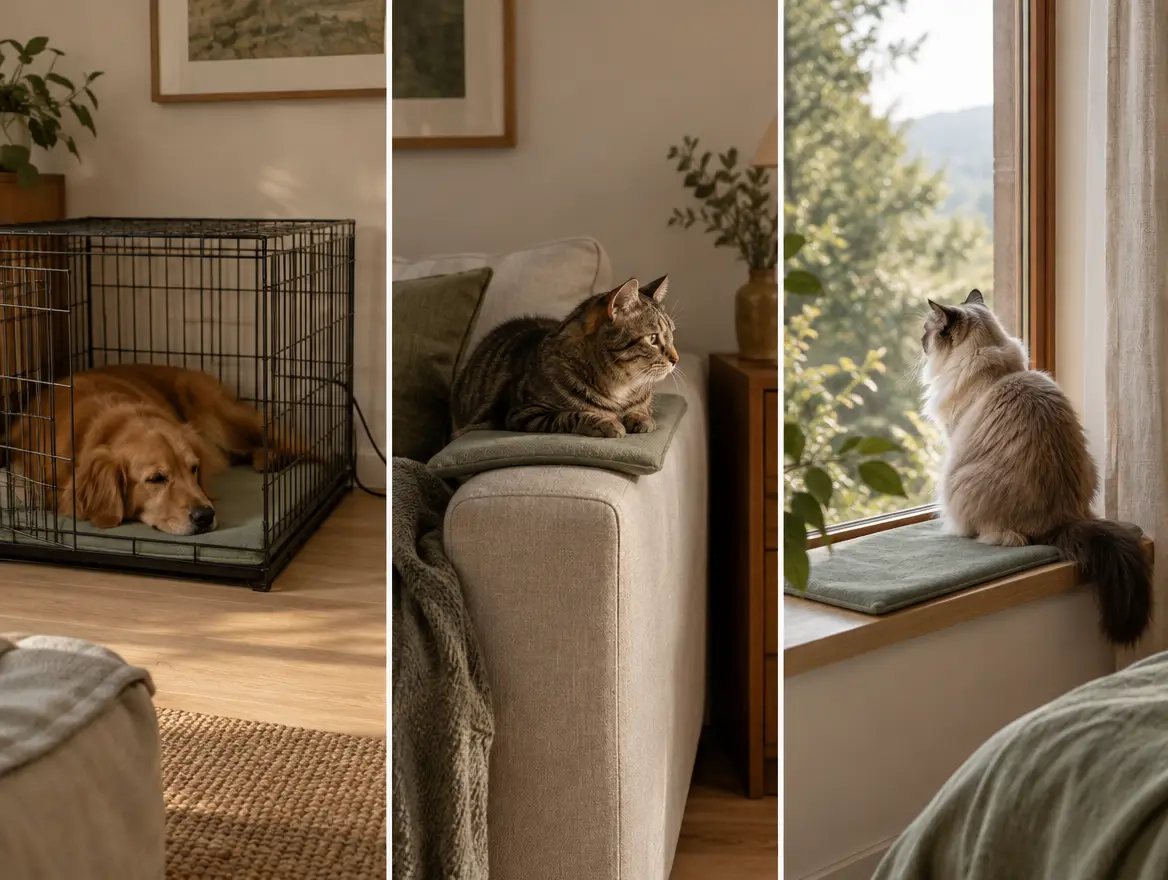
Put the mat where your pet already rests, not where you would like them to rest. That means their bed, their usual spot on the couch, a windowsill perch or the floor of their crate. Animals pick resting places for their own reasons, and a mat in the wrong spot simply gets ignored.
Watch your pet for a few days before you set anything up. Where do they sleep at 2pm? Where do they end up at night? The answer is your placement. If you have to coax, bribe or lift the animal onto the mat every time, you have chosen the wrong spot, and the cord is now running somewhere it does not need to.
Dogs in crates and beds
For a dog in a crate, the mat sits on the crate floor, and the cord must leave the crate and stay outside it. A cord inside a crate is a chew toy with a plug on the end. Before you buy, check that you can route it out of a corner or gap and straight to the wall without slack.
Wire crates are the tricky case. A cord running down the outside of the bars is still within reach of a determined paw or muzzle. Push the crate against a wall so the cord runs behind it, and add a cord cover over the exposed section. If you cannot get the cord out of reach, do not use the mat in that crate. That is a placement decision, not a failure.
For a dog bed, the same rule applies. Lay the mat flat on the bed surface, smooth out any bunching, and run the cord to the wall along the skirting or behind the bed frame. If your dog moves between a bed and a couch, pick the spot they choose most often and start there.
Cats on sofas and windowsills
Cats pick places for warmth, height and view, and those places are rarely near a socket. For a cat on a sofa, put the mat on the end or corner they already use and run the cord behind or under the sofa. For a windowsill, check that the cord can reach the wall without trailing across the floor.
Claws are the cat-specific problem. A loop of cord is something to hook, pull and play with. Keep the cord flat against a wall or skirting, secure it with clips or a cover, and leave no dangling slack near the mat. If you cannot make a windowsill run tidy, the windowsill is not the spot.
If your pet shares your bed or couch with you, think about where two cords end up before you plug in anything. Tidy is safer than clever.
How do you keep the cord away from teeth and claws?
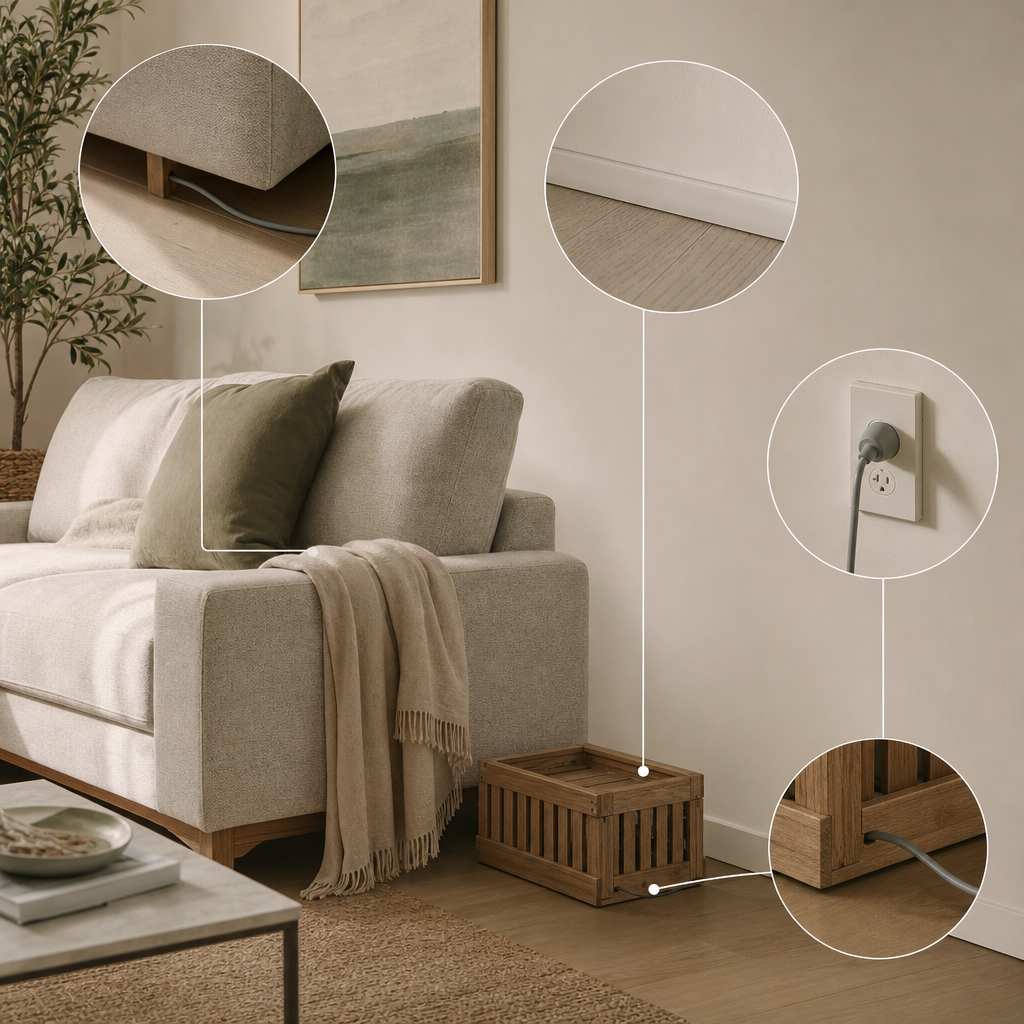
Route the cord behind furniture, cover any exposed run with a cord cover, keep crate cords outside the crate, and unplug when your pet is unsupervised. Then check the cord for bite marks every time you plug in. No setup stops a determined chewer, so supervision and routine checks matter most.
I cannot tell you your pet will not chew the cord. Nobody can. Some animals never look at a cable, and others regard it as a project. So I design the routine around the worst case rather than the average one.
A practical cord routine
- Route behind furniture. Run the cord behind the sofa, bed frame or crate so your pet never sees it.
- Use cord covers. Where the cord has to cross open floor or run along a wall, cover it. Flat covers and conduit-style covers both work. Choose one you can open to inspect the cord.
- Keep crate cords outside. The cord leaves the crate and stays out of reach, with the plug end and any slack well away from the bars.
- Remove loops and slack. Loops get hooked by claws and mouthed by teeth. Shorten the run with clips instead of coiling the excess.
- Unplug when unsupervised. This matters most for puppies and kittens, who explore with their mouths. If you cannot watch, unplug at the wall.
- Check for bite marks. Each time you plug in, run your eye and fingers along the cord. Look for dents, scuffs, exposed wire and kinks near the plug.
When you unplug, pull the plug body at the wall, not the cord.
If you find damage
Unplug at the wall before you touch anything. Stop using the mat and cord, keep your pet away from it, and contact us. If your pet has chewed the cord and you are worried about them, speak to your vet.
The grounding cord connects to the earth pin of a wall socket and no mains power flows through it by design. That is why the earth pin and resistor matter, and our article on whether grounding sheets are safe to plug in explains both. It does not make a chewed cord acceptable. A damaged cord means the mat is finished until it is replaced or checked.
What about the question of cats and safety?
People search for "are grounding sheets safe for cats" and want a one-line yes. I will not give you one, because safety here depends on the setup and the animal. What I can say is what I control: the textile is tested, the connection is checkable, and the cord can be managed. What you control is placement, supervision and inspection. If your cat is a chewer, or you have any health concern, ask your vet first.
How do you check the mat is connected?
Use the tester pen that comes in the box. Check the connection when you first set the mat up, and again over time, especially after you move furniture or tidy the cord. It is a quick check you can do yourself, which is the point of putting it in every box.
This is my "test it before you believe it" rule. I would rather you see the result with your own eyes than take my word for it. The tester pen does that job, and it applies to a pet mat the same way it applies to any of our grounding products.
I will not re-explain the whole process here. Our tester pen article walks through using it step by step, and our troubleshooting article covers what to do if the mat is not working. If the pen does not give you the result you expect, start there, then contact us.
Two cautions. First, do not regard the pen as a durability guarantee. It tells you about the connection on the day you test, not about how the mat will behave next year. Second, do not check only after cleaning. Check at setup and then every so often, and certainly after you have moved things around.
How do you clean a pet grounding mat?
Unplug the mat at the wall first, wipe it with a damp cloth, and let it dry fully before you reconnect. Follow the care label on the product page for what the mat can and cannot take. Never plug in a mat that is still damp.
Pets are messy, and that is fine. The routine is the same for each kind of mess.
- Hair. Unplug, then lift loose hair with a dry brush, lint roller or hand-held vacuum before it works into the fabric.
- Paw prints. Unplug, wipe with a damp cloth, and leave it to dry.
- Accidents. Unplug immediately. Blot the area, wipe with a damp cloth, and let the mat dry fully. Keep the cord and plug end away from any moisture. If the mat is soaked through, leave it unplugged and contact us before you use it again.
Check the care label on the product page before you use any cleaning product. The label governs what is suitable for the mat. If you are unsure, plain water and a damp cloth is the safest starting point.
Drying matters as much as wiping. Reconnect only when the mat is completely dry. If you can, wipe it in the morning, leave it unplugged through the day, and put it back when you are sure.
What should you ask before you buy a pet grounding mat?
Ask every brand, including us: certified to what standard, what exactly was tested, and what does the certificate cover? A badge can look impressive with very little behind it. A certificate number, a named standard and a stated scope are what turn a claim into something you can check.
These are the questions I use, adapted for a pet mat. Ask them of Organic Earthing too.
- What is the mat actually made from? Read the product page, not the headline.
- What makes it conductive, and what conductive material is used? "Conductive" is not an answer by itself.
- Can you test the conductivity yourself? A tester pen in the box says yes.
- How does it connect to ground? Look for the earth pin of a wall socket and an explanation of the resistor.
- What testing or documentation does the company have? Certified to which standard, covering what?
Here is what we publish. Our OEKO-TEX Standard 100 certificate number is SH025 231655, and our manufacturing partner is certified at Product Class I. That is our own data. Before you buy the certified pet grounding mat, confirm on the product page that the pet mat sits within that certificate's scope. That is exactly the question I am telling you to ask.
Our RoHS certificate and our 10% silver thread figure apply to our grounding sheets only. Do not read them as describing the pet mat. Keeping each claim attached to the product it covers is the whole discipline.
The offer is proof, not a price cut: a tester pen in every box, a 90-night trial from delivery and a 1-year warranty. Returns need to be in reasonable condition, and return postage is on the customer. For the wider picture, see the pet grounding guide.
Why I judge the mat on the fabric before the grounding
Most of the conversation about grounding is about whether it works. I would flip the order: judge the product first on what it is made of and what it has been tested for, because that is what touches your skin every night, and what your pet lies, licks and sheds on.
When I started Organic Earthing, I wanted to know what was in the products I was selling and to have independent testing behind them, particularly for harmful or restricted substances. The category was talking only about whether grounding worked. So I chose OEKO-TEX Standard 100 and accepted the higher cost and a more complicated supply chain. The result is that we can publish certificate numbers instead of adjectives. I don't want customers to trust us because we've written "premium" on a website. I want there to be something behind it.
That is the idea I call the two kinds of claim. One is what the fabric is and what it has been tested for: a named standard, a number, a stated scope. The other is what grounding does for sleep, which is a separate, open question. The small published studies have limits in sample size and design, and I will not claim more than they show. For pets I make no health claims at all.
The practical consequence for your mat is simple. Cord safety is something you manage with routing, covers and supervision. The textile is something you can question before you buy. Do both, and ask the second question of us before you ask it of anyone else.
If you want to see it for yourself, see the certified pet grounding mat. It comes with a tester pen in the box, a 90-night trial from delivery and a 1-year warranty. Sleep on it for 90 nights, decide later.
References
- OEKO-TEX, STANDARD 100 by OEKO-TEX
- ACCC, Product Safety Australia
- Organic Earthing, Grounding for pets
- Organic Earthing, Pet grounding guide
Take this with you
Grounding for pets, in your inbox.
How to introduce a dog or cat to a grounding mat: where to put it, how long, and how to keep it clean.
Questions people ask
Are grounding sheets safe for cats?
Safety depends on the setup and the cat. The main risk is the cord, so route it behind furniture, keep it flat, unplug when your cat is unsupervised and check it for bite marks. This is a wellness product, not a medical device. If your cat chews cords or you have a health concern, ask your vet first.
Where should I put a grounding mat for my dog?
Put it where your dog already rests: their bed, their spot on the couch or the floor of their crate. Do not try to move the dog to the mat. For a crate, make sure the cord leaves the crate and stays out of reach of paws and teeth.
What if my dog or cat chews the cord?
Unplug at the wall, stop using the mat and keep your pet away from the cord. Contact Organic Earthing before using it again. If you are worried about your pet, speak to your vet. For puppies and kittens, unplug whenever you cannot supervise.
Can I leave a pet grounding mat plugged in when I am out?
Organic Earthing recommends unplugging when your pet is unsupervised, especially puppies and kittens, who explore with their mouths. Unplugging removes the cord as something to chew and the mat as something to disturb while you cannot watch.
How do I clean a pet grounding mat?
Unplug it first, wipe with a damp cloth and let it dry fully before reconnecting. For hair, use a dry brush, lint roller or hand-held vacuum. For accidents, unplug immediately and keep the plug end dry. Follow the care label on the product page.