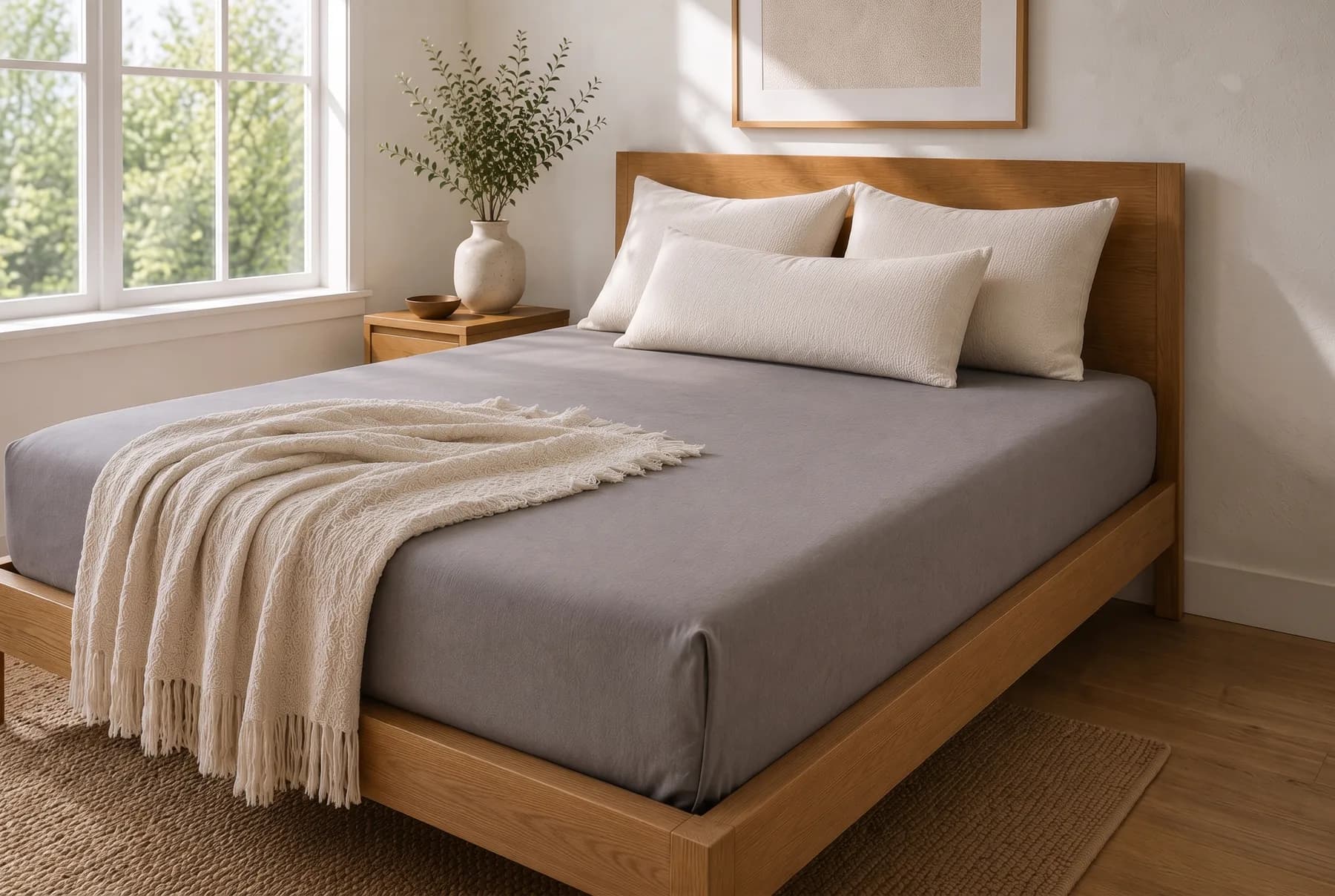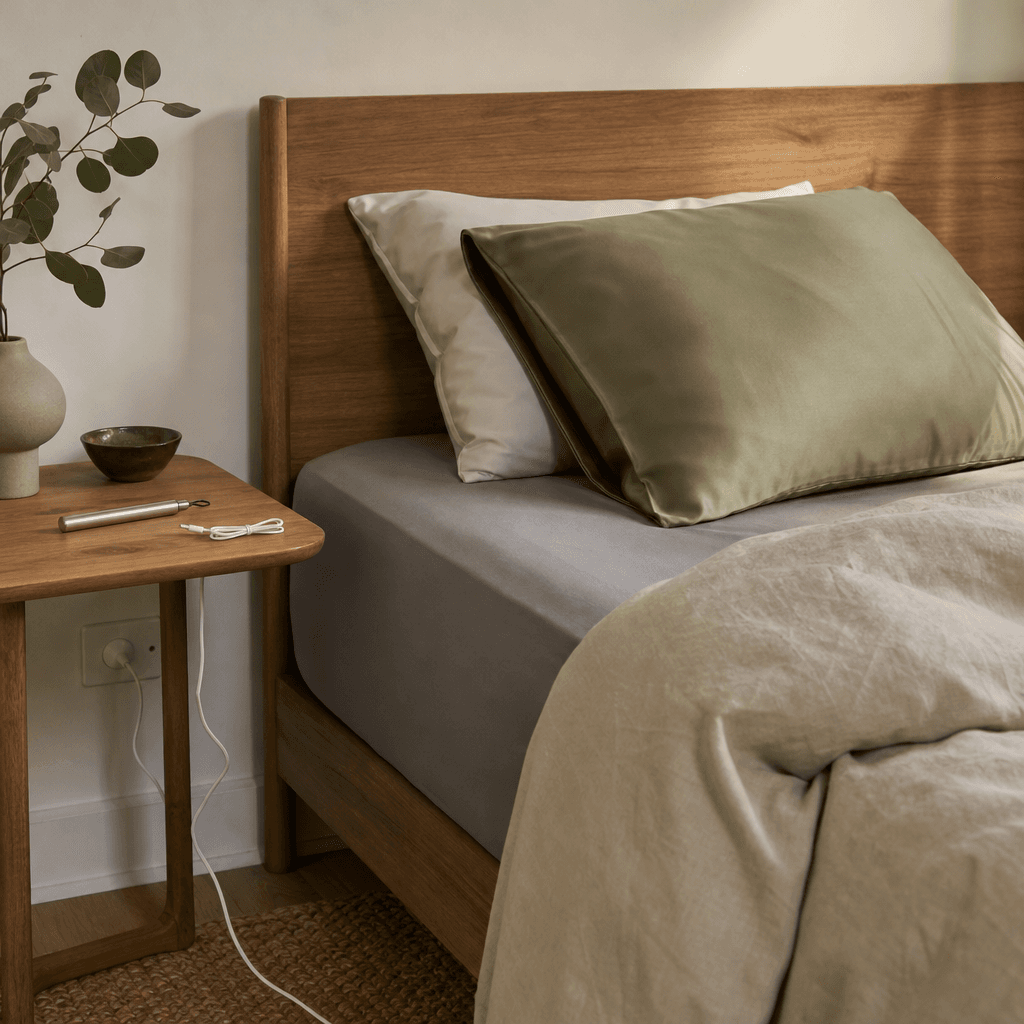
Grounding · 22 Oct 2026 · 17 min read
Fitted vs Flat Grounding Sheet: How to Choose for Your Bed and the Way You Sleep
Fitted or flat grounding sheet? Match the format to your mattress depth, sleep position and whether you share the bed, then test it with the tester pen.
By Jade Castle, founder. Wellness product, not a medical device.
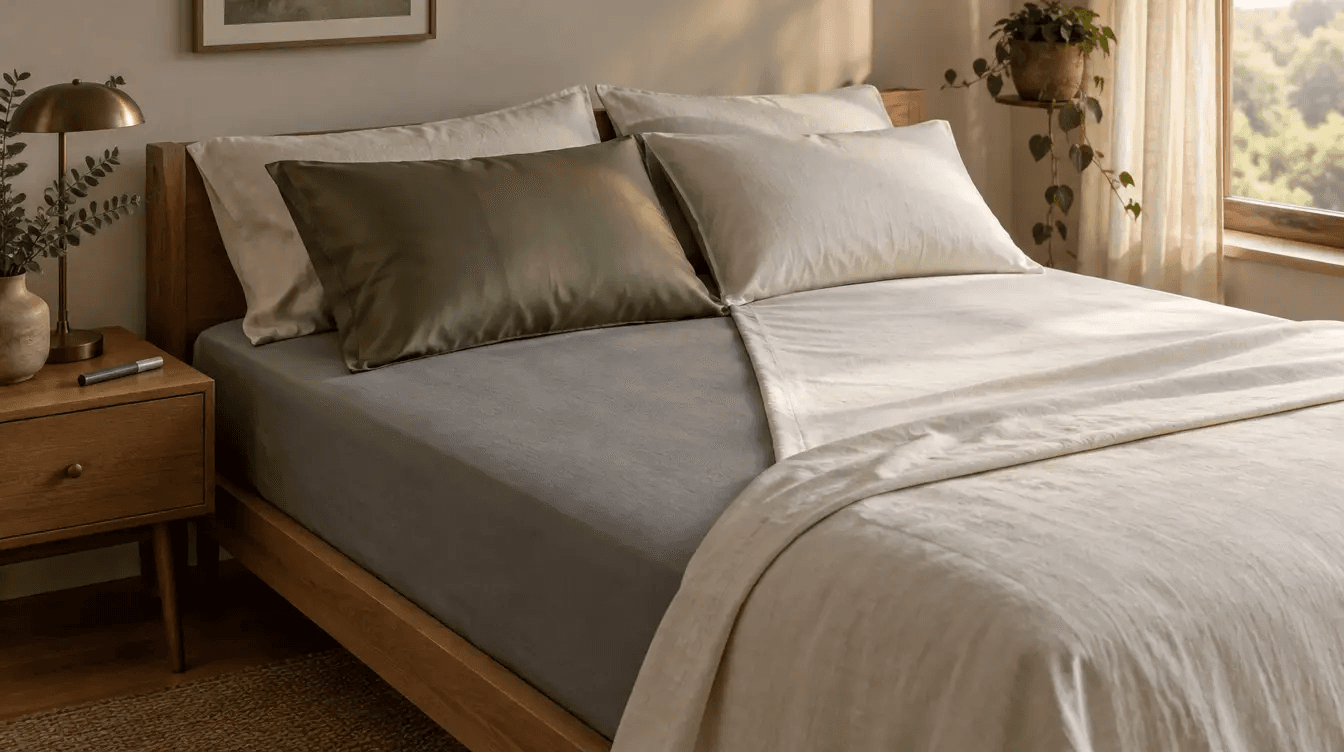
Choose a fitted grounding sheet if you want steady skin contact all night, because it stays put under you. Choose a flat grounding sheet if you share the bed, sleep hot or move a lot, because you can tuck it, lay it over you, or cover one side only.
I'm Jade, founder of Organic Earthing, an Australian-owned, family-run brand selling globally. Most grounding articles argue about whether grounding works. This one answers a narrower question: once you have decided to try a sheet, which format belongs on your bed?
The answer depends on three things: your mattress, how you sleep and whether you share. Below you will find our sizes, a way to measure your mattress depth, how each format behaves for back, side and restless sleepers, and how to check what you are buying, including the claims we make ourselves.
Key Takeaways
- Fitted suits most people who want consistent contact all night. The elastic pocket keeps the sheet flat under you.
- Flat suits sharers, hot sleepers and people who move around the bed. It can be tucked as a bottom layer or laid over you.
- Measure your mattress depth including any topper. Our fitted sheets have a 33 cm pocket. If you are deeper than that, flat is the safer format.
- If your partner is not interested in grounding, the Half flat sheet covers your side only.
- Check everything, including us: certificate numbers, the tester pen in the box, the 90-night trial and the 1-year warranty.
Fitted vs Flat Grounding Sheet at a Glance
| Question | Fitted | Flat |
|---|---|---|
| How does it stay in place? | Elastic pocket holds it under you | Tucked in, or laid over you |
| Best for | Solo sleepers who want contact all night | Sharers, hot sleepers, people who move a lot |
| Deep mattress or topper | Works up to its pocket depth | Safer choice beyond the pocket depth |
| Sharing with a partner who is not interested | Covers the whole mattress | Half size covers one side only |
| Warm nights | Always underneath you | Can be used as a lighter top or bottom layer |
| Setup effort | Low, fits like a normal fitted sheet | Needs tucking, may need re-tucking |
Fitted or Flat: The Short Answer
A fitted grounding sheet suits most people who want consistent contact all night, because the elastic pocket holds it flat under you. A flat grounding sheet suits sharers, hot sleepers and restless movers, because you can tuck it, lay it over you, or use it on one side.
The fabric is the same in both formats: organic bamboo woven with 10% silver thread, OEKO-TEX Standard 100 certified. So you are not choosing between materials. You are choosing a shape. The question is which shape keeps your skin on the sheet in the way you actually sleep.
I keep two kinds of claim apart throughout this article. What the fabric is made of and tested for is one thing. What grounding does for sleep is a separate, open question that the small studies have not settled. Format matters for the first kind of question, because it decides whether the sheet is where your skin is. It says nothing about the second. This is a wellness product, not a medical device.
We have covered the material question separately in Bamboo vs Cotton Grounding Sheets, and the difference between grounding and regular fitted sheets in Grounding Fitted Sheets vs Regular Fitted Sheets. This piece assumes you have settled on a textile and want to settle the format.
Measure Before You Choose: Sizes and Mattress Depth
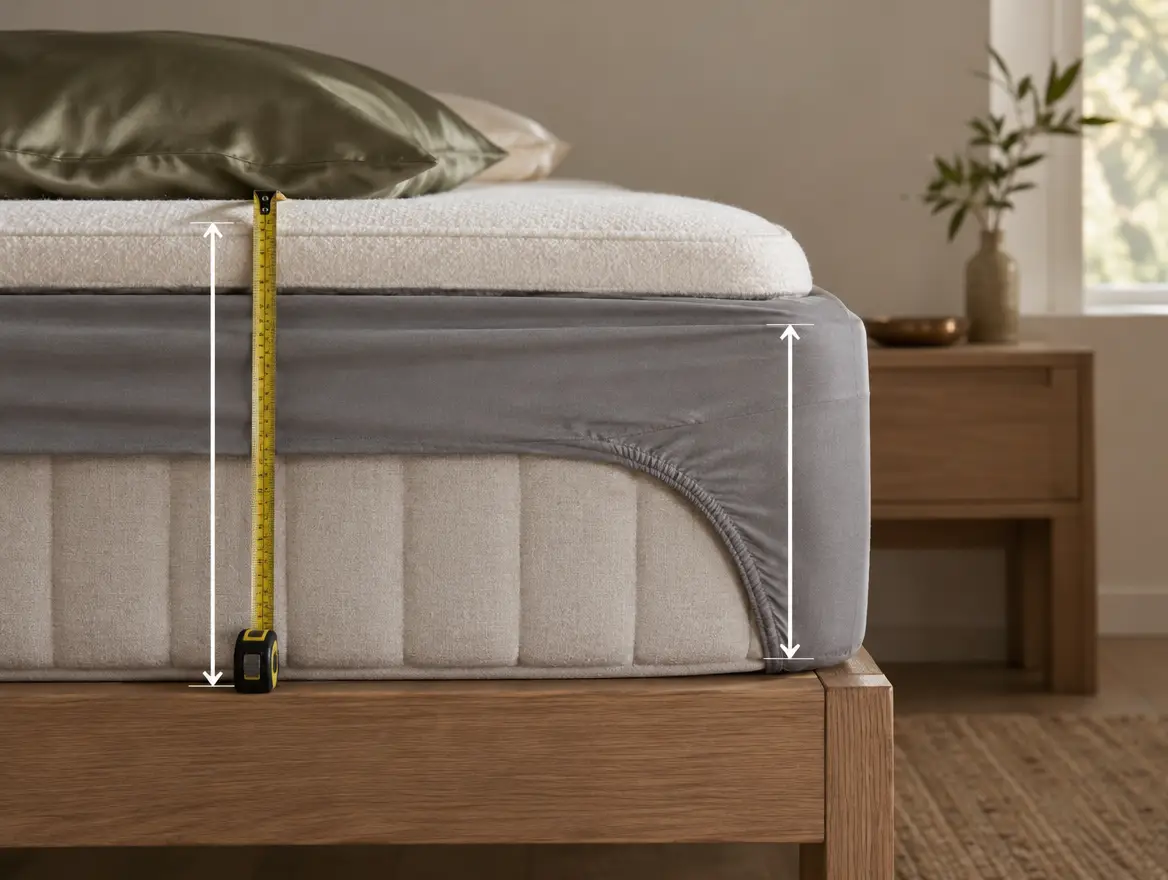
Measure your mattress length, width and depth in centimetres, including any topper, before you pick a format. Our fitted sheets have a 33 cm pocket. Beyond that depth, or if you want a looser fit, the flat range is the more forgiving option.
Source: Organic Earthing product specifications (the brand's own data).
| Format | Size | Dimensions | Source |
|---|---|---|---|
| Fitted | Single | 90 x 190 cm | Organic Earthing product specifications |
| Fitted | Double | 137 x 190 cm | Organic Earthing product specifications |
| Fitted | Queen | 153 x 203 cm | Organic Earthing product specifications |
| Fitted | King | 183 x 203 cm | Organic Earthing product specifications |
| Flat | Half | 125 x 260 cm | Organic Earthing product specifications |
| Flat | Queen | 245 x 260 cm | Organic Earthing product specifications |
| Flat | King | 265 x 260 cm | Organic Earthing product specifications |
The fitted sizes match common Australian mattress sizes. The flat sheets are much longer than a mattress, at 260 cm, because the extra fabric is what you tuck.
How to measure mattress depth
The depth of your mattress is only half the story. A topper adds to it, and so does a mattress protector or a thick wool underlay. Here is the quick method:
- Strip the bed back to the mattress and any topper.
- Hold a tape measure flat against the side. Measure from the base of the mattress to the top surface of the highest layer.
- Write the number in centimetres and compare it to the 33 cm pocket.
If you are comfortably under 33 cm, a fitted sheet will sit as a normal fitted sheet does. If you are near or over, do not force it. A fitted sheet pulled tight over a deep stack tends to ride up at the corners, and a sheet that rides up is a sheet that is not under you.
Where each size sits
On a Single, Double, Queen or King, the fitted range maps to your mattress one for one. Our flat range starts at the Half, then goes to Queen and King. If you are on a Single or Double and want a flat format, the Half is the one to look at.
One point about flat sheets: size up on purpose. A flat sheet needs fabric to tuck. The Queen flat at 245 x 260 cm is sized for a Queen bed with room to tuck, not for a bed one size up.
How You Sleep Decides the Format
Your sleep position decides where your skin meets the sheet, and that decides the format. Back sleepers get the widest contact on a bottom layer. Side sleepers need the sheet to stay smooth under hip and shoulder. Restless sleepers need a format that stays in place or follows them.
The point of any grounding sheet is skin on the fabric. Whatever you wear, if the sheet is bunched at your feet or kicked to the floor, there is no contact to talk about. So the practical question is simple: which format is still under you at 3 am?
Back sleepers
Back sleepers spend most of the night in one place, with large areas of skin on the bottom layer. A fitted sheet is the simplest answer. It sits across the whole mattress with no tucking, and it does not move when you shift your legs.
Side sleepers
Side sleepers press hip, shoulder and arm into the mattress, and the pressure points change as they turn. A fitted sheet keeps the surface smooth through those turns. The elastic holds the corners, so the fabric does not drag towards the middle of the bed as you roll.
Restless sleepers
If you change position often, you have two reasonable options.
- Fitted: the sheet stays put underneath you however you move, as long as the pocket depth suits your mattress.
- Flat, tucked as a bottom layer: the 260 cm length means there is fabric wherever you roll. The trade-off is that a flat sheet can pull loose at the edges overnight. If you pick this, tuck firmly and expect to re-tuck now and then.
Flat sheet as a bottom layer or a top layer
You can use a flat grounding sheet in two ways. Tucked under the mattress like a traditional flat sheet, it becomes your bottom layer. Laid over the top, it touches whatever skin is outside your other bedding.
Be honest with yourself about the second option. A flat sheet laid over you only makes contact where it touches you. If you kick the covers off, contact goes with them. For anyone who moves a lot or throws bedding around, I would tuck the flat sheet as a bottom layer first and only use it over you once you know your habits.
Sharing a Bed: When the Half Flat Sheet Makes Sense
If your partner is not interested in grounding, a Half flat grounding sheet (125 x 260 cm) covers your side only. Lay it as a bottom layer on your half, tuck the ends, and your partner sleeps on whatever they already use.
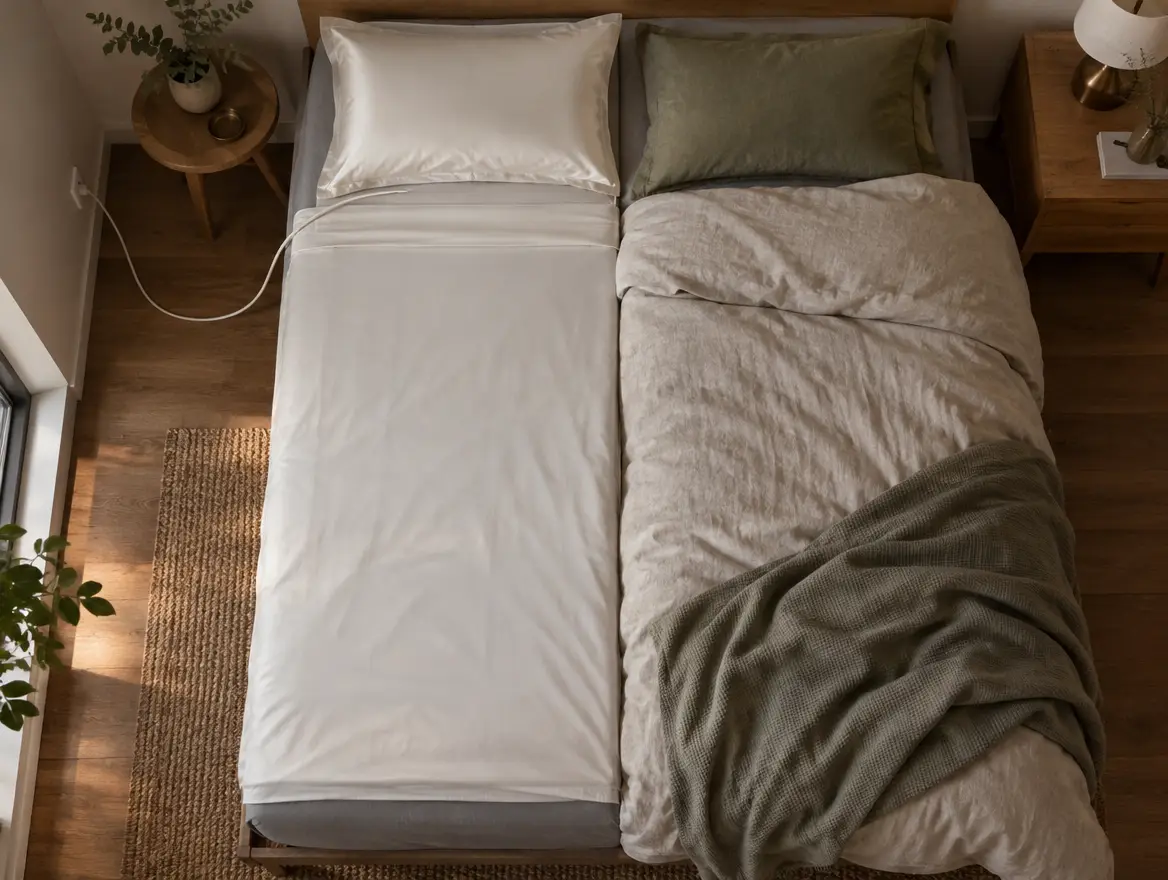
This is the case where flat clearly beats fitted. A fitted sheet covers the whole mattress, which is the right call when the whole bed is going to be grounded. It is the wrong call when only one of you wants it.
Setting up a half grounding sheet
- Position it along your side of the bed, with the long edge running head to foot.
- Tuck the head and foot ends under the mattress, so it does not shift when you turn.
- Keep the cord on your side of the bed, close to your wall socket, and out of walkways.
- Test it with the tester pen when you first set it up (more on that below).
The cord connects to the earth pin of a wall socket. No power flows. Only the grounding connection is used. If your socket is on your partner's side, plan the cord route before you commit to a layout.
Grounding sheet for couples who both want it
If you both want to try it, the full-width Queen or King sheet in either format covers the bed. Fitted is the easier choice if neither of you wants to tuck. Flat is the better choice if you each run at a different temperature and want separate top layers. I would not buy two Half sheets and overlap them unless you want to manage two connections.
One caveat that matters: a shared sheet is a shared decision. If one partner is only trying it to be polite, the Half is a lower-pressure way to begin, and you can always move to a full-width sheet later.
If you may want both a fitted base and a flat layer, our Grounding Sleep Bundle includes both formats.
Hot Sleepers: Why a Flat Layer Suits Warmer Nights
Hot sleepers tend to do better with a flat layer because it gives them control: one thin layer, easy to adjust through the night. Bamboo with 10% silver thread keeps the softness and breathability of bamboo, and the silver has a job to do: conduct.
Bamboo on its own is not conductive enough to ground a body. So fine silver fibres are woven through the bamboo rather than coated on top. The sheet keeps the softness, breathability and moisture handling that bamboo is known for, which matters if you run warm. Neither material is there because it sounds good in marketing. For context, the competing products we have looked at state 5% silver or less (our own comparison of brand specifications). Ours is 10%.
What people report, and what I will not claim
Warm sleepers describe comfort in plain terms: a smooth, lightweight feel, and being able to drop a layer when the night is warm. That is a report about fabric and bedding, not a claim about what grounding does to a body. I will not make that second claim. The research on grounding and sleep is small, and it has not settled the question.
Consider someone in their fifties who kicks the covers off by 2 am. A flat sheet laid over the top will end up on the floor with everything else. The more reliable setup is a flat sheet tucked as the bottom layer, with a light top cover they can discard without losing contact. The format choice is a bedding choice first.
A practical hot-night setup
- Tuck the flat grounding sheet as your bottom layer.
- Keep your top bedding light, so you can drop it without disturbing the sheet.
- Make sure your skin is on the sheet, not on thick sleepwear. Whatever you wear, direct contact is the aim.
- Test it with the pen at setup so you know the connection works before the first night.
If you already own a fitted grounding sheet and want a flat layer for warmer months, that is exactly what the flat format is for.
Check What You Buy: Questions to Ask Any Grounding Brand
Check what you buy by asking five questions of any grounding brand, including us. What is the sheet made from? What makes it conductive? Can you test it yourself? How does it connect to ground? Certified to what standard, and what does it cover?
Here is how we answer them, and then why you should not simply take our word for it.
- What is it made from? Organic bamboo woven with 10% silver thread.
- What makes it conductive? The silver fibres woven through the bamboo. The bamboo does not conduct on its own.
- Can you test it? Yes. There is a tester pen in every grounding box.
- How does it connect? A cord runs to the earth pin of a wall socket. No power flows.
- What documentation exists? OEKO-TEX Standard 100 certificate SH025 231655, and RoHS compliance certificate CHHB26080392392 for the grounding sheets.
What the certificates cover
OEKO-TEX Standard 100 is a testing standard for harmful substances in textiles. Our manufacturing partner is certified at Product Class I, the strictest class. RoHS is an EU directive restricting certain hazardous substances in electrical and electronic equipment, and we had the grounding bedding tested for compliance.
Now the limits. Neither document says anything about whether grounding works or what it does for sleep. They are about what the textile is and what it has been tested for. That is the first kind of claim, and the only kind a certificate can support. The word certified in this article attaches to a named standard and number, nothing else.
Question every certificate, including ours
I don't want customers to trust us because we've written premium on a website. So question everything on a product page, ours included. Ask: certified to what standard, and what does it cover? What exactly was tested? Which entity holds the certificate? Is the number published so you can check it? You can look up an OEKO-TEX certificate number using the label check on the OEKO-TEX website.
A badge can look impressive with very little behind it. If a brand cannot tell you the standard, the number and the scope, you have learned something about the brand. Customers questioning brands more would be good for the whole category.
For a wider checklist on buying in this market, see Grounding Sheets in Australia: What to Check Before You Buy.
Test it before you believe it
The tester pen is how you check conductivity yourself. Use it when you first set the sheet up, and again over time. I will not tell you to test after every wash, and I will not offer a durability guarantee. The pen is there so you can see what the sheet is doing, not so you have to take my word for it.
The rest of the offer is deliberately plain:
- 90-night trial from delivery. Sleep on it for 90 nights, decide later.
- 1-year warranty on every grounding product.
- Returns in reasonable condition, with return postage on the customer.
- Certificate numbers published on the product pages.
These sit alongside your rights under Australian Consumer Law, which apply regardless of any brand's trial or warranty. The ACCC explains them on its consumer guarantees page (see References).
The first 30 nights
Set your expectations before you start. Some people notice something in the first week. Many notice nothing until the third. Both are normal, which is why the trial runs 90 days. I will not promise you a timeline of results, because I do not have one to promise. If you want a neutral overview of the research, the Sleep Foundation's guide to grounding sheets is a good starting point.
Why I Judge the Textile First and the Format Second
I started Organic Earthing before I had heard of grounding. I had already become conscious of what touches your skin every night, and I was choosing natural fabrics where I could. Then I found grounding, went down the rabbit hole, and could not find a brand that combined it with the materials and look I wanted in my own home. The products I found were clinical, generic or led with price.
That history shapes how I think about this decision. The category argues about whether grounding works. Almost nobody talks about the textile you are sleeping on for eight hours. So my position is a little contrarian: judge the sheet first on what it is made of and what it has been tested for. Then choose the format that keeps your skin on it.
Format is the cheapest mistake to avoid. A grounding sheet is a $419 decision made online, by people who cannot feel the fabric or know how they will sleep on it until it is on their own bed. A fitted sheet that is too shallow for a topper, or a flat sheet that works loose for a restless sleeper, is not a failure of grounding. It is a mismatch you could have caught with a tape measure.
That is why the offer is built around proof you can check at home, not a price cut. The trial and the tester pen lead every product page, and questions about returns go straight to me. A product at this price cannot argue with a clearance voice. It can show you what sits behind it, and then let you decide. That is the premium, transparent end of grounding.
Your next step
Measure your mattress depth, pick your format and test it with the pen inside your 90 nights. Want both formats? Choose the Grounding Sleep Bundle.
References
- OEKO-TEX, STANDARD 100 by OEKO-TEX
- European Union, Directive 2011/65/EU on the restriction of the use of certain hazardous substances in electrical and electronic equipment (RoHS)
- ACCC, Consumer guarantees
- Sleep Foundation, What Are Grounding Sheets?
Take this with you
Your first 30 nights, in your inbox.
What people usually notice in the first month on a grounding sheet, week by week, and why you get 90 days rather than 14.
Questions people ask
Is a fitted or flat grounding sheet better?
Neither is better in general. A fitted sheet suits most people who want consistent contact all night, because it stays put under you. A flat sheet suits sharers, hot sleepers and restless movers, because you can tuck it, lay it over you or cover one side only.
What mattress depth does a fitted grounding sheet fit?
Our fitted grounding sheets have a 33 cm pocket, designed for deep mattresses and toppers. Measure from the base of your mattress to the top of any topper. If you are near or over 33 cm, a flat sheet is the safer choice.
What is a half grounding sheet?
A half grounding sheet is a flat sheet that measures 125 x 260 cm. It covers one side of a shared bed, which suits you if your partner is not interested in grounding. Tuck it as a bottom layer on your half.
Can couples share one grounding sheet?
Yes, if both want to. A Queen or King sheet in either format covers a shared bed. If only one of you is keen, the Half flat sheet is a simpler choice, and your partner keeps their own bedding.
How do I know my grounding sheet is working?
Use the tester pen supplied in every grounding box. Check conductivity when you first set the sheet up and again over time. The pen shows you the sheet's conductivity. It does not tell you what grounding does for sleep, which is still an open question.