Grounding · 5 Nov 2026 · 16 min read
Grounding Sheet With a Mattress Protector, Topper or on the Road: Where the Layers Go and How to Check the Connection
Where a grounding sheet goes with a mattress protector, topper or travel setup, how to check the 33 cm pocket, and test the connection with the tester pen.
By Jade Castle, founder. Wellness product, not a medical device.
Part ofThe setup and care guide
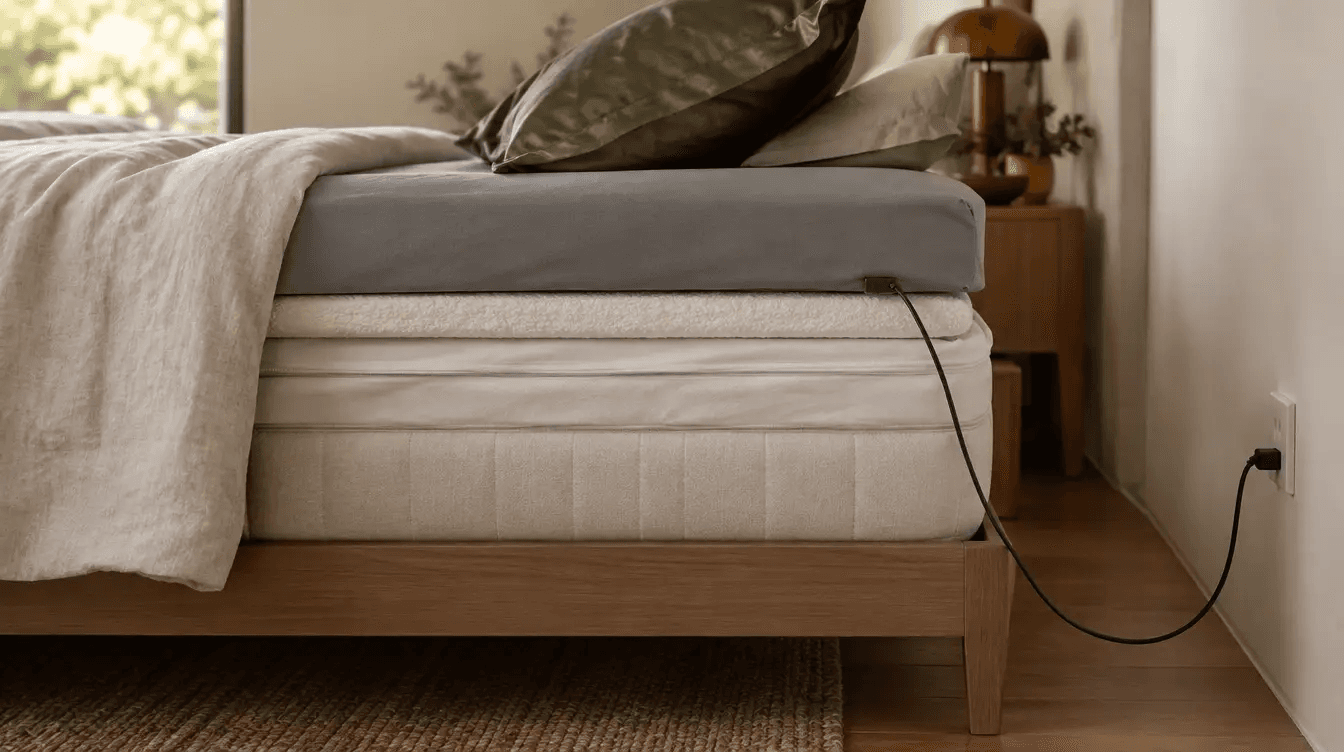
A grounding sheet goes on top of everything else on the bed. The order is mattress, then waterproof protector, then topper, then the grounding sheet, so nothing sits between your skin and the sheet. After any change to the bed, check the connection with the tester pen instead of assuming it still works.
Most grounding sheet problems are layering problems, not product problems. Consider the usual ways it goes wrong: a topper added for winter, a protector pulled over the top "to keep the sheet clean", or a hotel stay with a travel adapter that quietly drops the earth connection. In each case the bed looks fine and nobody checks whether the sheet is still connected.
Jade Castle, our founder, thought about what touched her skin long before she had heard of grounding. That is why we judge a setup the same way: textile first, connection second, claims last. This guide gives you exact steps for protectors, toppers and travel, and it links to our full grounding sheet setup guide for the basics. A grounding sheet is a wellness product, not a medical device, and nothing here is a health claim.
Key Takeaways
- The grounding sheet is the layer your skin touches, so it always goes on top: mattress, protector, topper, grounding sheet.
- A waterproof protector sits underneath. The sheet connects through its cord to the earth pin of a wall socket, not through the mattress.
- Measure mattress plus topper depth. If the total is over the 33 cm fitted pocket, or the topper shifts, a flat sheet is the easier choice.
- Recheck with the boxed tester pen after adding a topper, washing the sheet, moving the bed or reseating the cord.
- When travelling, test the hotel socket first. Any plug adapter must carry the earth connection, and many two-pin adapters do not.
- Question every setup claim, including ours: ask what was tested and what each certificate covers.
Summary Table
| Situation | What to do | What to check |
|---|---|---|
| Standard bed | Mattress, protector, grounding sheet on top | Tester pen on night one |
| Waterproof protector | Keep it underneath the sheet | Cord reaches the earth pin without strain |
| Topper added | Sheet goes over the topper | Combined depth against the fitted pocket, then the pen |
| Topper shifts or bed is very deep | Choose a flat sheet | Tuck in firmly, then the pen |
| Sheet washed or bed moved | Refit and reseat the cord | Tester pen again |
| Hotel or travel | Test the socket, use an earth-carrying adapter | Pen on the socket and on the sheet |
Where do the layers go on a bed with a grounding sheet?
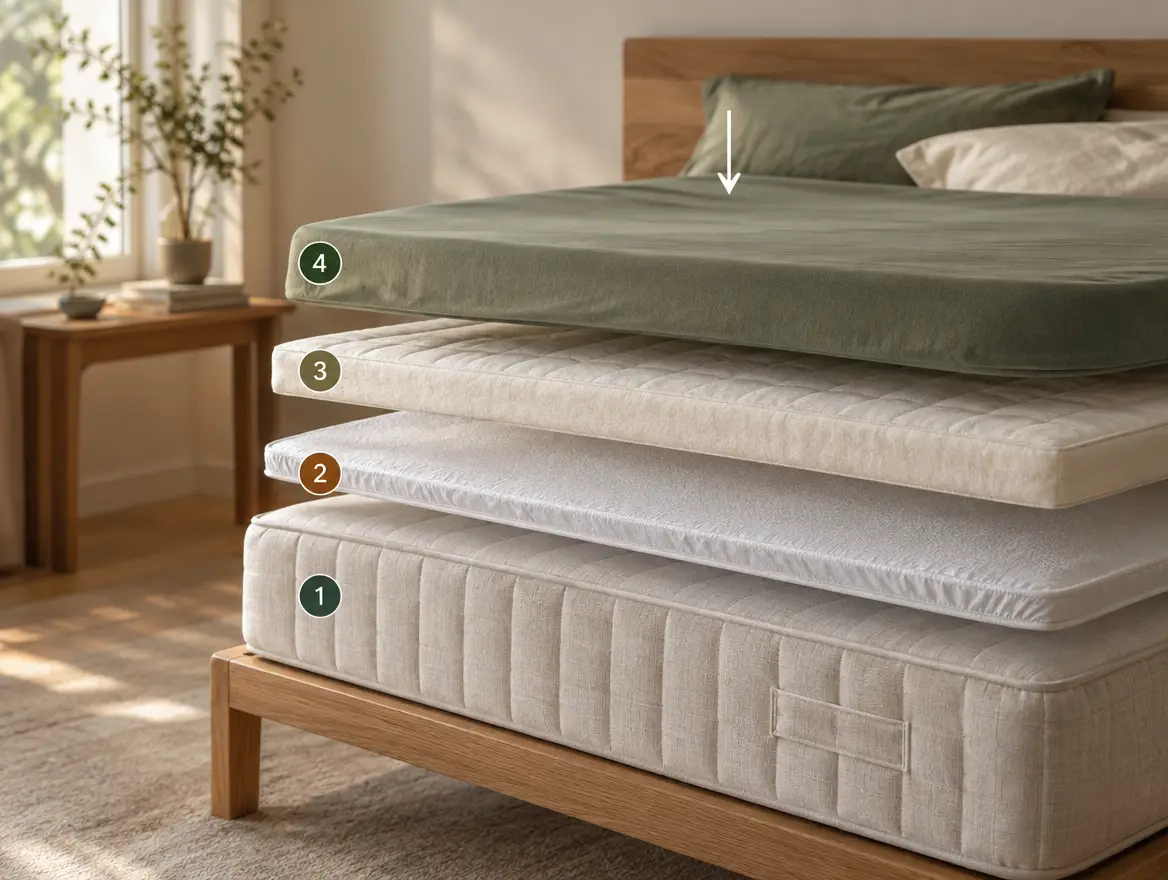
The grounding sheet goes on top, as the layer your skin touches. From the bottom up: mattress, waterproof protector, topper if you use one, then the grounding sheet. Nothing sits between your skin and the sheet, because the sheet is a surface you are meant to be in direct contact with.
The order, from the bottom:
- Mattress
- Waterproof mattress protector
- Topper (optional)
- Grounding sheet
- Your usual covers on top (doona, blanket) and pillows
The reasoning is simple. A grounding sheet is connected by a cord to the earth pin of a wall socket. The point of the setup is you, lying on that surface. Put a protector, a second sheet or a thick underlay above it and you have placed a barrier where the contact is supposed to be. Anything on top of you, like a doona, is fine. Anything between you and the sheet is not.
The sheet also replaces your normal bottom sheet rather than sitting on top of it. If you currently use a cotton fitted sheet over your protector, the grounding sheet takes that spot.
What about pillows, silk pillowcases and cooling toppers?
If you are a hot sleeper adding a cooling topper or a silk pillowcase, the same rule applies. A cooling topper is a mattress-level layer, so it goes under the grounding sheet. A silk pillowcase covers the pillow and does not compete with the sheet for the same position on the bed.
One note on fabric. Bamboo handles moisture and breathes, and the silver has a job to do: conduct. Our sheet is organic bamboo with 10% silver thread woven through it, so it keeps the feel of bamboo while the silver does the conducting. Hot sleepers care about that feel as much as the connection.
Does a mattress protector affect a grounding sheet?
A waterproof protector sits underneath the grounding sheet and does not change how it connects. The sheet grounds through its cord to the earth pin of a wall socket, not through the mattress or anything beneath it. The protector guards the mattress. The sheet does a separate job.
This is the question that trips people up most, so it is worth being exact. The mattress is not part of the circuit. Nor is the protector. Whether your protector is waterproof, quilted or terry-backed makes no difference to the connection, because the connection runs from the sheet, down the cord and into the earth pin. No power flows through the cord. Only the grounding connection is used.
Three practical points follow:
- Never put the protector on top of the sheet. That puts a barrier against your skin. If you want to protect the sheet from spills, wash it according to its care label instead.
- Count the protector in your depth measurement. Thick quilted protectors add depth, which matters if you are using a fitted sheet (see the next section).
- Check the cord path. A protector with deep skirts or a tight elastic edge can pinch a cord where it runs off the bed. Route the cord along the side of the bed so nothing clamps it.
If you swap or add a protector, regard it as a change to the bed and run the tester pen check.
How do you fit a grounding sheet over a mattress topper?
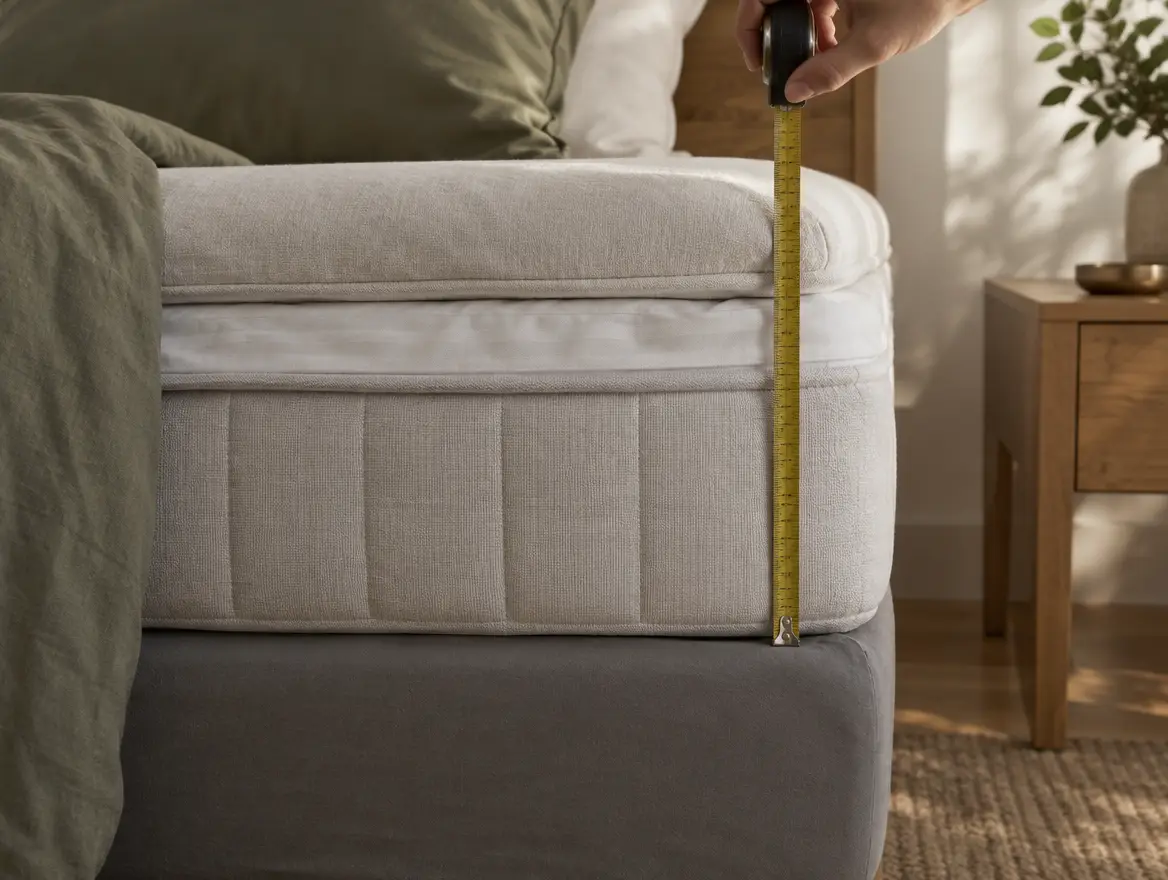
Measure your mattress and topper together, from the base of the mattress to the top of the topper. If the total is more than 33 cm, or the topper shifts when you move, choose a flat sheet instead. Our fitted sheet has a 33 cm pocket, and a stretched corner tends to lift and slide.
The grounding sheet goes over the topper, never under it. The measuring is where most people skip a step. Pocket depth is the number that decides fitted or flat, and it is not the same as the mattress label.
How to measure fitted grounding sheet pocket depth
- Make the bed with the mattress, protector and topper in place, exactly as you sleep on it.
- Press the topper flat at the corner, where it is least compressed.
- Hold a tape measure at the base of the mattress and run it up the side to the top surface of the topper.
- Write the number down. Compare it with the 33 cm pocket.
- If you are close to the limit, remember that thicker protectors and pillow-top mattresses are the usual culprits.
If the total is under 33 cm and the topper stays put, the fitted grounding sheet is the neater option. If the total is over 33 cm, or you have a topper that creeps across the mattress, a flat sheet is the easier choice. You tuck it in firmly and it does not rely on elastic gripping a deep corner. Our write-up on fitted vs flat grounding sheets goes through the trade-offs in more detail.
What if the topper shifts?
A topper that moves is the main reason to go flat. A shifting topper drags a fitted sheet with it, pulls on the cord and can change how the sheet sits. Fix the topper first if you can (some have straps or non-slip bases), then refit the sheet and test.
When should you check the connection with the tester pen?
Recheck with the boxed tester pen after adding a topper, washing the sheet, moving the bed or reseating the cord. Each of those can change the contact or the cord path. The check is quick, and it replaces an assumption with a result. Test it before you believe it.
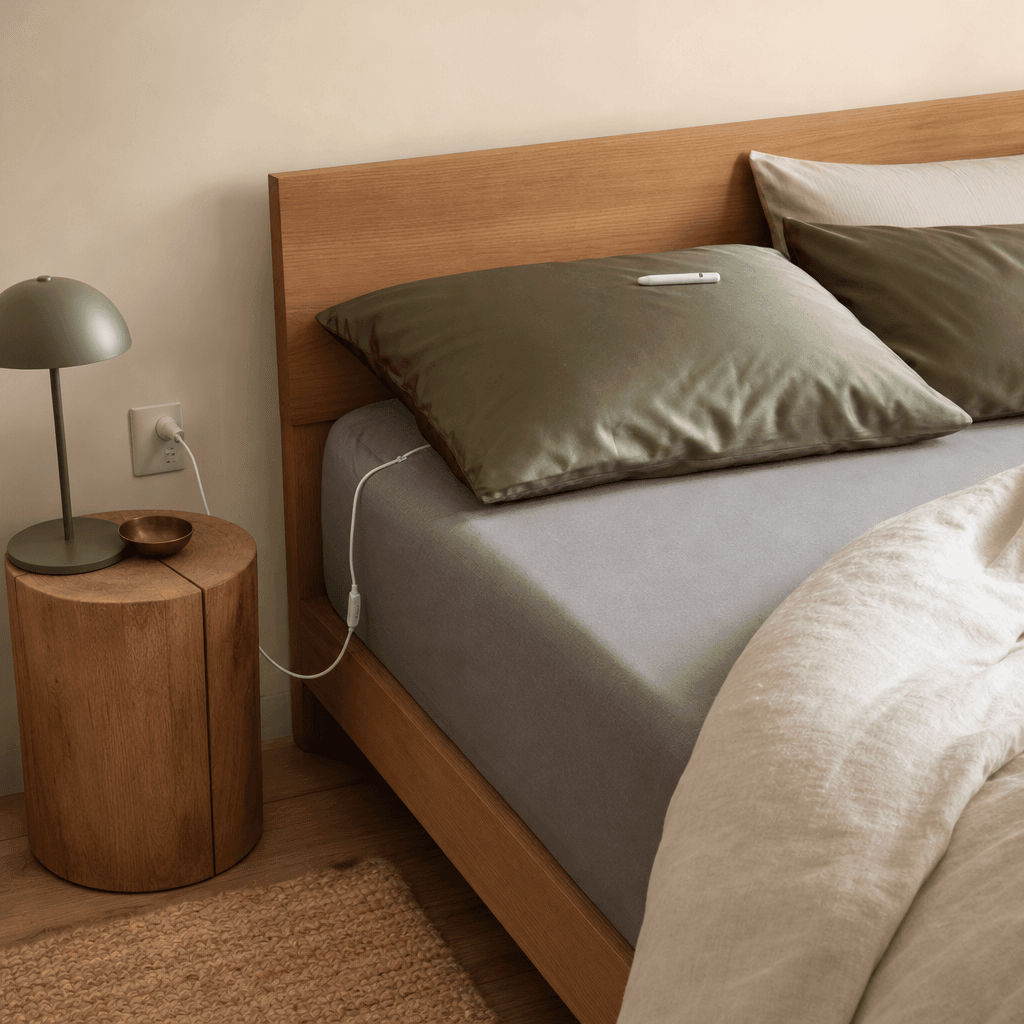
Every grounding box includes a tester pen so you can see conductivity for yourself instead of relying on a product page. Use it on night one, and again whenever something changes. Our tester pen article covers the method in detail, so here is just the trigger list:
- You added or swapped a topper or protector.
- You washed the sheet and refitted it.
- You moved the bed or the bedside table the cord runs past.
- You unplugged and reseated the cord, or changed sockets.
If the pen does not give the result described in the box, work through it in order. Reseat the cord at the socket and at the sheet. Check the cord is not pinched or kinked. Try another earth-connected socket. Retest. If it still does not read as expected, contact us. That is what the 90-night trial and 1-year warranty are for. Both run from delivery, with returns in reasonable condition and return postage on the customer.
Checking again over time is sensible. We would never tell you the sheet is guaranteed to read the same forever, which is why the pen lives in the box rather than in a marketing claim.
How do you use a grounding sheet when travelling?
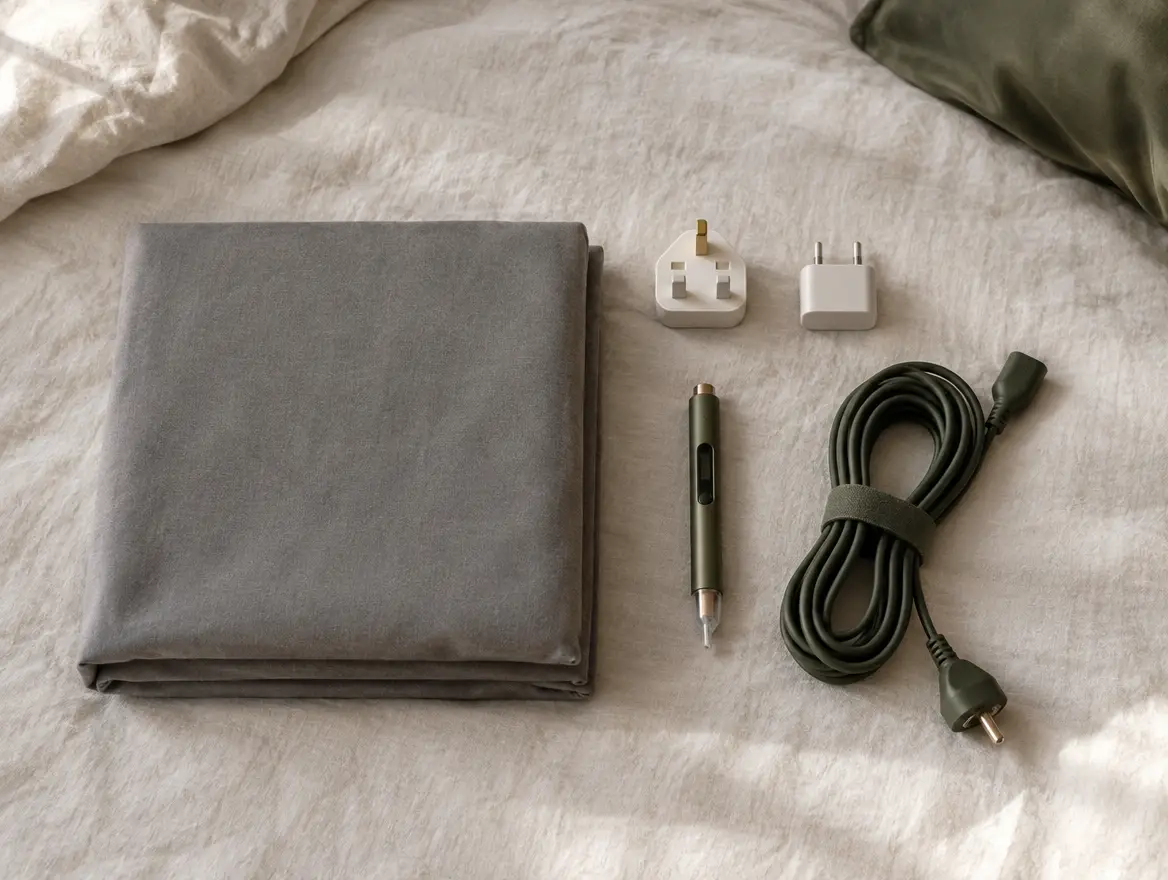
Test the hotel socket with the tester pen before you rely on it, and make sure any plug adapter carries the earth connection. Many two-pin travel adapters drop the earth pin entirely, which leaves a grounding sheet, mat or wristband connected to nothing.
Australian homes use a three-pin socket with an earth pin, so the setup at home is straightforward. Travel is where it breaks. Sockets vary by country, some outlets have no earth connection at all, and an adapter built only for two pins cannot pass one through.
A travel checklist for sheet, mat or wristband
- Check the adapter before you leave. It must have an earth pin or earth pass-through. If it only has two pins, it is the wrong adapter for this.
- Test the socket on arrival. Use the tester pen on the hotel socket before you set anything up.
- Look at the socket. If it is loose, cracked, scorched or hanging off the wall, do not use it. If you are unsure about a socket, ask the front desk or a licensed electrician, not a forum.
- Lay the sheet over the hotel's bottom sheet. Hotel beds often have a protector and a topper already. The same order applies: grounding sheet on top, nothing between you and it.
- Test the sheet itself. Regard every new bed as a change to the bed.
A flat sheet is usually the easier travel option. You cannot know the depth of a hotel mattress and topper in advance, and a flat sheet tucks into whatever you find. The same logic applies to a mat or wristband: a cord, an earth connection and a check.
How should you question any grounding setup claim, including ours?
Ask what was tested and what each certificate covers. A badge can look impressive with little behind it, so certified to what standard, and what does it cover? Apply the same questions to every brand, including us. You should be able to verify the answers yourself.
Here are the five questions we think every grounding brand should answer, with our answers:
- What is the sheet made from? Organic bamboo with 10% silver thread. The competitors we have seen state 5% or less, but check their pages rather than taking our word for it.
- What makes it conductive? Fine silver fibres woven through the bamboo, not coated on top. Bamboo alone is not conductive enough.
- Can you test it yourself? Yes. A tester pen is in every box.
- How does it connect to ground? By a cord to the earth pin of a wall socket. No power flows.
- What documentation exists? See below.
Our documentation, and what each item does and does not cover:
- OEKO-TEX Standard 100, certificate SH025 231655. This covers harmful substances testing on the textiles. Our manufacturing partner is certified at Product Class I, the strictest class. OEKO-TEX offers a public label check on its website, so you can look up the number yourself.
- RoHS compliance certificate CHHB26080392392. This covers restricted substances testing on the grounding sheets.
- GOTS scope certificate USB TEX-4007-GOTS-2509. This applies to our mulberry silk. It is a scope certificate, not a transaction certificate, and we only use the word certified alongside a named standard and number.
None of these says anything about what grounding does for sleep. That is a separate question, and the small published studies have not settled it. We keep the two kinds of claim apart: what the fabric is made of and tested for is one thing, and what grounding does is another.
Your consumer guarantees under the Australian Consumer Law apply regardless of any trial or warranty. Our 90-night trial and 1-year warranty sit alongside them and do not replace them.
Which sheet should you choose: fitted or flat?
Choose the fitted sheet if your combined mattress and topper depth fits the 33 cm pocket and the topper stays put. Choose the flat sheet if the total is over 33 cm or the topper shifts. Either way, test the connection with the boxed pen on night one.
A grounding sheet is a $419 decision made online, by someone who cannot feel the fabric or know how they will sleep on it until it is on their own bed. So the offer is built around checks you can do at home. Test it with the pen, sleep on it for 90 nights, decide later, and the 1-year warranty sits behind it. There is no price cut to lead with, and no countdown.
Expect the first few weeks to be unremarkable. Some people notice something in the first week, many notice nothing until the third, and both are normal. That is why the trial runs 90 days. Our first 30 nights guide sets out what to expect without promising a timeline.
Judge the Textile Before the Theory
The category argues about whether grounding works, and almost nobody talks about the fabric you are lying on for eight hours a night. Jade built Organic Earthing from the other end. She became conscious of what touched her skin, in clothing and fabrics, long before she heard of grounding. When she found it, she could not find a brand that combined it with the materials, quality and look she wanted at home.
Her view is that you judge the product first on what you sleep on: what it is made of and what it has been tested for. "I don't want customers to trust us because we've written 'premium' on a website," she says. She wants something behind the word, which is why she chose OEKO-TEX Standard 100 and separate RoHS testing, accepting a higher cost and a more complicated supply chain. The result is certificate numbers on the page instead of adjectives.
The same discipline applies to the bed layers above. Every layer on your bed is a choice, and every change to the bed is a change to the test. A protector, a topper, a hotel mattress: none of them is a problem if you keep the order, measure the depth and check the connection. Our position is that you should be able to verify all of it yourself, and that a brand that does not want to be questioned is not one to buy from. We are an Australian-owned, family-run brand selling globally, and questions about returns go straight to Jade.
References
- OEKO-TEX, STANDARD 100 by OEKO-TEX
- EUR-Lex, Directive 2011/65/EU (RoHS) on the restriction of hazardous substances in electrical and electronic equipment
- Global Organic Textile Standard, GOTS Standard overview
- ACCC, Consumer rights and guarantees
Take this with you
Your first 30 nights, in your inbox.
What people usually notice in the first month on a grounding sheet, week by week, and why you get 90 days rather than 14.
Questions people ask
Can you use a grounding sheet with a mattress protector?
Yes. The protector goes underneath the grounding sheet, between the mattress and the sheet. The sheet connects through its cord to the earth pin of a wall socket, so the protector does not affect the connection. Never place a protector on top of the sheet, because that puts a layer between your skin and the sheet.
Does a grounding sheet go over or under a mattress topper?
Over. The order from the bottom is mattress, protector, topper, then the grounding sheet. The sheet is the layer your skin touches, so nothing should sit between you and it. If the topper shifts or the combined depth passes 33 cm, use a flat sheet.
What if my mattress and topper are deeper than the fitted pocket?
Choose the flat sheet. The fitted sheet has a 33 cm pocket, so measure from the base of the mattress to the top of the topper. If the total is over 33 cm, a flat sheet tucks in more easily than a stretched fitted corner.
How do I check my grounding sheet is connected?
Use the tester pen that comes in every box. Check on night one, and again after adding a topper, washing the sheet, moving the bed or reseating the cord. If the result is not what the box describes, reseat the cord at both ends, check for pinching and try another earth-connected socket.
Can I use a grounding sheet in a hotel?
Yes, with checks. Test the hotel socket with the tester pen first and avoid any socket that looks damaged or loose. Any plug adapter must carry the earth connection, and many two-pin travel adapters do not. Lay the sheet over the hotel's bottom sheet, with nothing between you and it.
Is a grounding sheet a medical device?
No. A grounding sheet is a wellness product, not a medical device, and no health claims are made for it. The certificates cover what the textile is made of and tested for. What grounding does for sleep is a separate question that the small published studies have not settled.