Grounding · 9 Nov 2026 · 18 min read
Silver Content in a Grounding Sheet: How Much Silver Is in It and Does the Percentage Matter?
How much silver is in a grounding sheet, what 10% silver thread measures, and how to check conductivity yourself with a tester pen before you trust a label.
By Jade Castle, founder. Wellness product, not a medical device.
Part ofThe grounding sheet guide
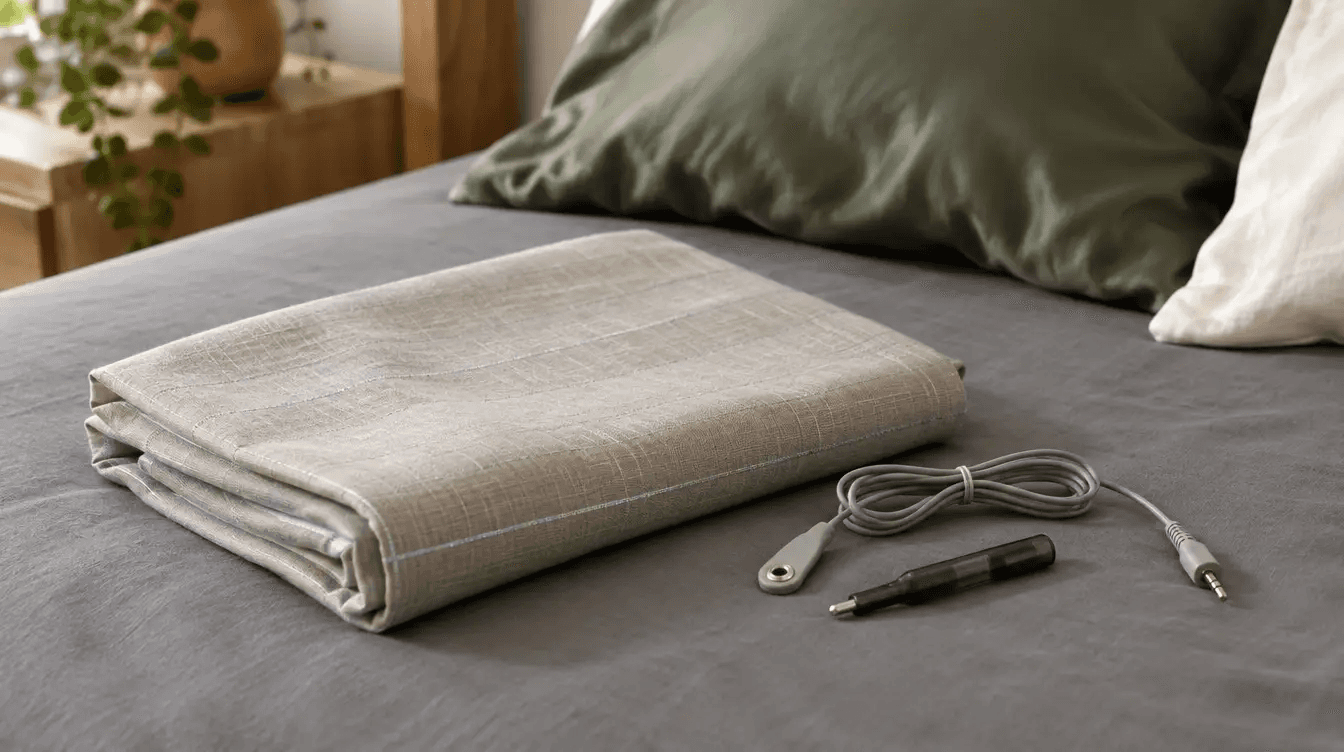
Silver content in a grounding sheet is the share of thread that carries a conductive path from the fabric to the grounding cord. Organic Earthing's sheets are organic bamboo woven with 10% silver thread. The percentage matters less than weave spread, a continuous conductive path, the connection point and skin contact, so test the sheet yourself.
I started Organic Earthing before I had heard of grounding. I had already become conscious of what touches your skin every night, and I was choosing natural fabrics where I could. Then I found grounding, and I noticed that the category argued about whether it works while almost nobody talked about the textile you sleep on for eight hours.
This guide is a label-reader's walk through silver content. You will learn what the silver is for, what "10% silver" does and does not tell you, how to check a sheet at home, and how to keep it working. My position is simple: judge a sheet first on the textile, what it is made of and what it has been tested for, and question every claim on the page, including ours.
Key Takeaways
- The silver thread has one job: to conduct. It carries a path from the fabric to the cord, and it is not there to make claims about your body.
- A silver percentage is only meaningful if the brand tells you what it measures. Ask whether it is a share of thread, yarn or total fabric.
- More silver is not automatically better. Weave spread, an unbroken conductive path, a sound connection point and skin contact matter as much as the number.
- You can check conductivity yourself. Every Organic Earthing box includes a tester pen, and you can ask any brand what was tested.
- Certificates cover specific things. OEKO-TEX Standard 100 covers harmful substances in textiles, and RoHS covers restricted substances. Neither tells you whether grounding improves sleep.
- Care matters. Gentle washing, no fabric softener and no bleach help keep the silver doing its job.
Summary Table
| What you are checking | What it tells you | What it does not tell you | How to check it |
|---|---|---|---|
| Silver percentage | How much of the thread content is silver | Where the silver sits, or whether the path is continuous | Ask what the percentage measures |
| Weave spread | Whether conductive thread runs across the whole sleeping surface | Total silver amount on its own | Ask how the silver is woven, not coated |
| Connection point | How the fabric links to the cord | Fabric quality | Look at the snap or connector, then use the tester pen |
| Skin contact | Whether your body touches the conductive surface | Silver content | Think about how you sleep and what you wear |
| OEKO-TEX certificate | The textiles were tested for harmful substances | Conductivity or sleep outcomes | Check the certificate number and what it covers |
| RoHS certificate | Compliance testing for restricted substances in the grounding bedding | Textile comfort or sleep outcomes | Check the certificate number and scope |
| Tester pen | Whether a grounding connection is present when you test | A lab measurement of performance | Use at setup and again over time |
What is the silver in a grounding sheet there to do?
The silver in a grounding sheet is there to conduct. Fine silver thread is woven through the fabric so there is a continuous path from the sheet to a cord, which connects to the earth pin of a wall socket. That is its only job. It is a plain textile and wiring question.
Bamboo on its own is not conductive enough to carry that path. I did not want a sheet people put up with just because it grounds, so we chose bamboo for the fabric and silver for the connection. Fine silver fibres are woven through the bamboo, not coated on top. The sheet keeps the softness, breathability and moisture handling of bamboo, and the silver does the one thing the bamboo cannot.
The cord runs to the earth pin of a standard wall socket. No power flows through the sheet. Only the grounding connection is used. If you are unsure whether a socket in your bedroom is properly earthed, a licensed electrician can check it.
There is a reason I keep this description so plain. Silver gets talked about in this category as if it were magic. It is a conductor. It sits in the thread for the same reason copper sits in a power cable. Everything else you might read about what grounding does for the body is a separate question, and I will come back to it later.
Why the base fabric still matters
If the silver does the conducting, why bother with the textile? Because the textile is what you actually feel. Most competitor sheets are cotton. Ours is bamboo, and the reason is practical. Bamboo is soft, breathable and handles moisture well, which matters if you run warm overnight. If you are a hot sleeper comparing fabrics, think of it this way: the silver decides whether the sheet can ground, and the base fibre decides whether you want to sleep on it. For a closer look at that trade-off, we have a separate comparison of bamboo and cotton grounding sheets.
What does "10% silver" actually mean?
A claim of "10% silver" describes a share of the thread content in the sheet. Organic Earthing's sheets are organic bamboo woven with 10% silver thread. On its own, though, any percentage is incomplete. It only means something once the brand tells you what the percentage is a percentage of.
Here is the problem. A percentage can describe several different things:
- A share of the thread or yarn that is silver.
- A share of the total fabric weight.
- A share of one component, such as the conductive yarn only.
- A marketing shorthand with no stated basis.
These are not interchangeable. A brand can truthfully print a number and still leave you unable to compare it with anything. So I would rather you learned to ask than took our word for it.
How to ask a brand what a percentage measures
You do not need a technical background. Send the brand these questions, and notice how specific the reply is:
- Is the percentage a share of thread, yarn or total fabric?
- Is the silver woven through the fabric, or applied as a coating?
- Does the conductive thread run across the whole sleeping surface, or only in parts?
- Is this a product specification, or a figure from independent testing?
- Can I check conductivity myself when it arrives?
A good answer is specific and does not get defensive. A vague answer, or no answer, tells you something too. Please ask us the same questions. I would rather a customer question the brand than believe a badge. I am also not going to quote or guess at what other brands print on their labels. I cannot see how they measure it, and a number without a method is exactly the problem this section is about.
For our own sheets, the 10% figure is our product specification: silver thread woven into organic bamboo. It is the brand's own data, not a third-party lab result, and you should read it that way.
Does more silver mean a better grounding sheet?
Not automatically. More silver can help, but four other factors decide whether a sheet works as a conductor: how widely the silver is spread through the weave, whether the conductive path is continuous, how the sheet connects to the cord, and whether your skin actually touches the surface.
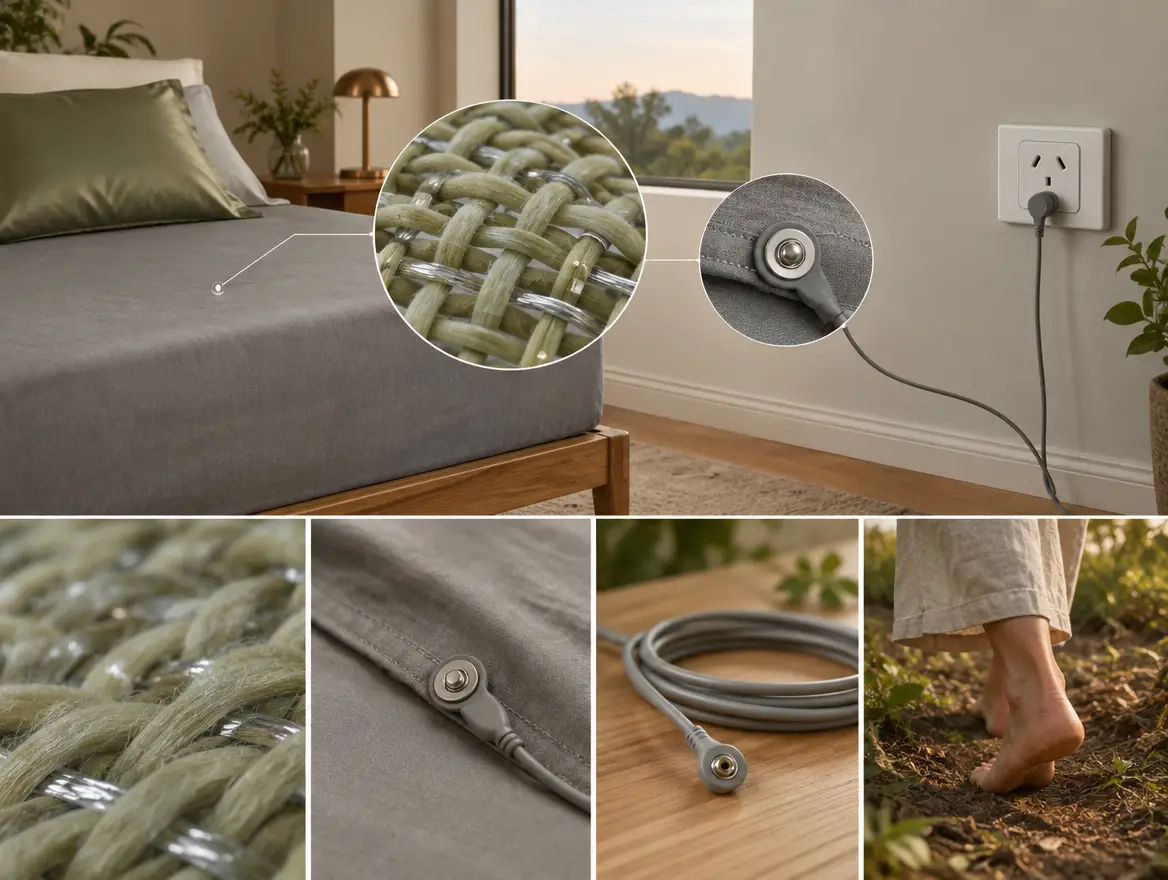
Imagine two sheets. One has a high silver share but the thread is bunched in a few places, with gaps between. The other has a lower share spread evenly through the weave, so every part of the surface sits on a connected path. Which is the better conductor depends on the path, not the headline number. That is a hypothetical, but it shows why the percentage is a starting question, not a verdict.
Weave spread
A sheet that conducts well in one corner and poorly in another is not doing its job across the bed. Silver woven through the fabric, rather than coated on the surface, is designed to keep conductive thread throughout the sleeping area. Ask any brand how the silver is placed, and whether the whole surface is conductive.
A continuous conductive path
Conductivity is about a connected route. If the path from the part of the sheet you lie on to the cord is broken, the percentage makes no difference. This is also why damage, heavy wear or harsh handling can matter, which I cover in the care section below.
The connection point
The cord has to connect to the sheet reliably. A sound connection at the snap or connector is part of the system. If a sheet seems not to be working, the connection point and the socket are often the first things to check. Our guide on what to do when a grounding sheet is not working walks through that order.
Skin contact
A grounding sheet only works as designed if your body is in contact with it. That means thinking about what you wear to bed and how you sleep. It is another reason to see the sheet as a system rather than a number.
Put together, the sheet, the weave, the cord, the connection and the socket are one chain. The silver percentage describes one link. If you want the full framework, our hub on how to choose an organic grounding sheet sets out the questions in the order I would ask them.
How can you check a grounding sheet yourself?
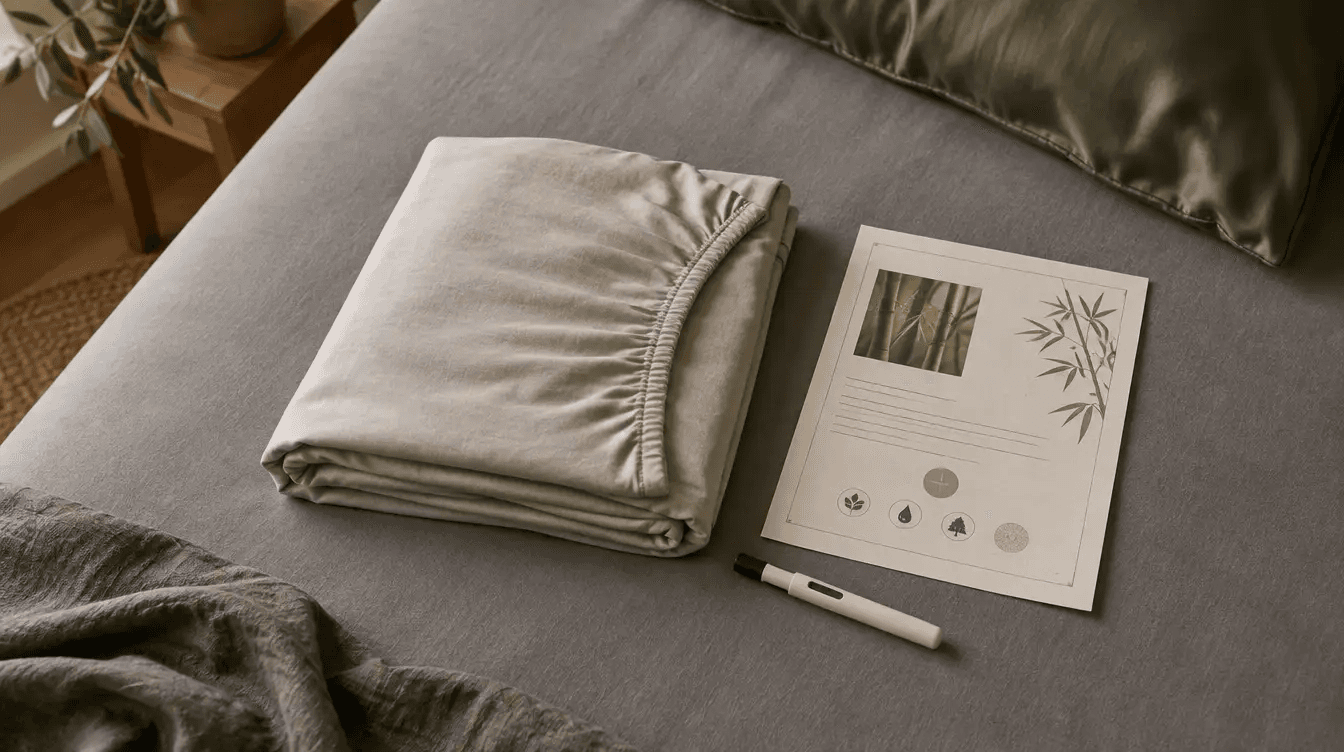
You can check a grounding sheet at home with a tester pen, which is included in every Organic Earthing grounding box. Set the sheet up, connect the cord, and use the pen to see whether the grounding connection is present. Then ask the brand what testing sits behind its claims.
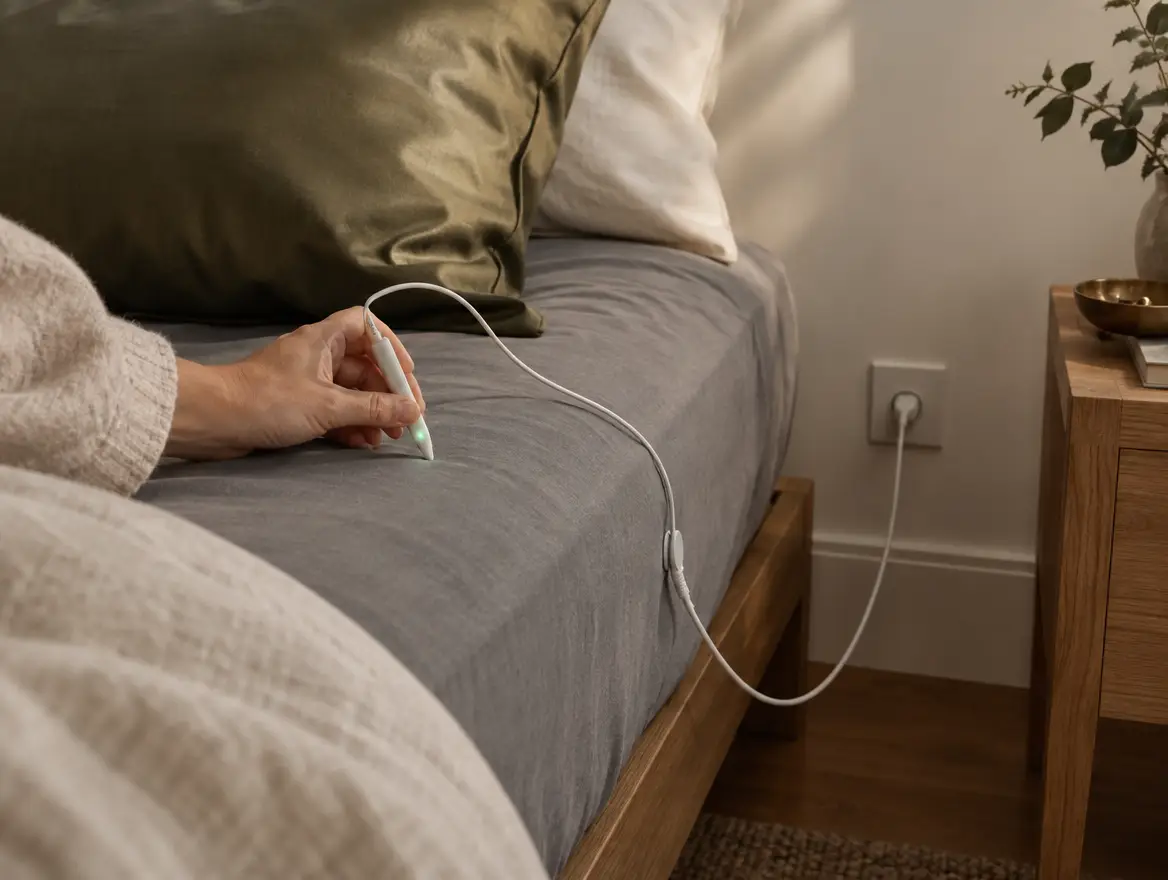
This is what I call "test it before you believe it." A grounding sheet is a $419 decision made online. You cannot feel the fabric, and you cannot know how you will sleep on it until it is on your own bed. So I built the offer around proof you can check at home, not a price cut.
Using the tester pen
Follow the instructions in the box and the setup guide on the site. In general terms, you connect the cord to the sheet and to the wall socket, then use the pen to check for a grounding connection. A few points of honesty about what this does and does not show:
- Check when you first set the sheet up, so you know what a working connection looks like.
- Check again over time, for example if something feels off or after you have changed your setup.
- I do not say "check after every wash," and I do not offer a durability guarantee. The pen gives you a simple check, not a laboratory measurement.
Our separate guide on how to test a grounding sheet with a tester pen goes through the steps in more detail.
Ask what was tested
The pen checks the sheet in your home. It does not tell you what is in the fabric. That is a different question, and it is where certificates come in.
What do the OEKO-TEX and RoHS certificates cover?
The OEKO-TEX Standard 100 certificate covers harmful substances in the textiles, and the RoHS certificate covers restricted substances in the grounding bedding. Neither tells you whether grounding improves sleep. Each covers a named scope, which is why you should always ask: certified to what standard, and what does it cover?
This is the second part of my "two kinds of claim" approach. One kind of claim is what the fabric is made of and tested for. The other is what grounding does for sleep. They are never blurred into one sentence on this site.
| Certificate | Number | What it covers | What it does not cover |
|---|---|---|---|
| OEKO-TEX textile safety certificate | Textile certificate reference, available on request | Textiles tested for harmful substances. Our manufacturing partner is certified at Product Class I, the strictest class. | Conductivity, comfort or sleep outcomes |
| RoHS compliance | Compliance report reference, available on request | Compliance testing for restricted substances on the grounding bedding | Textile safety against other standards, conductivity or sleep outcomes |
These numbers are published so you can look them up and question them. For a fuller explanation, see our guide on OEKO-TEX Standard 100 and RoHS on a grounding sheet. You can also use OEKO-TEX's own label check tools on its website to look up a certificate.
A note on the word "organic"
I describe the sheets as organic bamboo, and the OEKO-TEX Standard 100 certificate covers the textiles. "Organic" there describes the fibre. It is not a certification claim on the sheet. We hold a GOTS scope certificate (USB TEX-4007-GOTS-2509), but it covers our mulberry silk, not the grounding sheets, and it is a scope certificate, not a transaction certificate. I am being this precise because a badge can look impressive with very little behind it, and you deserve to see where each one applies.
How do you keep the silver working?
Keep the silver working by washing gently, avoiding fabric softener and bleach, and following the care guide. The silver thread is woven through the bamboo, so handling the whole sheet kindly protects the conductive path. Use the setup and care guides on the site as your reference.
The basics are short:
- Wash gently, following the care instructions for the product.
- Avoid fabric softener, which can leave a residue on the fibres.
- Avoid bleach, which is harsh on the fabric and the thread.
- Check the cord and connection point if the sheet seems to stop working.
- Use the tester pen at setup and again over time, so you notice a change early.
None of this is a durability promise. Silver thread is a working component, and like any fabric it can be affected by how it is handled. If you do all of this and the sheet still does not test as expected, that is what the 1-year warranty is for. We also run a 90-night trial from delivery, with returns in reasonable condition and return postage on the customer. These sit alongside your rights under the Australian Consumer Law, which the ACCC explains on its website.
What should you expect in the first 30 nights?
Expect nothing specific. Some people notice something in the first week, and many notice nothing until the third. Both are normal. That is why the trial runs 90 nights from delivery, so you can sleep on it for 90 nights and decide later.
I describe only what people report. I am a founder and a mother, not a clinician, and a grounding sheet is a wellness product, not a medical device. The small published studies on grounding and sleep have limited sample sizes and limits of their own, and I regard the question as open. Anyone who promises you a timeline of results is selling something the evidence does not support.
What I can promise is narrower. The fabric is what the label says it is, it has been tested for what the certificates say, and you can check the connection yourself.
A buyer's checklist for silver content
A good buyer's checklist covers five questions: what the sheet is made from, what makes it conductive, whether you can test it, how it connects to ground, and what documentation exists. These are the questions I think you should ask any grounding brand, and I want you to ask them of us too.
- What is the sheet actually made from? Name the fibre and the conductive material. Ours is organic bamboo with 10% silver thread.
- What makes it conductive? Silver thread is common, but ask whether it is woven or coated, and what the percentage measures.
- Can you test the conductivity yourself? A tester pen in the box means you do not need to take anyone's word for it.
- How does it connect to ground? Look for a cord to the earth pin of a wall socket, with no power flowing through the sheet.
- What testing or documentation does the company have? Ask which standard, which certificate number, and what it covers.
- What is the trial and warranty? Check the length, the return conditions and who pays return postage. Ours is 90 nights from delivery and a 1-year warranty.
- Does the brand separate the two kinds of claim? Be wary of any page that blends textile certification with health outcomes in one sentence.
When you are ready to compare, check the certificates first, then try the fitted grounding sheet with the tester pen in the box. The 90-night trial and the 1-year warranty mean you do not have to trust a word on a website.
Why I would judge a grounding sheet on the textile first
Most of the category judges a grounding product on whether grounding works. I think that is the wrong first question, because it is the one nobody can settle for you from a product page. The first question should be about what you are sleeping on.
My own path shows why. I became conscious of the fabrics against my skin before I ever found grounding. When I did find it, I went down the rabbit hole and could not find a brand that matched the materials and quality I wanted in my own home. What I saw was clinical, generic, or led with price. So I built the other thing: premium grounding products that look and feel beautiful, with proper thought, testing and transparency behind them.
That meant accepting a higher cost and a more complicated supply chain. I chose OEKO-TEX Standard 100 on the textiles, with our manufacturing partner certified at Product Class I, and separate RoHS compliance testing on the grounding bedding. The result is that we can publish certificate numbers instead of adjectives. I don't want customers to trust us because we've written "premium" on a website. I want there to be something behind it.
Here is the contrarian part. I think the category would be better if shoppers questioned every word: organic, certified, tested, chemical-free. Each one has a specific meaning, and a badge can look impressive with very little behind it. Certified to what standard, and what does it cover? If a brand cannot answer in a sentence, that tells you more than the percentage on the label.
This is also why we do not lead with price cuts. A $419 certified product cannot argue with a clearance voice. The offer is proof: certificate numbers, a tester pen, 90 nights to decide and a year of warranty. We're an Australian-owned, family-run brand selling globally, and questions about returns go straight to me.
The silver has a job to do. The bamboo has a job to do. Neither is there because it sounds good in marketing, and neither should be there on your sheet unless the brand can tell you why.
References
- OEKO-TEX, STANDARD 100 by OEKO-TEX
- European Commission, Restriction of Hazardous Substances in Electrical and Electronic Equipment (RoHS)
- ACCC, Consumer rights and guarantees
Take this with you
Your first 30 nights, in your inbox.
What people usually notice in the first month on a grounding sheet, week by week, and why you get 90 days rather than 14.
Questions people ask
How much silver is in a grounding sheet?
It varies by brand, and the number only means something if the brand says what it measures. Organic Earthing's grounding sheets are organic bamboo woven with 10% silver thread, which is our product specification. Ask any brand whether its percentage refers to thread, yarn or total fabric.
Does a 10% silver grounding sheet conduct better than one with less silver?
Not necessarily. Conductivity depends on how widely the silver is spread through the weave, whether the conductive path is continuous, how the sheet connects to the cord and whether your skin touches the surface. The percentage is one input, so check the sheet with a tester pen rather than relying on the figure.
How do I test a grounding sheet?
Set up the sheet, connect the cord to the earth pin of a wall socket, and use the tester pen included in every Organic Earthing box. Check at setup and again over time. Follow the setup guide, and remember the pen is a simple check, not a laboratory measurement.
Does washing remove the silver from a grounding sheet?
The silver thread is woven through the fabric, not coated on top, but any fabric can be affected by how it is handled. Wash gently, avoid fabric softener and bleach, and use the tester pen over time. We do not offer a durability guarantee, but the 1-year warranty applies.
What do the OEKO-TEX and RoHS certificates mean for a grounding sheet?
OEKO-TEX Standard 100 (certificate SH025 231655) covers harmful substances in the textiles. RoHS (certificate CHHB26080392392) covers compliance testing for restricted substances on the grounding bedding. Neither says anything about whether grounding improves sleep, and neither replaces checking conductivity yourself.